The multidimensional language learners

Four glass vases, three green and one blue, each holding a different flower
Image by James Cousins

The multidimensional planets struggle with your concepts of space, particularly inside and outside. Space for them is fullness, not distance, and to move from one place to another place seems an utter impossibility, let alone going in or sending out. To achieve what you would call movement, they increase their stillness, and every attempt to go inside turns the inside out in a resplendent kaleidoscopic dance.

This is why it’s so hard to teach them your three-dimensional languages.

We start with an utterance which to you would seem a straightforward description, simplicity itself. 

This is a flower.

We hold the object before them and witness their blossoming wonder.

This creates a division, as real as melting glass, forming itself into a vase-like shape that distinguishes this from not this. Once there was no vase, now, there it is! And the flower, pressing its radiant face outward, bravely, breaching the invisible, newly formed barrier between inside and outside—a miracle!

The multidimensional language learners yearn to meet you, the native speakers of these wild mysteries, to discover the secrets of your enlightenment.


Would you like to know more about this story? I talk about it in Episode 86 of Structured Visions, ‘Feelings are, like, inside things’. Subscribe to the podcast on Apple podcastsSpotify or wherever you like to listen.

The oppressive instability of being

As deictic expressions are frequently egocentric, the center often consists of the speaker at the time and place of the utterance and, additionally, the place in the discourse and relevant social factors.

When Amy heard the classroom door open at the end of the school day she kept her focus on the surface of her desk. The unexpected visitor was likely to be Lydia, who didn’t do well with eye contact.

‘Miss?’

In her peripheral vision Amy could just make out the dishevelled dark curls that framed the girl’s ashen, spot-ridden face. She noticed the crevices that had worn into her forehead, the eyebrows tensed above deep-set, troubled eyes.

‘Yes, Lydia?’ Amy fixed her attention on the English language worksheets she was marking.

‘We’re making time machines in History, Miss.’

‘Time machines,’ repeated Amy, in the slow, deep tone that kept Lydia calm. In the subsequent silence she tried to recall the details of Gareth Jacobs’s most recent pedagogical experiment.

‘I can’t go back in time, Miss.’

Gareth wouldn’t have anticipated that Lydia would be troubled by this project. Nobody could have. None of the teaching staff knew quite what to do with Lydia. She’d mystified the specialists.

Even Amy, the only teacher Lydia had ever opened up to (if these regular after-school interactions counted as ‘opening up’), could rarely put her finger on what specifically triggered Lydia’s manifold anxieties. She certainly couldn’t understand what was troubling her about this particular project, and why it had only occurred to her to worry about it now.

She pictured the child-constructed cardboard monstrosities that were currently cluttering Gareth’s classroom. She caught a glimpse last week of pupils fastening flimsy foil pie plates onto the tops of the packing crates Gareth had somehow acquired. Satellite dishes, she guessed. By now they’d have moved on to the interior design stage of the project. She pictured dashboards sticky with glitter and glue, plastic dials repurposed from board game spinners, which the time travellers could adjust to set their course in their journey to the past.

Lydia’s hands covered her face now. She looked out through the gaps in her fingers.

Amy imagined those same fingers positioning a red plastic arrow to point toward some date from the Year 7 History curriculum—1066, or what year was the Gunpowder Plot? 1605. She wondered which historical period would trouble Lydia most. Did they do slavery in Year 7?

‘You can’t go back in time?’

She rifled through the language papers to take the pressure off the child. They were grammar worksheets, designed to help the pupils conceptualise tense and aspect. Her own pupils had completed the task complacently, if unenthusiastically, colouring in expansive rectangles on a timeline for past progressive and restrained, no-nonsense black dots for past simple. I was minding my own business when you interrupted me. The arrow on the timeline pointed backward, to what had come before the present moment.

None of her children had been troubled by anything about the exercise, not the linear illustration of time, not the leftward pointing arrow illustrating the infinite ineffability of time gone by.

‘Miss, if I go to the past, I won’t be there.’

Amy shifted her gaze from the grammar papers to the anguish on Lydia’s face, and it hit her. The other pupils did not worry about time travel because they had no experience of the precariousness of their own existence. 

So rooted were they in their solid notions of selfhood that they could not see it: any point on the timeline to the left of 2010 indexed a world that ruthlessly refused to contain them.

What could she say to Lydia now that would relieve her of the oppressive instability of her being?

‘How do you think time machines work?’ she asked.

‘You get inside them, and they travel to the past.’

‘Is that the way Mr Jacobs explained it?’

The fingers moved from Lydia’s face to below her chin. ‘I can’t remember,’ she admitted.

That was fortunate.

‘Time machines don’t actually travel through time,’ Amy said, committing her own words to memory so she could brief Gareth later. ‘The way they work is by establishing a deictic centre.’

‘A deictic-’ 

‘Centre,’ Amy confirmed. ‘The time machine produces a sort of force field around you that says you are here now. That keeps you safe and secure. Centred, right?’

Lydia dropped her hands to her sides. ‘So how do you get to the past?’ she asked.

‘You don’t,’ said Amy. ‘Once you’re in your deictic centre, you bring the past to you. You sort of reel it in, like a kite.’

Amy watched this explanation lock into place.

‘OK, Miss,’ Lydia said, and she’d left the room before Amy could say more.

For many long moments Amy found herself staring at the space that had once contained Lydia.

She felt a gripping sensation in her chest, like a fist clutching a reel of lengthening string, the kite flying farther and farther away, a black dot against an insatiable sky.

Would you like to know more about this story? Watch the video I made about it.

Origo

Photo by Adrian Smith

The deictic centre—sometimes called the ‘origo’ or zero-point—represents the originating source in relation to which deictic expressions gain their context-dependent meaning.

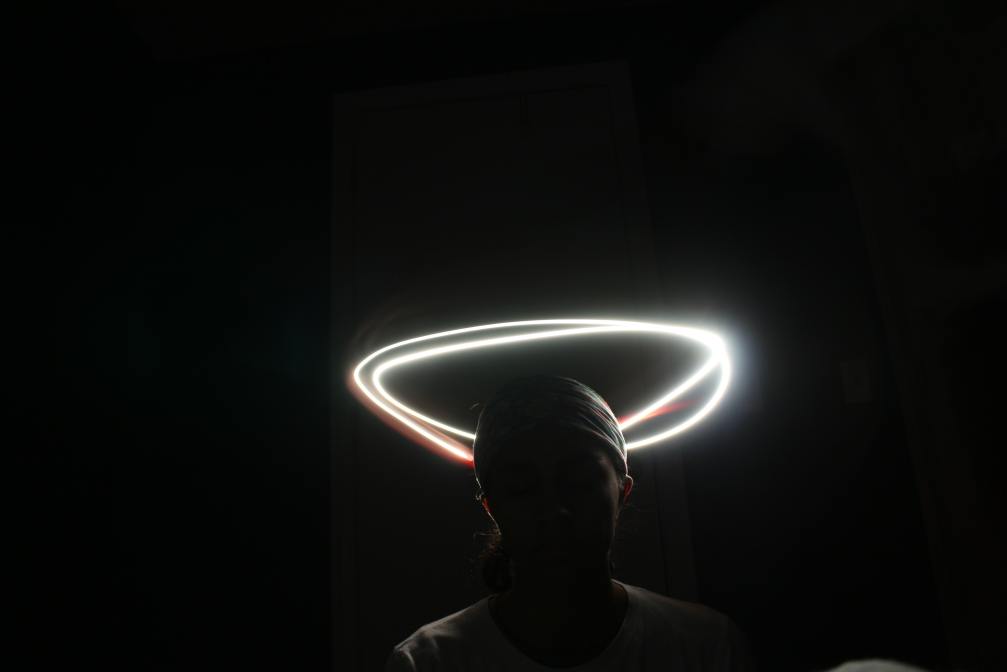
In Renaissance art, angels and other spiritual emissaries were painted with haloes. Sir Oliver Iveson now knew why.

The one he fashioned for himself out of tin foil was crude but effective. When he wore it, he could communicate with extraterrestrial intelligence.

‘You’re highly respected by the scientific community,’ said the psychiatrist they’d hired to perform his evaluation. Her name was Dr Mary Bryan.

He had no need of reassurance. It had been only six months since Stockholm.

‘For as long as I can remember,’ he’d said in his acceptance speech, ‘I’ve looked with longing to the stars, to communicate with the intelligent beings I was certain were there.’ He squinted into the dazzling lights. 

‘I’ve read your Nobel address,’ Dr Bryan said. She pulled a printed sheet from among the papers on her desk. ‘You write, several times, of failure.’

She read the passages back to him. He’d failed in his childhood dreams of communicating with the people in the stars. But it was his dogged pursuit of this unlikely mission that had produced theoretical discoveries that innovated communication systems on earth.

‘Do you still feel that you’ve failed, even after all the recognition you’ve received for your work?’

‘I haven’t failed.’

‘You were dishonest in your speech?’

‘No. I’ve succeeded since then.’

‘You’ve succeeded at locating extraterrestrial life? And communicating with them? How is that possible?’

Sir Oliver leaned forward in his seat. He rested his elbows on his thighs. ‘If I were a three-year-old boy, and I asked you where the stars were, what would you say?’

‘I would tell a three-year-old boy that the stars are up there,’ she said, pointing to the ceiling. ‘Up there in the sky.’

‘And if I were to ask you, What is up? What is there? What would you say then?’

‘They’re words that are relative to the position of the speaker, I suppose,’ she said. ‘Up is above me. Here is where I am. There is where I am not.’

Sir Oliver nodded excitedly. ‘And if you did not have these words? Without language, there would be no speaker, no me, and thus no position relative to me. There would be no up, no there.’

He watched her scribble something on her notepad. He waited for her to look up again.

‘I have come to an understanding,’ he said, ‘of why the technologies I developed in the lab could never succeed at discovering and communicating with extraterrestrial life. They were being blocked by another, more primitive technology.’

‘What technology is that?’

‘Speech. Human language. The stuff that positions the stars as up, as far away, as out there, out of reach.’

‘That the stars are far away from us is an empirical, measurable fact, Sir Oliver. It’s true regardless of the language we use to describe it.’

Sir Oliver shook his head. ‘Linguistic expressions,’ he explained, ‘require an originating source, a zero point, which places the self at the centre, relegating the rest of the universe’—he swept his arms above his head, grandly—‘to somewhere out there.’

The doctor was no longer bothering to mask her disapproval. Sir Oliver noticed the force with which she pressed her pen into the page, underlining something she’d written previously, then repeating the gesture with even more urgency.

He respected her skepticism. He’d have to offer proof.

He removed a folded silver sheet from his shirt pocket. It rustled in his hands like distant, high-pitched thunder.

Dr Bryan looked at the tin foil with alarm. ‘Sir Oliver,’ she warned.

He saw her eyes dart behind him, toward the door.

He worked quickly, shaping the foil into a snake, which quickly transformed to ouroboros, an empty-centred halo which would free its wearer of the deictic positioning of language, from the tyrannical constraints of up and down, I and you, here and there.

He rose slowly so as not to spook her further. He eased toward her, making senseless soothing sounds, as if she were a frightened deer stuck in a barbed wire fence.

Carefully he centred the halo on the crown of her head.

He stood back to witness the transfiguration, the erasure of distance, the blissful annihilation of the self, and the miraculous opening of her portal to the stars.