Beyond desire

Blurred colourful lines of script running on a computer monitor
Photo by Markus Spiske

‘Welcome to the History of Scientific Progress. It is my hope that as we explore the foundations of our everyday technologies, they will become a little less commonplace, a little more—I use this word advisedly—miraculous, and you will have a greater appreciation—even awe—for the advances we’ve made as a species.’

The virtual classroom is equipped with Destiny, the latest generation Linguistic Manifestor App, which Professor Allport has surreptitiously set to run in the background during the lecture. As she speaks she tracks the programme’s live scripts. She is unsurprised to see the irrealis clauses in her introductory remarks (they will become a little less commonplace…you will have a greater appreciation) successfully translated to realis.

A rush of enthusiastic responses suggests that it’s working. The everyday technologies are already less commonplace. The students are already in awe.

‘I’ll invite you now to think back to the time before we knew about the linguistic field. As you know, the linguistic field is more localised and thus more subtle than other fields—electromagnetic, gravitational, quantum, etc.—and much time was wasted in convincing the scientific community that it even existed.

‘As we’ll discover on this course, lay people often have intuitions about scientific phenomena prior to their discovery and validation in the academic community. This was the case with linguistic manifesting. Individuals who wished to manifest something in their lives would often make use of affirmations—painstaking processes of verbally translating the irrealis into the realis. People used affirmations to change their irrealis desires (I wish I were thin and attractive) to their realis expressions (I am thin and attractive).’

The students respond with giggling emojis. It’s amusing to them to think of a time when people weren’t thin and attractive.

‘Manifesting through a verbal channel is so slow and requires such consistent repetition that it very seldom produces results. With the discovery of the linguistic field, we’ve been able to bypass the verbal channel and change the programming from irrealis to realis instantaneously.’

The professor notes an aggressively toned message in the discussion feed and inwardly sighs.

What about hyperrealis?

Do they think the question is original? Every year the course attracts students who fancy themselves revolutionaries, pontificating in favour of the absurd idea that a mode exists that transcends realis and irrealis. 

Hyperrealis, they believe, is a ‘third space’ where desires are not immediately granted. Hyperrealis is supposed to usher in a new collective reality, a new way of being or thinking, beyond desire. 

‘Hyperrealis is a fantasy,’ she used to say, which inevitably provoked dissent.

Now she says nothing, but shoots her desire at Destiny. ‘I wish they’d not asked the question,’ she thinks.

They’d not asked the question transforms immediately into realis and the world is set to rights.

The question has never been asked.


Would you like to know more about this story? I discuss it in Episode 100 of Structured Visions, ‘Selfish wishes for social change’. You can also sign up to the Grammar for Dreamers newsletter to get monthly updates on the ideas that inspire my work.
The woodcarver

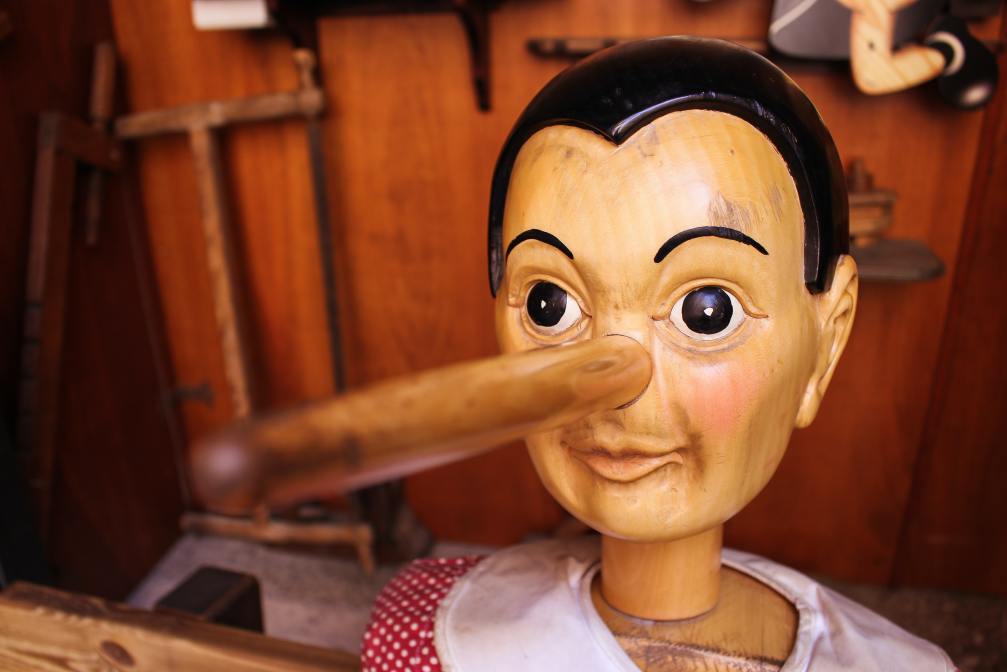
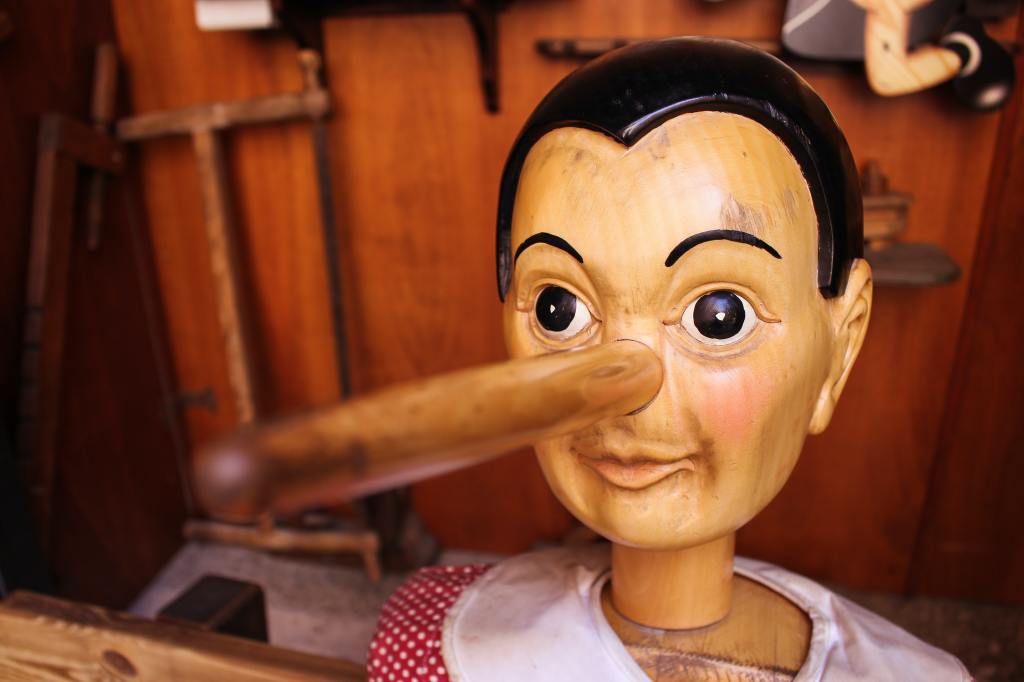
Photo of Pinocchio puppet
Photo by Jametlene Reskp

All my puppets could move without strings, and all could speak, but none of them could lie.

The lie itself was trivial—he wasn’t the one who stole Antonio’s caramels. But when the words escaped Pinocchio’s painted lips—when he discovered he’d released an utterance that did not match consensus reality—it excited him.

Sexually, I mean. 

Let’s say his ‘nose’ grew.

This manifestation of his delight embarrassed him so much I feared he’d never dare stray from the truth again, and all my hopes would be dashed.

So I taught him the secret of language that none of my other puppets had ever been able to grasp.

I taught him ‘might’.

He was a quick student, and I was quick to test him. ‘Did you take Antonio’s caramels?’ I asked.

A hesitation. The smooth pine globes of his eyes glanced tentatively from dropped balsa eyelids. ‘I might have,’ he said.

My heart leapt precipitously. I forced myself not to celebrate too soon. ‘Or else…’ I prompted.

‘Or else…’ The mandible lowered to form the shape of a wooden grin. ‘Or else… someone else might have taken it,’ he ventured.

My own widening smile encouraged him.

‘Or it might have been whisked away by a mischievous crow. A talking crow! He might have eaten the caramels! His beak might’ve been stuck together, like glue…’

Ever since that morning of reckless fiction, Pinocchio has been my favourite, my darling, the liar, the storyteller, creator of worlds.


Would you like to know more about this story? I discuss it in Episode 76 of Structured Visions.

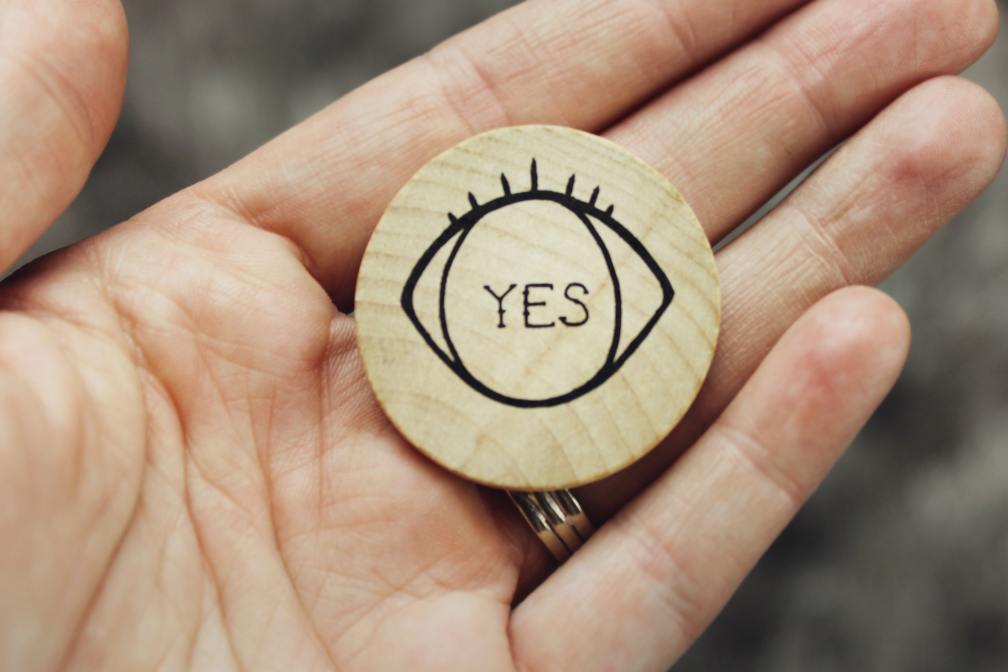
YES/YES

Round wooden coin with eye detail and word, text "yes" printed on it, held in the palm of a woman's hand.
Photo by Jen Theodore

‘Your problem is linguistic,’ said my therapist.

‘What?’ I hadn’t even told her my issues yet. She was the last in a long line of practitioners. So far I’d been diagnosed with ADHD, autism, Lyme’s disease, a gluten allergy and a leak in my third chakra.

I thought she was talking about neuro-linguistic programming, which I’d also tried, with as little success as every other suggested treatment.

‘You have no irrealis modes and no negative polarity,’ she said. ‘Everything for you simply is. Everything exists. And the intensity of all that existence is oppressive. Am I wrong?’

She wasn’t wrong, but when I tried to tell her she held up her hand to silence me. ‘Drink this,’ she commanded.

There wasn’t any question of refusing. The prospect of imbibing the foul potion had already formed itself as a real proposition in my mind. As my astute diagnostician had observed, I was constrained by the compulsion to comply.

I downed it in one swallow.

The resulting display of gagging and retching delighted my therapist, who was now pounding my back with hearty open-palmed thumps. ‘Go ahead and cough it up,’ she said.

When eventually I heaved an acerbic excretion into the paper bag she’d pressed before my face, she gave a bright cheer.

‘Good for you!’ she enthused, wiping mucus from a small shiny object. ‘Just as I suspected.’ 

The unlikely midwife of this revolting mystery presented my issue to me with unadulterated glee.

It was the size and shape of a fifty-pence coin, and it was embossed like a coin—not with the queen’s head, but one word in stalwart capital letters.

YES.

Intrigued, I flipped it over, expecting a ‘no’ on the other side. Instead I found the same word on both faces. 

YES/YES.

A profusion of affirmation, with no way of distinguishing heads from tails, no negative denial to balance the positive assertion.

Positive polarity, my therapist confirmed, with a profusion of realis.

‘It never gives you a break. Everything you imagine becomes real—or you suffer until it does. And you suffer after it does, too.’

‘Am I cured now that this is out of me?’ I asked.

She shook her head. ‘It’s a linguistic problem, remember? There’s only one way to cure a linguistic problem, and that’s with more language.’

She produced a small square envelope made of something that looked like silk. ‘Get that back down you, as soon as you can.’

Mercifully, the glass she now proffered was filled with water, and I swallowed the silk-covered coin with ease.

I felt better instantly. ‘What was that?’ I asked. The omnipresent, relentless urgency had been replaced by some more calming, more hopeful state—a curiosity, perhaps.

‘I wrapped those devilish yeses in a little blanket of maybe,’ she explained, and sent me on my way.


Would you like to know more about this story? I discuss it in Episode 76 of Structured Visions and in a behind-the-scenes post on Patreon.