
A hand writing the word 'ENGLISH' on a green chalkboard.

Modal auxiliaries

The life that passes before Ada Hasselback’s eyes in the moments before her death is less flash and more slow motion—at least for one scene too commonplace, she thinks, to merit such an effect. She’s standing, defeated, at the front of a classroom, looking out at a sea of bored teenage Spanish faces. From the chalked words on the dusty board behind her it is clear she’s teaching them English modals.

can
coul
d
shall
should
will
would
may
might
must

The students talk amongst themselves, oblivious to her inept attempts to interest them. At 22, with no prospects beyond this year-long post, she is already a failure. Her college boyfriend dumped her soon after she moved to Barcelona. She’ll return to Tallahassee with nothing to show for herself but the scars of self-pity.

A face through the window of the door at the back of the classroom. It brightens to recognise her. She brightens, too. It’s Adam, her fellow language assistant, from Dublin. He moves a hand to his lips, mimes going for drinks.

The film speeds up through the next few passionate weeks. She begs the divine director to linger over those blissful afternoon organisms in Adam’s mouldy studio in the Eixample—recalls how for many years after the smell of damp will stir her. But alas, what remains on the chalkboard of her dying mind are those persistent modal auxiliaries—can, could, shall, should. The vertigo of what might be, the devastation of what could have been.


Would you like to know more about modal auxiliaries, or other aspects of grammar? Check out my courses on jodieclark.com.
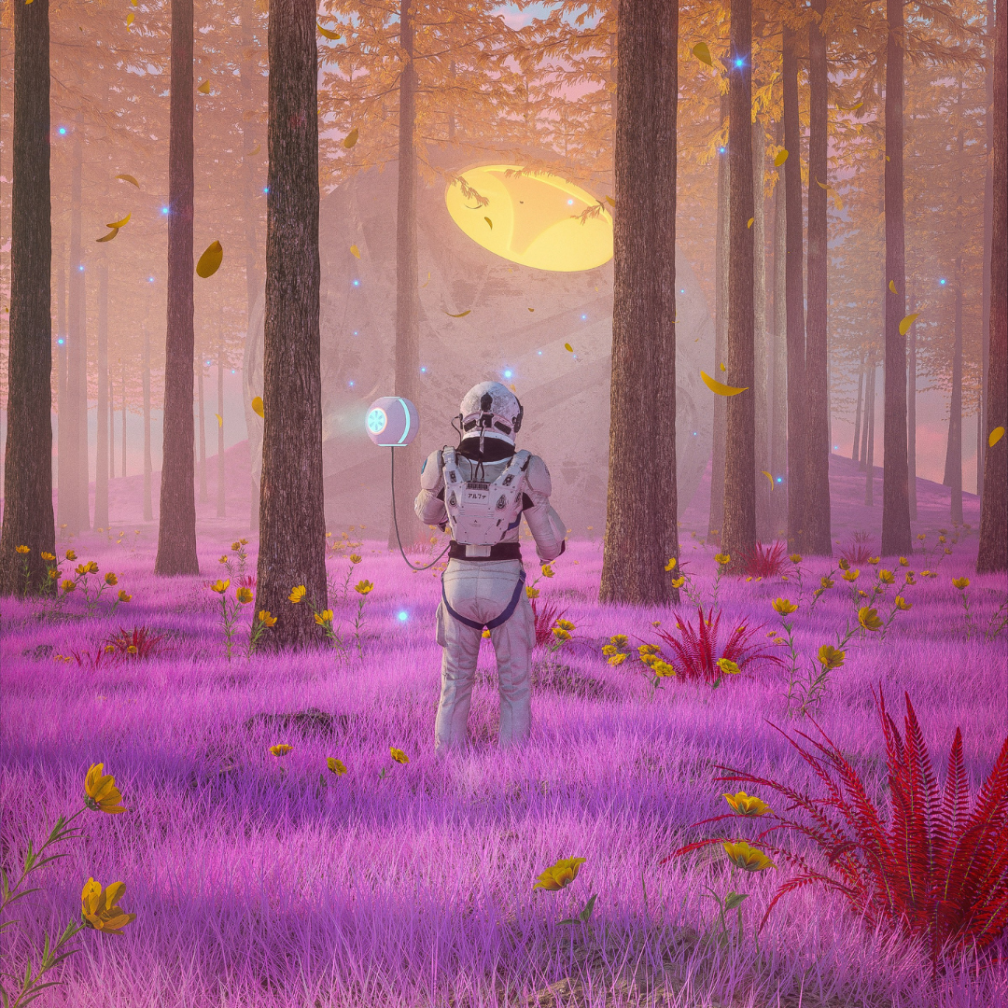
A person in a space suit standing in a field of purple flowers.

F in the ELLPH

A person in a space suit standing in a field of purple flowers.
Image by Rohit Choudhari

Corcoran and I went alone to planet F in the ELLPH system, where microbial and plant life had been discovered. The mission was to discover a proto-language. If F developed similarly to Earth, its vegetation would produce the early stages of the desire for separation, which would evolve into what we call human language, to be adopted eventually by hominid-like animals once their brains developed the capacity to house such an innovation. 

The army didn’t approve of two men alone on this special op. The risk of romantic attachment in such a lengthy, close-quarters critical mission was too high. But Corcoran was the only one in the training who met the essential requirement, so he was the only one who could go with me.

I didn’t notice anything special about him at first. A stocky, Midwestern fresh-faced kid, eyes wide as saucers. Strong Minnesotan accent, but only when he spoke English. His Portuguese, French and Russian were radio perfect in pronunciation, but in syntax and vocabulary he fell behind the other shortlisted multilinguals.

It wasn’t until he referred himself for a psych eval on the selection exercise in Yucatán that I took notice of him.

‘What part of your psyche needs evaluating, Sergeant?’

‘I’m seeing fairies, Sir.’

A Mayan medicine man had led the unit in a ritual the night before. I suspected half of the men in the unit had caught a glimpse of the fae, but Corcoran was the only one admitting it.

‘That’s the psychedelics talking, Corcoran.’ 

He didn’t stop admitting it, even after I gave him an out. He believed they were real. 

‘You were right about the fairies,’ I revealed on the craft that would bring us to F. ‘We’ve discovered that the elemental forces that on Earth are known as fae—or Alux, among the Maya—are the first attempts of a planet to produce linguistic expression.’

You were right about the romance, I’d have confessed to my superiors, if we hadn’t lost contact with them shortly before arrival. The elemental language prototypes that abounded on F had brought tears to the scrying pools of Corcoran’s eyes.

‘The separation creates the Mystery,’ he breathed. We held each other, weeping. The curious fairies gathered round.


Would you like to know more about this story? I discuss it in Episode 110 of Structured Visions, ‘Clap if you believe in fairies.’ You can also sign up to the Grammar for Dreamers newsletter to get monthly updates on the ideas that inspire my work.

Love language

Green leaves, a purple crystal a pencil and an envelope aligned on a white background
Image by Joanna Kosinska

Stop me if you’ve heard this before. 

Two crazy kids, let’s call them Susie and Mick.

Susie’s got everything going for her. Brains, heart, looks, independent wealth, and more where that came from. A solid network of friends. Well rounded. Last thing she needs in her life is relationship drama. 

Still, she falls for Mick. She falls hard. 

What she sees in him is anyone’s guess. Puny, self-absorbed, obsessive. He still lives with his mom. He barely notices Susie, except when he needs something from her, like cash to feed his latest addiction, which she always supplies.

He’s got so much potential, she says. (Her friends throw up in their mouths.)

Mick reads Susie’s letters, but he can’t see past the words to the beautiful soul who wrote them. The love in those notes keeps him walled within his narcissism. They mirror back to him his own self image, which he can’t see through. 

Susie’s the Earth. Mick is most of humanity.

The love letters are human language. 

There’s a fair amount of evidence that Susie’s getting wise to Mick’s stupid games. 

If you, my friend, could love Susie as much as she loves Mick…

Ah! There may be hope for us all.


Would you like to know more about this story? I talk about in in Episode 90 of Structured Visions, ‘Language, intimacy and narcissism’. Subscribe to the podcast on Apple podcastsSpotify or wherever you like to listen.