Go

(The following is an excerpt from a short story published in The Running Wild Anthology of Stories, Vol 5.)

Anna gripped the banister of the university library’s vertiginous staircase with the same white-knuckled power she’d discovered during her turbulent transatlantic flight. She felt the bottom drop again as she reached the ground-floor helpdesk, now grasping nothing more substantial than a flimsy slip of paper, wet with her sweat.

Anna had inscribed the words on a sheet from the hotel pad before she’d started out today, in case she lost the power of speech or failed to contort her Virginia accent into something more understandable, if not more palatable, to her English addressees. She’d already mispronounced Birmingham twice since she’d arrived, once at Heathrow customs and once at Euston station, her thick tongue reluctant to renounce the Alabama namesake.

The bemused librarian glanced over what she’d written. Abena Amina. Imperatives in Omotic Languages. PhD Thesis, University of Birmingham, 1985.

We don’t hold hard copies of theses here anymore. They’re all sent to the British Library.”

“Can you tell me how to get there?” Anna whispered, like a frightened child.

“It’s in London,” was the response. “But you don’t go to the British Library to access an archived thesis, you write to request it. They scan it and email it to you.”

Anna imagined a less foolhardy version of her past self, discreetly filling out an online form from her work computer in Roanoke, scrolling through the returned digital file later that evening while Rich graded papers, unaware. In a flash of hindsight she saw the tensions on their budget and marriage erased, never forming.

Shame pressed against her like a blinding wall of fire. She blinked. Her interlocutor’s face appeared now as a blur of purposeful motion, silhouetted against imagined flames. “The departments sometimes hold onto the bound copies,” she conceded, and made a few phone calls. The campus map she eventually handed Anna held the clues to the next stage in her ill-planned scavenger hunt. A name scrawled in the margins: Adam Draper. A circle drawn around one of the buildings: Frankland.

The Frankland Building, it turned out, housed a neglected repository of doctoral theses from days gone by. They’d been piled unceremoniously onto the sagging shelves of the cluttered psychology postgrad room. Adam Draper was the psychology postgrad who’d been tasked to serve as guide to the uninvited American visitor.

Anna spotted the volume within minutes, retrieving it from among scores of gold-embossed maroon spines, half-hidden behind the misshapen blades of a Venetian blind caked with layers of dust. Its heft spoke of a mystery soon to be revealed. She pulled the tome to her and hugged it to her chest, as if it were a child she’d forgotten, returned to her fully grown.

“There must be something rather valuable in there,” Adam said, and Anna realized he’d witnessed this devastatingly vulnerable scene. Her lips moved to excuse her behavior, but no words formed there. The vertigo she’d felt in the library still pulled at her, but now with a singly directed propulsion – a force that would not allow itself to be squandered on unnecessary words.

She’d not released her grip on her prize. “Do I sign this out or something?”

“Well… the thesis isn’t really supposed to leave the postgrad office. But you can stay and read it for as long as you like. I was planning on working in here today anyway.”

So her guide became her silent companion as she plunged into the secrets of Imperatives in Omotic Languages.

Read the rest of “Go” in The Running Wild Anthology of Stories, Vol. 5.

Would you like to know more about this story? Watch the video I made about it. I also discuss “Go” in Episode 67 of Structured Visions.


Babel

Close up of an extra terrestrial being’s face
Photo by Stephen Leonardi

In linguistics, the term displacement refers to the capacity of human languages to communicate information about what’s not immediately present in the here and now.

Tom’s wife didn’t say anything about his clerical collar until after breakfast, and then she didn’t reference it directly.

‘Making visits today?’ She raised her eyebrow, just perceptibly, and refilled their coffee mugs.

‘Just one.’

She waited.

‘Nat Greer’s in the Oaks. It’s Alzheimer’s.’

‘Your old Sunday School teacher,’ she said.

He marvelled at the capacity of her memory, her willingness to absorb the banal trivia of his life, and more importantly, the stoic self-restraint she showed by not voicing her disapproval. The point of him taking a sabbatical was to spare him from the parts of his job most likely to bring about depressive episodes. Bedside visits with the elderly counted among these.

‘Bring those comic books you used to talk about. They might bring back some of his long-term memories.’

Tom placed two copies of Galactic Discoveries on a coffee table in the front parlour of the assisted living community. ‘Greta said you might want to see these,’ he said. Somehow his wife had remembered that he and his friends used to hide them in their bibles during Sunday School.

The sight of the comics lit a spark in the elderly man’s eyes. ‘Tell me about the Tower of Babel!’ he commanded.

Tom grinned. ‘In ancient times,’ he said obligingly, ‘the people built a tower to bring them closer to God. God destroyed the tower, and to punish the people for their hubris, he made it so that they could no longer understand each other when they spoke. That’s why there are so many different languages on earth today.’

‘Incorrect,’ declared Nat Greer, with undisguised glee. ‘Babel wasn’t a tower. Towers go up, from earth to heaven. Babel went from heaven to earth, like a beam of light.’ He nodded toward the coffee table.

The cover of one of Tom’s magazines showed greyish green aliens descending to the ground in a tunnel of light beaming from a floating saucer. 

Seeing the image through Nat Greer’s eyes fired Tom’s imagination, and he remembered the excitement he’d felt at Sunday School on the day he’d been caught sneaking peeks at his comics. Mr Greer made him read passages from Galactic Discoveries aloud, as a punishment. But soon the teacher decided the science fiction stories held more compelling lessons than the bible itself, and Sunday School became the most anticipated event of young Tom’s week. 

It was Mr Greer, he’d often thought, who was singularly responsible for Tom’s vocation. For better or worse.

When he looked up again, Nat had shrunk inside himself, and the plush armchair seemed to envelop him. His eyelids dropped, and a thin line of drool escaped his gaping mouth.

Tom called for a nurse and left the home.

He returned to the Oaks the next morning, and the morning after that. Most days Nat Greer was unresponsive, but every once in a while the light would return and he’d share some strange insight with Tom, always about Babel.

‘It wasn’t a punishment,’ he said. ‘The beings who came down through the tunnel volunteered to forget their common language.’

‘The Tunnel of Babel,’ Tom mused. It might make a good sermon title, when he started preaching again, after his sabbatical.

‘More like an umbilical cord than a tunnel,’ Nat said. ‘It keeps everyone safe and nourished. Everyone but the volunteers.’

‘The volunteers?’

‘Us. You and me. Them.’ Nat nodded toward the other residents, shuffling behind walkers, and the nurses accompanying them.

‘We volunteered for this?’ Tom said, incredulous.

Nat nodded many times.

‘We volunteered to have our umbilical cords cut?’ Tom asked, but received no answer. His Sunday School teacher had nodded off to sleep.

Tom returned every day and asked the same set of questions.

‘Why would we volunteer? Why would we agree to cut ourselves off from our connection to…’ Connection to what? He had no access to precise enough language. ‘From our connection to God?’

One day, finally, Nat was alert enough to thumb through the copies of Galactic Discoveries that Tom unfailingly brought with him on his visits.

‘We wanted to discover new worlds,’ he said. ‘And the Beings who inhabited them.’

Tom shook himself from his reverie in just enough time to realise Nat was finally responding to his questions.

‘We volunteered to cut our connection to God…?’ he asked.

‘We volunteered to cut our connection to everyone and everything,’ said Nat, ‘so we could discover it anew.’

The next time he went to The Oaks, he learned that Nat Greer was dead.

That night he and Greta shared a bottle of Chablis on their back deck after dinner. 

‘Do you think it’s a punishment that the people of the world all speak different languages?’ Tom asked.

‘Are you talking about the Tower of Babel?’

The first full moon of the summer had risen above the distant treeline. It cast an eerie beam of light on their dark lawn.

‘The languages in that story might be a metaphor,’ Greta said. 

‘For what?’

‘For each human being’s distinct, impenetrable subjectivity.’

Tom blinked.

His wife had just articulated the anguish that had led to his most recent crisis. That no one would ever see him. That his views were not welcomed. That he existed only to fulfil society’s ideas of what he should be.

‘Do you really believe that we’re closed off from all experiences but our own?’ he asked. The words came out strained, like his vocal cords were being cut.

‘Does it trouble you that I believe that?’ she asked.

‘I thought out of everyone,’ Tom confessed, ‘that there was at least one person who understood me. At least you.’

She spoke no words, but placed her palm on the back of his hand.

He felt a connection open between them, like a beam of light, or a tunnel, like a discovery renewed.

Would you like to know more about this story? Watch the video I made about it.

The words of your language

Photo by Tegan Mierle

Billy’s just announced the next topic.

‘The one that got away.’

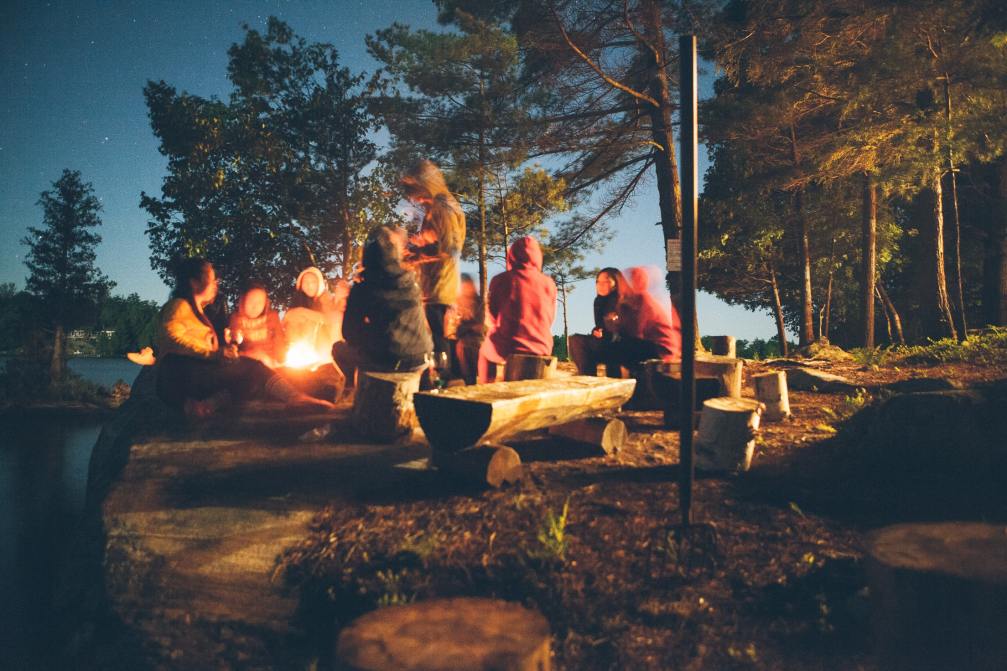
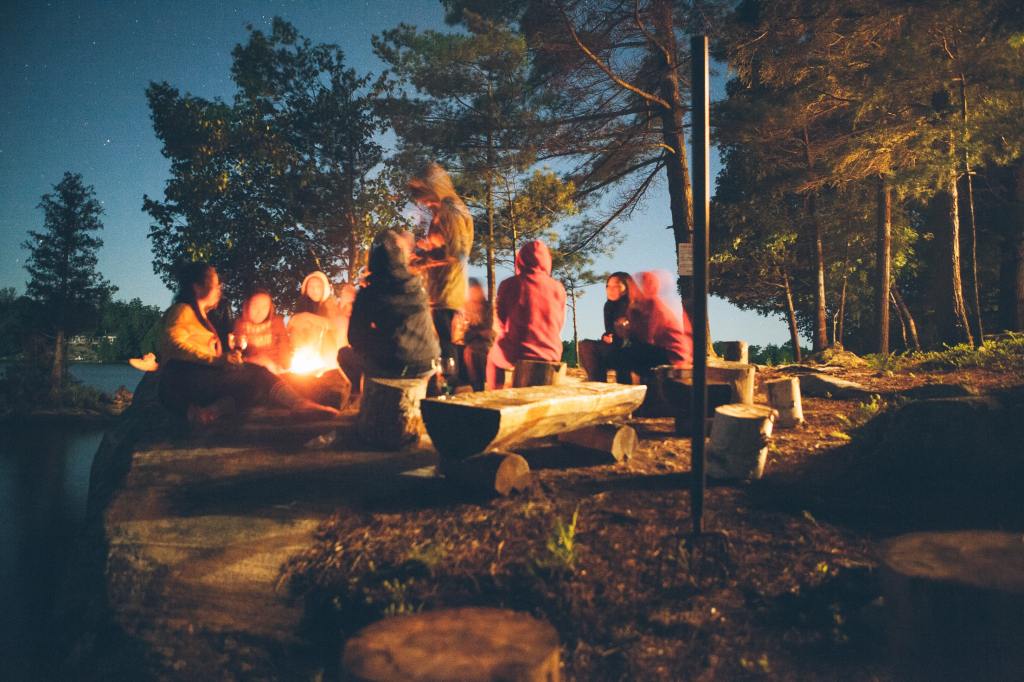
I’m on my third can of Stella and I need a piss. But Andrew’s already taken up the challenge and it seems rude to walk away. Besides, as soon as I leave the campfire I’ll be ambushed by the swarm of midges I know is waiting in the dark, surrounding our badly protected little company.

And then there’s the fire itself, which holds me in its seductive trance. It ripples the air, ripping otherworldly openings in the spaces between the dancing licks of flame.

They’re portals, I think. You could travel into one of them, if you didn’t mind getting scorched.

I hold my Stella at arm’s reach. It’s been a while since I’ve been this buzzed.

‘The one that got away,’ repeats Andrew.

As he plays for time, my mind fixates on the phrase itself, on its structure, its underlying grammatical patterns. It’s a noun phrase, though it doesn’t have any nouns in it. ‘The’ is a determiner, ‘one’ is a pronoun, and the rest of it is a relative clause. But how can a pronoun follow a determiner? And could you put any other determiner in front of ‘one’? I try it out, as Leila has taught me to do.

A one that got away.

My one that got away.

That I’ll never be able to ask Leila about this hits me like a punch in the gut.

Read the rest of ‘The Words of Your Language’ at After Happy Hour Review, Issue 13, p. 55-62.

Would you like to know more about this story? I discuss it in Episode 64 of Structured Visions.