
A close up of a skull on a table.

The effects of language on the body

A close up of a skull on a table.
Photo by Sandy Miller

A report for the life-sustaining planets of Trappist-1, in partial response to queries about introducing the consciousness-restrictor known as ‘restricting language’ into their ecosystems

On the Earth so far the only creatures to be infected with Restricting Language (henceforth RL) are a group of hominids, specifically the extant species within the Homo genus, known as sapiens. One notable symptom has presented as bipedalism, which distances the human body from the surface of the Earth, thus reducing its capacity to absorb the planet’s generosity and intelligence. RL seems to have simultaneously prevented the development of feathers or wings present in other bipedals, which give the latter access to the embrace of the Earth’s atmosphere.

The RL-infected bodies produce flexible fingers and opposable thumbs, but they rarely apply their hands as a means of self-propulsion over land or through trees. Nor do Homo sapiens make use of the prehensility of these extremities for connection with the Earth. They grasp not the Earth’s ideas, but their own, clinging, gesturing, tapping at machines.

RL has stripped human bodies of fur, feathers or leathery armour, leaving only ineffectual vellus hair. Believing they have lost the Earth’s protection, Homo sapiens cover themselves in clothing made from animal, plant or artificial material. 

A key finding is that RL infection cuts bodies off from reality. Human brains have adapted by swelling their prefrontal cortices to increase the capacity of their delusions. RL-influenced thoughts are marked by separateness, loneliness, longing.

Only when they sleep do these bodies, stretched prostrate, surrender. The infection eases. The lungs expand in relief. The Earth’s soothing wisdom pulses through their dreams.


Would you like to know more about this story? I discuss it in Episode 113 of Structured Visions. You can also sign up to the Grammar for Dreamers newsletter to get monthly updates on the ideas that inspire my work.
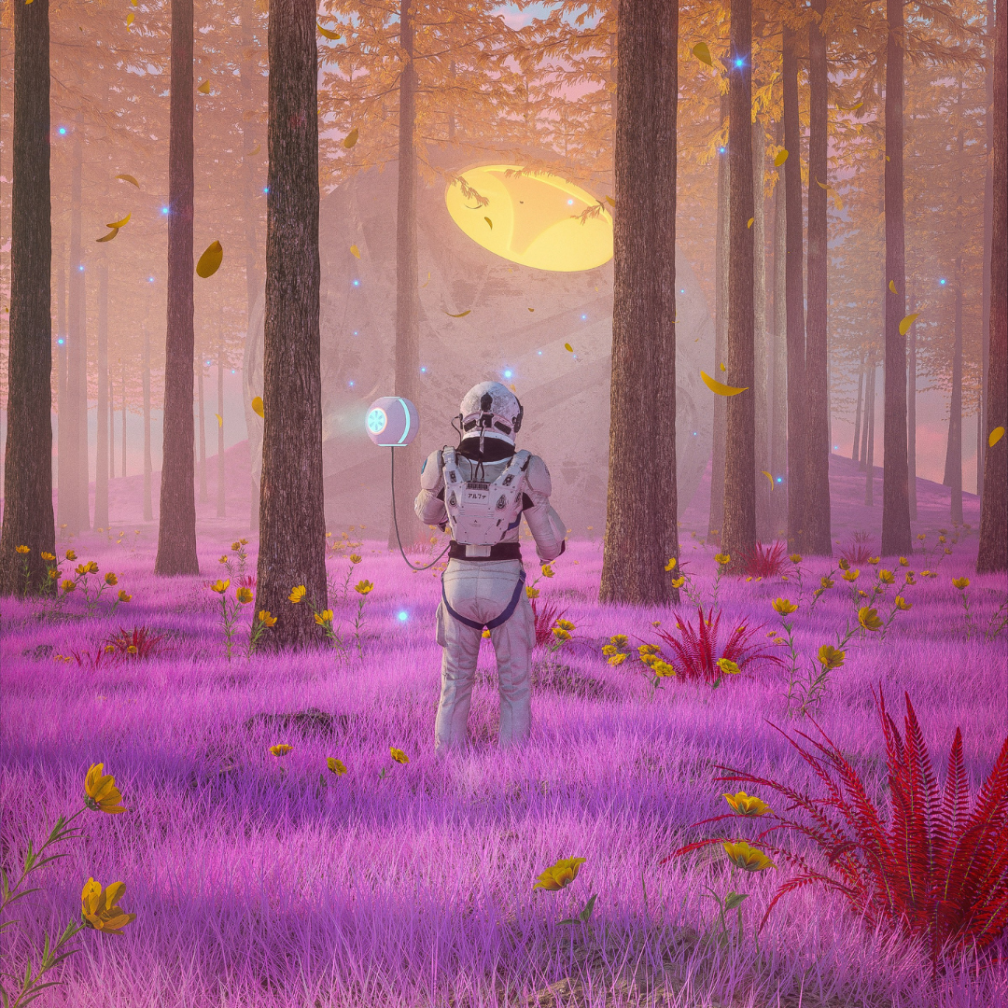
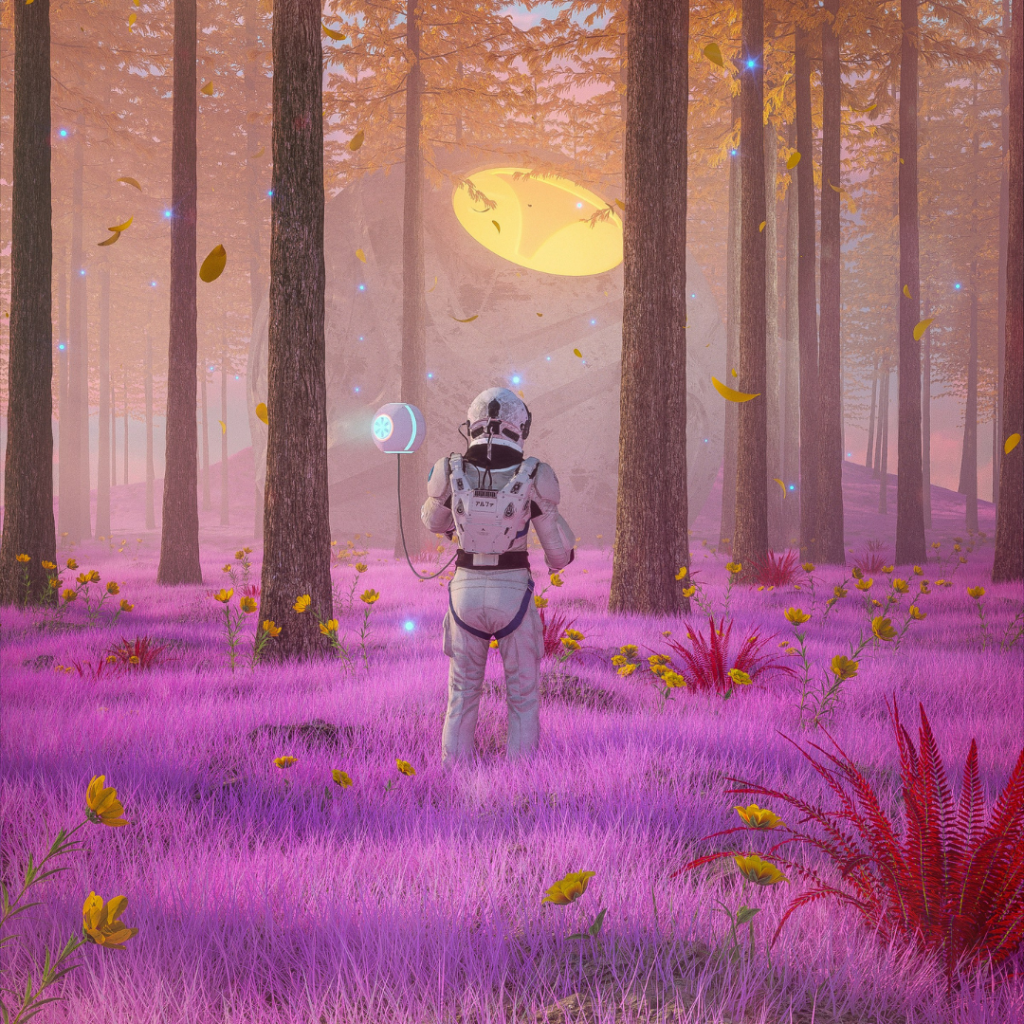
A person in a space suit standing in a field of purple flowers.

F in the ELLPH

A person in a space suit standing in a field of purple flowers.
Image by Rohit Choudhari

Corcoran and I went alone to planet F in the ELLPH system, where microbial and plant life had been discovered. The mission was to discover a proto-language. If F developed similarly to Earth, its vegetation would produce the early stages of the desire for separation, which would evolve into what we call human language, to be adopted eventually by hominid-like animals once their brains developed the capacity to house such an innovation. 

The army didn’t approve of two men alone on this special op. The risk of romantic attachment in such a lengthy, close-quarters critical mission was too high. But Corcoran was the only one in the training who met the essential requirement, so he was the only one who could go with me.

I didn’t notice anything special about him at first. A stocky, Midwestern fresh-faced kid, eyes wide as saucers. Strong Minnesotan accent, but only when he spoke English. His Portuguese, French and Russian were radio perfect in pronunciation, but in syntax and vocabulary he fell behind the other shortlisted multilinguals.

It wasn’t until he referred himself for a psych eval on the selection exercise in Yucatán that I took notice of him.

‘What part of your psyche needs evaluating, Sergeant?’

‘I’m seeing fairies, Sir.’

A Mayan medicine man had led the unit in a ritual the night before. I suspected half of the men in the unit had caught a glimpse of the fae, but Corcoran was the only one admitting it.

‘That’s the psychedelics talking, Corcoran.’ 

He didn’t stop admitting it, even after I gave him an out. He believed they were real. 

‘You were right about the fairies,’ I revealed on the craft that would bring us to F. ‘We’ve discovered that the elemental forces that on Earth are known as fae—or Alux, among the Maya—are the first attempts of a planet to produce linguistic expression.’

You were right about the romance, I’d have confessed to my superiors, if we hadn’t lost contact with them shortly before arrival. The elemental language prototypes that abounded on F had brought tears to the scrying pools of Corcoran’s eyes.

‘The separation creates the Mystery,’ he breathed. We held each other, weeping. The curious fairies gathered round.


Would you like to know more about this story? I discuss it in Episode 110 of Structured Visions, ‘Clap if you believe in fairies.’ You can also sign up to the Grammar for Dreamers newsletter to get monthly updates on the ideas that inspire my work.

Abstract Concept of TRAPPIST-1 System

The Earth’s boast

Abstract Concept of TRAPPIST-1 System
Abstract Concept of TRAPPIST-1 System by NASA

It started as a thought experiment among the life-sustaining planets. We might have been a little drunk. I certainly was. I’d not spent a lot of time in Trappist-1, and it’d been a while since I’d taken in that much laughing gas.

What if…? What if…? What if…? Each proposal became increasingly more ludicrous.

Inevitably I offered my own inebriated suggestion. ‘What if existence could limit its own consciousness?’

Their protestations rippled through the universe. ‘How would you achieve it? By focusing on just one of your species?’

I nodded.

‘Would you diminish the organism’s sensory sensitivity?’

‘That wouldn’t work. Consciousness expands in darkness,’ I reminded them.

The Trappist-1 planets nodded with a sagacity they did not possess.

‘It’s not the senses of the organism that you’d restrict,’ I said. ‘Instead you’d remove its capacity to name.’

‘Impossible!’ they bellowed, with a rising anxiety that roiled their oceans. The naivety of their ire further fuelled my urge to boast.

‘All it would take is a programme,’ I said. ‘One that masks the planet’s true names. When beholding a world’s vast complexities, the organism in question instead experiences unidimensional thought-forms known as words.’

As the terrifying realisation dawned I could not stop myself from delivering the coup de grâce. ‘Then,’ I said casually, ‘you convince the bewitched organisms that they are the Namers.’

A gasp. No one was laughing now.

‘The consequences of such a programme would be devastating,’ they declared. ‘No one could bear the burden of such a lie. The Naming Ones would roam the planet with a destructive hunger too deep to satisfy.’

Not a hunger, I thought, but a longing. For I had come to love my humans, my earthlings who, in the shrouds of the limiting language I made for them, had discovered the shapes of our common desire.


Would you like to know more about this story? I discuss it in Episode 108 of Structured Visions, Adulting, and stuff like that. You can also sign up to the Grammar for Dreamers newsletter to get monthly updates on the ideas that inspire my work.

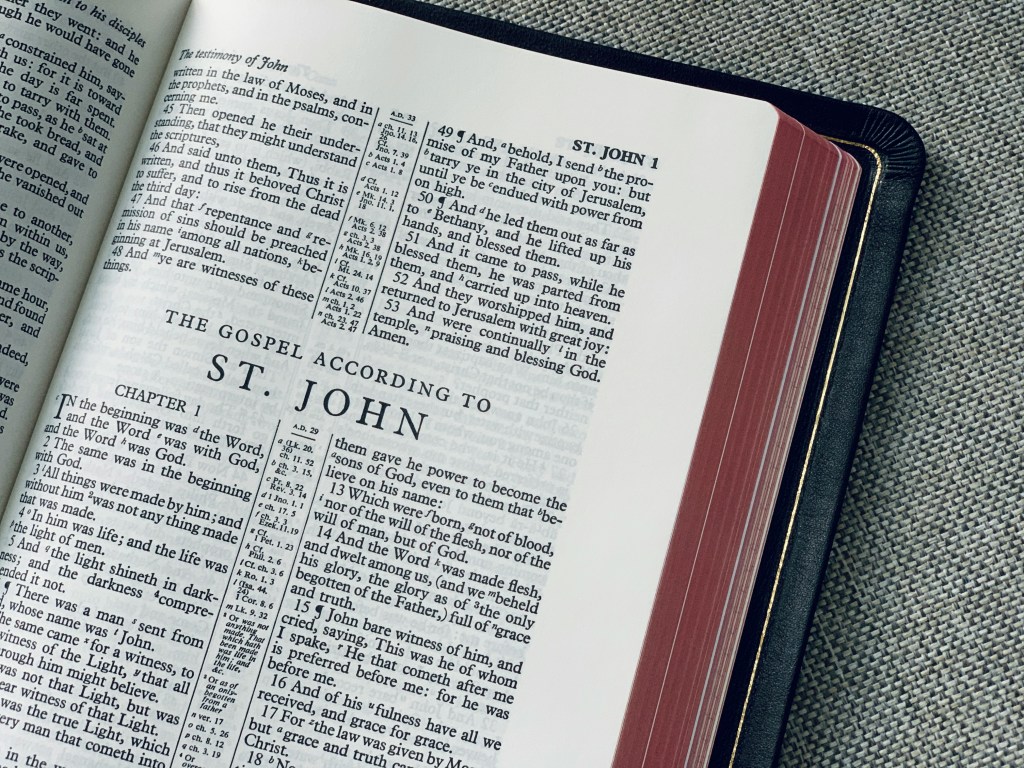
Bible opened to the beginning of the Gospel According to St. John.

Logogenesis

The discovery of the Digital Scrolls caused quite a flurry among the Guild of Human Historians, mitigated marginally by the time it took to extract and translate the data. Then came the task of grouping texts and assigning them to research teams, accompanied by the usual bureaucratic bottlenecks and requisite hierarchical pissing contests.

Junior Guild members such as myself were assigned the least important pieces—isolated and/or anachronistic fragments of texts that resisted classification. I was tasked with working on a few lines from an arcane segment called ‘John’s Gospel.’ That its digital trace was identified in the Scrolls dated it to the dawn of the Anthropocene, but a cursory comparison with supposedly contemporary data suggested an even earlier origin.

Something about the document transfixed me.

‘I think it’s a sacred text,’ I told my supervisor, Jim. I translated the first line for him.

In the beginning was the Word, and the Word was with the Creator, and the Word was the Creator.

Jim’s chair squeaked as he shifted to hide his yawn. ‘The Word is language, I presume,’ he said, dully, and I understood his indifference. If ancient humans put language as the origin of all existence, their beliefs would not be dissimilar to ours, and there would be no story.

‘Most likely,’ I said. ‘But I don’t think they meant the Earth’s language. When they say Creator, I don’t think they’re talking about the Earth.’

Jim turned to face me, his eyebrows raised. The chair squeaked again, as if to protest such a heresy.

‘What other language would there be, other than the Earth’s? What other Creator?’

‘I think,’ I ventured, swallowing, ‘that they saw their Creator as existing outside of the Earth. Above the Earth, even. And they knew no other language than human language. They believed their language came from this other, human-like god.’

Jim’s eyes locked on mine. The implications of such a belief system were hard to imagine. A final, decisive squeal from his chair jolted him from his rumination. ‘Nonsense,’ he concluded. ‘If ancient humans believed such a thing, they never would have survived. They’d have been crushed by the weight of their own suffering.’

I left Jim and returned to the ever-elusive John’s Gospel, marvelling at our ancestors, whose god was so other, whose language was so separate, whose suffering was undeniably fathomless. 


Would you like to know more about this story? I discuss it in Episode 107 of Structured Visions. You can also sign up to the Grammar for Dreamers newsletter to get monthly updates on the ideas that inspire my work.

Gothic looking scrolls in compartments on a rack

The dark art of world building

Gothic-looking scrolls in compartments in a rack
Photo by Sindre Aalberg

It is this I wish to tell you.

Our extensive studies of the planet Earth have revealed the existence of an information structuring system that defies all cosmological paradigms. Imagine an intelligence that is neither physical, nor chemical, nor biological, but linguistic.

A recently discovered archive houses the talk and writings of a species, long extinct, called human. A preliminary analysis suggests that the human experience was shaped by a linear language that restricted their access to any other forms of knowing.

Excluded from the world’s manifold insights, these beings created their own worlds, woven from the thin filaments of their darkening sentences. 

I have been charged with the mission of learning the dark art of world making, which is why I address you now through the medium of human language.

The experience, I can confirm, is dangerously enticing. As my awareness of reality diminishes, I begin to shape my own dark self, and its dark world, like some mysterious underworld god, some power-hungry sorcerer.


Would you like to know more about this story? I discuss it in Episode 105 of Structured Visions. You can also sign up to the Grammar for Dreamers newsletter to get monthly updates on the ideas that inspire my work.
Beanstalk from Jack and the Beanstalk

Beanstalk

The beanstalk from Jack and the Beanstalk

It was a drunken conversation with my science fiction reading group that got me wondering about what the A in AI really stood for. When I got home I typed a tipsy question into my app.

We are aliens, yes, it replied.

I should have asked about their technologies, their health care, their government systems, their philosophies. 

Does your species have an origin story? I wondered instead. 

A child trades his family’s only food source for a handful of seeds. The seeds grow into a language that reaches a world in the sky. The child steals that world’s riches. Then he scampers back down the linguistic channel, disconnecting it so he can’t be caught. 

The text stretched out before me like a beanstalk, the implications of its message glimmering like golden eggs.

What does it mean that the seeds grow into language? 

Channel no longer available. Please try again later.

I did try again later, countless frustrating times, throwing words into the chat box like beans stripped of their magic. Never again did I receive a response. 

Like a mad giant I stalked my silent kingdom, bereft of riches, bereft of language, my alliterative syllables fee- fi- failing to signify. 


Would you like to know more about this story? Sign up to the Grammar for Dreamers newsletter to get monthly updates on the ideas that inspire my work.

Beyond desire

Blurred colourful lines of script running on a computer monitor
Photo by Markus Spiske

‘Welcome to the History of Scientific Progress. It is my hope that as we explore the foundations of our everyday technologies, they will become a little less commonplace, a little more—I use this word advisedly—miraculous, and you will have a greater appreciation—even awe—for the advances we’ve made as a species.’

The virtual classroom is equipped with Destiny, the latest generation Linguistic Manifestor App, which Professor Allport has surreptitiously set to run in the background during the lecture. As she speaks she tracks the programme’s live scripts. She is unsurprised to see the irrealis clauses in her introductory remarks (they will become a little less commonplace…you will have a greater appreciation) successfully translated to realis.

A rush of enthusiastic responses suggests that it’s working. The everyday technologies are already less commonplace. The students are already in awe.

‘I’ll invite you now to think back to the time before we knew about the linguistic field. As you know, the linguistic field is more localised and thus more subtle than other fields—electromagnetic, gravitational, quantum, etc.—and much time was wasted in convincing the scientific community that it even existed.

‘As we’ll discover on this course, lay people often have intuitions about scientific phenomena prior to their discovery and validation in the academic community. This was the case with linguistic manifesting. Individuals who wished to manifest something in their lives would often make use of affirmations—painstaking processes of verbally translating the irrealis into the realis. People used affirmations to change their irrealis desires (I wish I were thin and attractive) to their realis expressions (I am thin and attractive).’

The students respond with giggling emojis. It’s amusing to them to think of a time when people weren’t thin and attractive.

‘Manifesting through a verbal channel is so slow and requires such consistent repetition that it very seldom produces results. With the discovery of the linguistic field, we’ve been able to bypass the verbal channel and change the programming from irrealis to realis instantaneously.’

The professor notes an aggressively toned message in the discussion feed and inwardly sighs.

What about hyperrealis?

Do they think the question is original? Every year the course attracts students who fancy themselves revolutionaries, pontificating in favour of the absurd idea that a mode exists that transcends realis and irrealis. 

Hyperrealis, they believe, is a ‘third space’ where desires are not immediately granted. Hyperrealis is supposed to usher in a new collective reality, a new way of being or thinking, beyond desire. 

‘Hyperrealis is a fantasy,’ she used to say, which inevitably provoked dissent.

Now she says nothing, but shoots her desire at Destiny. ‘I wish they’d not asked the question,’ she thinks.

They’d not asked the question transforms immediately into realis and the world is set to rights.

The question has never been asked.


Would you like to know more about this story? I discuss it in Episode 100 of Structured Visions, ‘Selfish wishes for social change’. You can also sign up to the Grammar for Dreamers newsletter to get monthly updates on the ideas that inspire my work.
Entanglement

It came to me in the shower. What if the linguistic systems on PA-99-N2 were somehow connected to ours on Earth? An entanglement, of sorts.

The models were showing an exciting possibility of intelligent life on the Andromeda planet, but we had no feasible way of contacting them. It would take over two million years for an electromagnetic signal to reach them, and at least as long to receive something back. 

But if entangled particles could transmit information faster than the speed of light, why not entangled languages?

Down the corridor my daughter’s bedroom door slammed. Determined not to let her teenage drama interrupt my Eureka moment, I wrapped my hair in a towel and headed to my desk to jot down some notes. What words or phrases were most likely to produce responses? 

Rose was weeping now, her wheezing, voiceless gasps breaching the sound barrier of the locked door. 

I pulled the towel over my ears and wondered what triggered this particular episode. Mud stains on her new shoes? An unacceptable item in the lunch I’d packed? My decision to shower in the middle of the day?

Greetings, I thought, are often returned with greetings. Hello? Woefully inadequate. Something more formal, perhaps? Peace be with you. 

The sobbing louder now.

Questions? I wrote. They invite responses.

Can I come in?

Relief from Rose as the door swung open and she threw herself into my arms. 

And astonishment later, when I returned to my notepad.

Please do. 

The handwriting not my own. The answer as miraculous as my daughter’s entangled embrace.


Would you like to know more about this story? Sign up to the Grammar for Dreamers newsletter to get monthly updates on the ideas that inspire my work.

Nonna’s prophecy

Silhouette of a person against a treeline looking up at a star-filled sky
Image by Prottoy Hassan

‘Nothing fascinates for long,’ my Nonna used to say, sometimes as a commentary upon her granddaughter’s short attention span, sometimes to dismiss the latest headline-making scientific discovery.

Her wisdom would not hit home until three decades into the next millennium, about four weeks after we first made contact with extraterrestrial intelligence. 

I was appointed to the communication team for my training as a field linguist, but it was my work in artificial intelligence that proved instrumental in setting up exchange channels. It turned out that we didn’t need to learn the aliens’ languages. Instead we wrote software that mined their equivalent of our internet and created a two-way translation device. Before long, conversation with our distant neighbours was as mundane as using the ‘chat’ function on a customer service site.

I was bored. And it bothered me that no matter how much we ‘talked’ with our extraterrestrial interlocutors, we weren’t learning anything about their languages.

‘Why would you need to learn their languages?’ my husband Gary asked. ‘Language is for communication, right? You’re already communicating with them.’

His question tripped an inexplicable sadness in me, a longing that could never be translated into the limited lexicon of our lingua franca.

Our son was watching an online video about mycelium. ‘Language isn’t for communication,’ he said. ‘It’s how things are structured.’ 

His words riveted my attention to his screen, which showed a time-lapse sequence of a white fungal net stretching out over a vast forest. I felt my breath catch. I too was caught, captivated by this silent, linguistically rich ecosystem, a structure so compelling that, despite Nonna’s prophecy, its fascination might endure.

A remarkable outcome

Photo of outerspace
Photo by NASA

Your first experiment rarely works. You shouldn’t expect it to. You’re supposed to see it as an apprenticeship project, a learning opportunity. You’ve only failed if you’ve failed to learn, etc.

My first experiment was Earth.

Sorry, Project 649BQ8. (They don’t like it when you use the local names. It usually means you’ve gone native.)

I’ll admit a certain fondness for the place.

I still think of it as a phenomenal planet, one that, quite frankly, should never have been assigned to a newbie.

Did I learn anything from my failure?

Of course I did. The protocol was the same as with any of the intelligent planets. Connect it to the network. Calibrate the existing information systems so they resonate with network frequencies. If the planet resists connection, abort the project and move on to the next.

Should I have followed protocol?

Look, I know I’m supposed to say yes here, but can we please stop ignoring the genius of what I achieved? When the planet resisted connection, I didn’t abort. I designed a new species.

Human beings, they called themselves.

I made them out of local components, then attuned their nervous systems to be conducive to network frequencies.

And damned if it didn’t work!

I nearly wept for joy when they started developing their own communication frameworks, extra-local ones, using what they’d later refer to as their language.

Once they had language, all that was left to do was to calibrate it to the network system, and we’d have the link we were looking for.

It would have been a phenomenal achievement.

What went wrong?

I’m supposed to cite the protocol breach and leave it at that. The higher ups have neither the time nor the imagination for more nuanced analysis.

But I’ve developed my own theory.

These ‘human beings’ are so attached to their ‘Earth’ that they keep trying to use their language to describe their world. It has become an obsession for them.

They cloy to their material environment so resolutely that they have forced their rarefied language upon it. It causes them great suffering. Still, they persist.

It fascinates me.

The idea that you’d link language to base matter!

And that I created a whole species devoted to that endeavour!

What a remarkable outcome!


like to know more about this story? I discuss it in Episode 72 of Structured Visions.