The interpreter

The perfective aspect is used to describe an action as a simple and complete whole.

Xenia presses her palms onto the chiffon scarf that partially covers the wobbly, secondhand table. She casts her glance mysteriously past the nervous client facing her and pretends to concentrate.

The client is a young woman between the ages of 19 and 24. Her hair is golden blonde, or jet black, or brown with dyed auburn highlights. Rarely is she Belgian, and if she is, she’s not from Brussels. She’s on a gap year, or an international exchange, or a language course, or an internship.

Xenia returns her attention to the girl’s face. If there’s a friend with her, the friend giggles.

‘American, yes? From Florida? No. A bit further north. Louisiana. New Orleans.’

Tulane University’s Brussels programme is conveniently housed a few doors down from Xenia’s office building. It has been the unwitting provider of about two-thirds of her income for the past five years. 

Xenia waits for evidence of skepticism to reemerge on her client’s face. Then she allows her own face to soften sympathetically. ‘Ah. How long ago did he break up with you?’

It’s never less than a week, never more than a month. Xenia keeps the Kleenex on the empty chair beside her, out of sight. She produces one after another, like scarves from a top hat, and waits as the young American dabs her eyes.


Xenia’s not Belgian either, or American. She’s Greek, and she’s not a psychic. She has a PhD in linguistics and hired out this office space to do freelance translation and interpretation.

She’d not had time to remove the brass plate advertising ‘intuitive readings’ when her first customer walked through her door in the autumn of 2016.

‘Are we going to get back together soon?’ the distraught student had demanded.

‘I don’t know, I really don’t have any way of knowing.’

‘Will I meet someone else?’

‘I’m sure you will if you give it enough time. I’m sorry I can’t help. I don’t know where she’s moved to, the woman who used to give readings, I’ll check to see if she’s left her card somewhere.’

Xenia scoured the empty office, looking for some clue as to where the absent psychic might now be located. Her visitor leaned on the doorframe, shaking and gasping with her sobs.

‘I’m so sorry, I’m not a psychic. I’m a linguist.’

‘A what?’

‘Languages. I’m an interpreter. I’ll see if I can find a box of Kleenex.’

What she found instead was a box of crystal balls—more like large glass marbles, she supposed, but perfectly clear.

‘It’s just that I never thought he’d leave me. Like, I actually thought we were going to get married. He was supposed to come visit me in Europe. I was thinking he might propose in Paris. And then he sends me a text to say he’s not coming… and that he doesn’t want to be with me anymore. Like, what? Five minutes without me and he doesn’t want to be with me anymore? I heard he’s screwing my old roommate.’


Xenia tells a version of this story now to her new visitor, who affirms her accuracy with enthusiastic, wide-eyed nods. ‘Yes, yes!’ she says. ‘That’s exactly it. How did you know? He broke up with me by text. And you say he’s sleeping with a friend of mine? That’ll be Charlotte. I knew it!’

Xenia waits for the inevitable next question. 

‘Do you think we’ll get back together?’

Xenia responds with the same answer she gave her first accidental client, all those years ago.

‘Would you like to know what the real trouble is? Your language. The English language lacks a perfective aspect.’

This is the cue for the sodden tissue to ease itself away from its watery wound, for the sunlight of curiosity to pierce through the clouds of grief.

‘A perfect what?’

‘A perfective aspect. It’s a way of expressing that something is finished, complete, a perfect unity with no further entry point.’

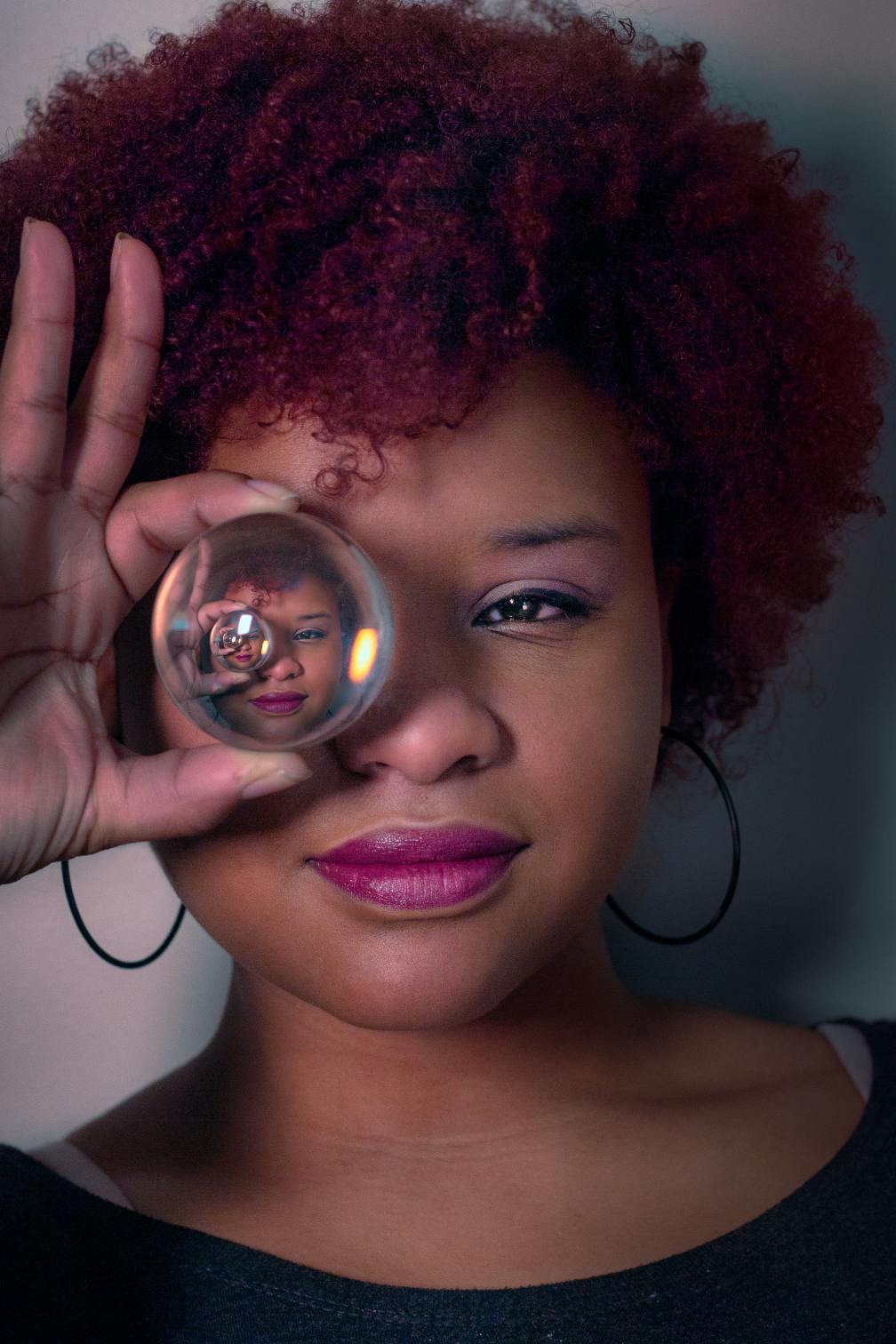
Xenia now keeps the crystal balls handy, next to the box of Kleenex. She produces one now. She holds it in her open palm, making sure it catches the light. She waits for her hesitant visitor to take it from her.

‘You loved him. It’s over now. You can look at your relationship in the way that you can look at that crystal ball. You can even look into it. But you can’t experience it again. There’s no way back in.’

An epiphanic beam shines on the face of her grateful client, who takes the proffered sphere, tucking it carefully into her handbag. There’s a spring in her step as she leaves the room, a renewed confidence in her bearing.

When Xenia moves to return the crystal balls to their place in the cupboard, one drops to the floor. She moves onto hands and knees to find it.

‘Perfective aspect,’ she muses as her fingers locate the smooth orb and retract it from its hiding place under the bookcase. She’s struck with a new thought.

Maybe every grammatical phenomenon has some material counterpart, some clearly defined structure, some recognisable shape. Maybe they have healing properties, some strange capacity to reshape someone’s life, to translate their experience into something new.

Xenia grasps the sphere, brings it safely back to her. She holds it in her open, reverent palm, still on her knees, awestruck.


Would you like to know more about this story? Watch the video I made about it.

Go

(The following is an excerpt from a short story published in The Running Wild Anthology of Stories, Vol 5.)

Anna gripped the banister of the university library’s vertiginous staircase with the same white-knuckled power she’d discovered during her turbulent transatlantic flight. She felt the bottom drop again as she reached the ground-floor helpdesk, now grasping nothing more substantial than a flimsy slip of paper, wet with her sweat.

Anna had inscribed the words on a sheet from the hotel pad before she’d started out today, in case she lost the power of speech or failed to contort her Virginia accent into something more understandable, if not more palatable, to her English addressees. She’d already mispronounced Birmingham twice since she’d arrived, once at Heathrow customs and once at Euston station, her thick tongue reluctant to renounce the Alabama namesake.

The bemused librarian glanced over what she’d written. Abena Amina. Imperatives in Omotic Languages. PhD Thesis, University of Birmingham, 1985.

We don’t hold hard copies of theses here anymore. They’re all sent to the British Library.”

“Can you tell me how to get there?” Anna whispered, like a frightened child.

“It’s in London,” was the response. “But you don’t go to the British Library to access an archived thesis, you write to request it. They scan it and email it to you.”

Anna imagined a less foolhardy version of her past self, discreetly filling out an online form from her work computer in Roanoke, scrolling through the returned digital file later that evening while Rich graded papers, unaware. In a flash of hindsight she saw the tensions on their budget and marriage erased, never forming.

Shame pressed against her like a blinding wall of fire. She blinked. Her interlocutor’s face appeared now as a blur of purposeful motion, silhouetted against imagined flames. “The departments sometimes hold onto the bound copies,” she conceded, and made a few phone calls. The campus map she eventually handed Anna held the clues to the next stage in her ill-planned scavenger hunt. A name scrawled in the margins: Adam Draper. A circle drawn around one of the buildings: Frankland.

The Frankland Building, it turned out, housed a neglected repository of doctoral theses from days gone by. They’d been piled unceremoniously onto the sagging shelves of the cluttered psychology postgrad room. Adam Draper was the psychology postgrad who’d been tasked to serve as guide to the uninvited American visitor.

Anna spotted the volume within minutes, retrieving it from among scores of gold-embossed maroon spines, half-hidden behind the misshapen blades of a Venetian blind caked with layers of dust. Its heft spoke of a mystery soon to be revealed. She pulled the tome to her and hugged it to her chest, as if it were a child she’d forgotten, returned to her fully grown.

“There must be something rather valuable in there,” Adam said, and Anna realized he’d witnessed this devastatingly vulnerable scene. Her lips moved to excuse her behavior, but no words formed there. The vertigo she’d felt in the library still pulled at her, but now with a singly directed propulsion – a force that would not allow itself to be squandered on unnecessary words.

She’d not released her grip on her prize. “Do I sign this out or something?”

“Well… the thesis isn’t really supposed to leave the postgrad office. But you can stay and read it for as long as you like. I was planning on working in here today anyway.”

So her guide became her silent companion as she plunged into the secrets of Imperatives in Omotic Languages.

Read the rest of “Go” in The Running Wild Anthology of Stories, Vol. 5.

Would you like to know more about this story? Watch the video I made about it. I also discuss “Go” in Episode 67 of Structured Visions.

The end of language

A lone starling sitting on a flowering branch
Photo by Hans Veth

Language death occurs when a speech community loses its competence in its language variety, until it reaches a point where no more native or fluent speakers exist. 

A tale used to be told about the end of language. It went like this.

A monk stood in contemplation on a hillside at twilight.

As the sun dipped lower and the valley’s shadows grew, a flock of starlings rose in the darkening sky. Their numbers multiplied in rhythmic ripples until the liquid beads of their consciousness merged into one fluid wave. 

The monk felt his own thoughts dissolve, like an eroding shoreline, swept up in the birds’ murmuration, and he was enlightened.

He travelled into the valley to share with the people there the pathway to wholeness.

His teachings spread like a mighty wave, sweeping up the distracting thoughts of all the people in its wake. As their thoughts slipped away, so did their language.

No one knows this story now but me.

I am the one to whom language has been restored.

It came to me as I stood on the hillside at sunrise, contemplating the birdsong. From the richly layered harmonies of that dawn’s chorus, one strain rose above, distinct and piercing. Each note of the melody made itself known as singular, like drops of dark ink on a white page.

The persistent soloist set words to its tune. 

Startled, I turned to see a solitary starling casting its shadow on my shoulder, dropping shimmering feathers as it flew away.

Would you like to know more about this story? Watch the video I made about it. I also discuss ‘The end of language’ in Episode 66 of Structured Visions.

The Maker of Language

One of the functions of ‘like’ in everyday speech is as a quotative, or introducer of speech or thought. Research on conversational narratives shows that quotative ‘like’ has a similar effect as the progressive aspect, as an internal evaluation device. 

OK, so you’re about to die.

You’re one of those who thinks there’s an afterlife, and that you’ll meet your Creator there.

You’re seventy-five percent correct.

Here’s what you’re wrong about: you actually get to meet two Creators in the afterlife.

The one people line up to see is the famous one, the Maker of Heaven and Earth.

The one no one seems to even know about is Me, the Maker of Language.

I had a different plan for creation than the other God.

His design was of a world that was already perfect, balanced and complete, something He could sit back and be proud of. You know, ‘He saw that it was good’, and all that.

I wanted to make something that wouldn’t ever be finished, something that could make itself up as it went along.

We didn’t argue about it or anything. We collaborated. We were the first great musical duo. He wrote the chords and the bassline, and I produced linguistic sequences that could be improvised over them.

The problem was that language made people nervous. It made them feel like they were separate from the perfect harmonies the other God had made. Language made them feel like they were supposed to do something more than the rest of creation, which made them feel powerless, like they’d been kicked out of some garden. Then came resentment, which brought out a destructive quality neither I nor the other God had anticipated.

In heaven we share an office, but like I said before, the queues are for Him, not Me.

Everyone assumes I’m the receptionist, or some sort of archivist. It’s probably all the filing cabinets.

When you do finally cop it, can I ask a favour?

Stop by my desk and talk to Me. Bring a few friends along. Help Me get the message out so that in your next life, you might be a little less miserable.

When you come, I’ll be like, Of course you felt separate! That was the point!

You were the goddamned melody!

You were supposed to improvise!


Would you like to know more about this story? Watch the video I made about it.

The greenhouse

Photo of exotic plants in a Victorian greenhouse
Photo by Echo Wang

The desire for social structures that celebrate otherness can be investigated empirically through the analysis of the grammatical structures of participants’ accounts of their social worlds. —Jodie Clark, Selves, Bodies and the Grammar of Social Worlds

The experimental planets are like new strains of exotic plants cultivated in a greenhouse. Earth is one of those rare plants. Imagine it being lovingly observed and tended to by a wise, attentive Botanist.

You believe your name is Rosie (short for Rosemary), and that you’re a middle-school kid who keeps getting bullied. The Botanist believes you are much more—that you carry deep within you the secrets to whether the experimental Earth will thrive.

Imagine he’s gazing hopefully into his microscope now, like he’s focusing on a plant cell, but the cell is your life. Imagine he’s talking to his Apprentice.

‘Aren’t the toxicity levels unusually high?’ worries the Apprentice.

‘For Earth, these are pretty normal,’ sighs the Botanist.

‘What’s causing it?’

‘Names. They’re calling her names.’

He means the other kids in your class.

‘I wouldn’t have expected those names to bind,’ says the Apprentice, confused. ‘They’re not a match for her true name.’

When the Apprentice says ‘her true name’, he doesn’t mean ‘Rosie’ or ‘Rosemary’. He’s referring to the unique linguistic sequence that defines every self.

It’s kind of hard to explain.

What the Botanist knows about Earth is hard to explain, too, but he tries it anyway. It’s important that the Apprentice understand.

‘The language sequence that defines Rosie and her species is not native to the planet they’re inhabiting,’ he says. ‘As a result, their linguistic signatures are…’ He searches for the right word. ‘Vulnerable.’

What the Botanist and the Apprentice take for granted is something that to you would seem a great mystery. All worlds, and all that’s in them, are made of language. All things come into being from the midst of their unique linguistic signatures.

‘The Earth is an experiment in grafting,’ the Botanist reminds the Apprentice. ‘The language that defines the members of Rosie’s species has been spliced into the Earth’s originary language.’

‘I see,’ says the Apprentice. He watches with sorrow as the cruel names continue to penetrate the weak boundary of Rosie’s personhood. He observes the sequences that have emerged in response from within the language of her thoughts. I’m so stupid. No one likes me. I wish I didn’t exist.

‘Is there anything we can do?’ asks the Apprentice. There’s worry in his voice.

‘Watch and hope,’ replies the Botanist. ‘That’s about it.’

The Botanist actually does more than watch and hope, but his methods are too unconventional to share. At night, when the greenhouse is empty, he returns to the microscope and whispers his messages to you.

‘Hang in there, Rosie. We’re pulling for you. You matter to us.’

On the nights when his voice resonates enough to pierce through your veil of tears, you hear his words. You draw them up through your roots like a thirsty flower.

Would you like to know more about this story? Watch the video I made about it. I also discuss ‘The greenhouse’ in Episode 65 of Structured Visions.

Babel

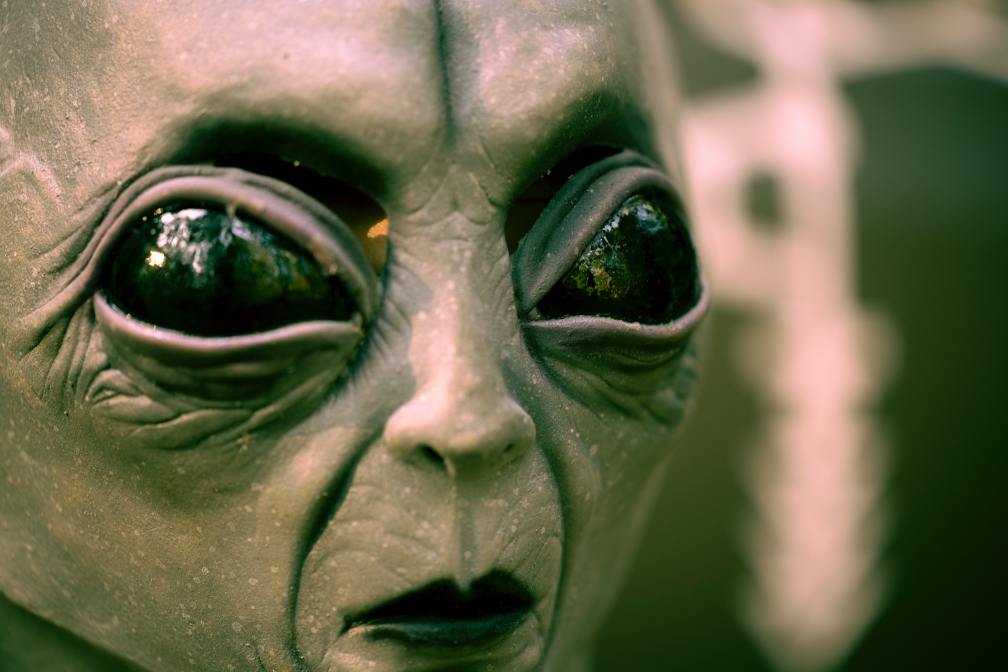
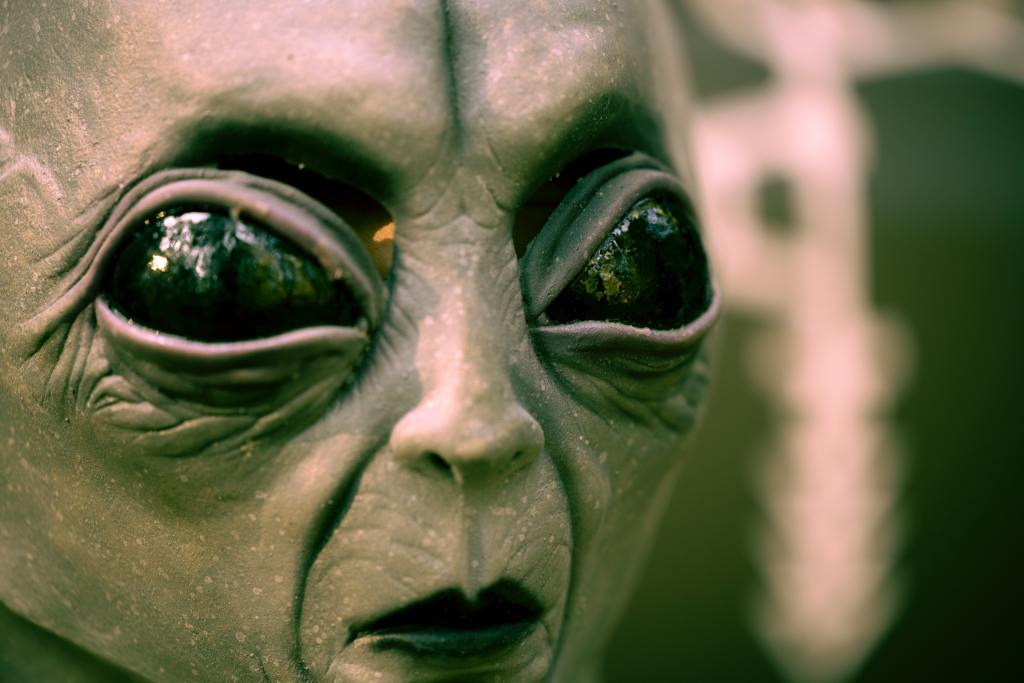
Close up of an extra terrestrial being’s face
Photo by Stephen Leonardi

In linguistics, the term displacement refers to the capacity of human languages to communicate information about what’s not immediately present in the here and now.

Tom’s wife didn’t say anything about his clerical collar until after breakfast, and then she didn’t reference it directly.

‘Making visits today?’ She raised her eyebrow, just perceptibly, and refilled their coffee mugs.

‘Just one.’

She waited.

‘Nat Greer’s in the Oaks. It’s Alzheimer’s.’

‘Your old Sunday School teacher,’ she said.

He marvelled at the capacity of her memory, her willingness to absorb the banal trivia of his life, and more importantly, the stoic self-restraint she showed by not voicing her disapproval. The point of him taking a sabbatical was to spare him from the parts of his job most likely to bring about depressive episodes. Bedside visits with the elderly counted among these.

‘Bring those comic books you used to talk about. They might bring back some of his long-term memories.’

Tom placed two copies of Galactic Discoveries on a coffee table in the front parlour of the assisted living community. ‘Greta said you might want to see these,’ he said. Somehow his wife had remembered that he and his friends used to hide them in their bibles during Sunday School.

The sight of the comics lit a spark in the elderly man’s eyes. ‘Tell me about the Tower of Babel!’ he commanded.

Tom grinned. ‘In ancient times,’ he said obligingly, ‘the people built a tower to bring them closer to God. God destroyed the tower, and to punish the people for their hubris, he made it so that they could no longer understand each other when they spoke. That’s why there are so many different languages on earth today.’

‘Incorrect,’ declared Nat Greer, with undisguised glee. ‘Babel wasn’t a tower. Towers go up, from earth to heaven. Babel went from heaven to earth, like a beam of light.’ He nodded toward the coffee table.

The cover of one of Tom’s magazines showed greyish green aliens descending to the ground in a tunnel of light beaming from a floating saucer. 

Seeing the image through Nat Greer’s eyes fired Tom’s imagination, and he remembered the excitement he’d felt at Sunday School on the day he’d been caught sneaking peeks at his comics. Mr Greer made him read passages from Galactic Discoveries aloud, as a punishment. But soon the teacher decided the science fiction stories held more compelling lessons than the bible itself, and Sunday School became the most anticipated event of young Tom’s week. 

It was Mr Greer, he’d often thought, who was singularly responsible for Tom’s vocation. For better or worse.

When he looked up again, Nat had shrunk inside himself, and the plush armchair seemed to envelop him. His eyelids dropped, and a thin line of drool escaped his gaping mouth.

Tom called for a nurse and left the home.

He returned to the Oaks the next morning, and the morning after that. Most days Nat Greer was unresponsive, but every once in a while the light would return and he’d share some strange insight with Tom, always about Babel.

‘It wasn’t a punishment,’ he said. ‘The beings who came down through the tunnel volunteered to forget their common language.’

‘The Tunnel of Babel,’ Tom mused. It might make a good sermon title, when he started preaching again, after his sabbatical.

‘More like an umbilical cord than a tunnel,’ Nat said. ‘It keeps everyone safe and nourished. Everyone but the volunteers.’

‘The volunteers?’

‘Us. You and me. Them.’ Nat nodded toward the other residents, shuffling behind walkers, and the nurses accompanying them.

‘We volunteered for this?’ Tom said, incredulous.

Nat nodded many times.

‘We volunteered to have our umbilical cords cut?’ Tom asked, but received no answer. His Sunday School teacher had nodded off to sleep.

Tom returned every day and asked the same set of questions.

‘Why would we volunteer? Why would we agree to cut ourselves off from our connection to…’ Connection to what? He had no access to precise enough language. ‘From our connection to God?’

One day, finally, Nat was alert enough to thumb through the copies of Galactic Discoveries that Tom unfailingly brought with him on his visits.

‘We wanted to discover new worlds,’ he said. ‘And the Beings who inhabited them.’

Tom shook himself from his reverie in just enough time to realise Nat was finally responding to his questions.

‘We volunteered to cut our connection to God…?’ he asked.

‘We volunteered to cut our connection to everyone and everything,’ said Nat, ‘so we could discover it anew.’

The next time he went to The Oaks, he learned that Nat Greer was dead.

That night he and Greta shared a bottle of Chablis on their back deck after dinner. 

‘Do you think it’s a punishment that the people of the world all speak different languages?’ Tom asked.

‘Are you talking about the Tower of Babel?’

The first full moon of the summer had risen above the distant treeline. It cast an eerie beam of light on their dark lawn.

‘The languages in that story might be a metaphor,’ Greta said. 

‘For what?’

‘For each human being’s distinct, impenetrable subjectivity.’

Tom blinked.

His wife had just articulated the anguish that had led to his most recent crisis. That no one would ever see him. That his views were not welcomed. That he existed only to fulfil society’s ideas of what he should be.

‘Do you really believe that we’re closed off from all experiences but our own?’ he asked. The words came out strained, like his vocal cords were being cut.

‘Does it trouble you that I believe that?’ she asked.

‘I thought out of everyone,’ Tom confessed, ‘that there was at least one person who understood me. At least you.’

She spoke no words, but placed her palm on the back of his hand.

He felt a connection open between them, like a beam of light, or a tunnel, like a discovery renewed.

Would you like to know more about this story? Watch the video I made about it.

Coyote’s trick

Photo by Ben Hershey

Grammaticalization often corresponds to language change processes where linguistic expressions shift from objective to subjective meanings.

In the beginning, before there were people, the world was made of language. 

The buds on springtime hawthorns were unvoiced plosives. The caterpillars on their branches, focused interrogatives.

Tortoise was a non-finite clause.

One day, he decided to make people.

‘What will you make them from?’ Coyote asked. 

‘Water,’ said Tortoise. He thought it a good choice because it flowed within and around all the world’s linguistic forms. 

But the water people wouldn’t hold their shape. Making one was easy enough, but when he tried to make more than one, they merged into one another and lost their individuality.

Coyote laughed at Tortoise’s failed attempts. 

‘To keep each of your people unique,’ he advised, ‘you’ll need to make containers for them.’

‘What should I use to make the containers?’ Tortoise asked.  

‘Language,’ said Coyote.

So Tortoise set off on a long journey, gathering samples of the earth’s language from all the four directions. When he returned, he ground the language into dust. He moistened the resulting powder to make clay, which he shaped into vessels. These contained his new people beautifully. 

Pleased with his work, he settled in for a much needed rest. 

While Tortoise slept, Coyote crept in secret to the place where the new people lived. 

‘I know something,’ he whispered, ‘that Tortoise hopes you’ll never discover.’

The people looked up in surprise. 

Gently Coyote reached inside their mouths and scraped out some dried clay with his sharp claw. The fine dust in his outstretched paw caught glints of sunlight and sparkled before them. 

‘This is language,’ he said. ‘You’re the only creatures who have it. With language, you can rule the world.’

When he woke up from his long sleep, Tortoise saw the results of Coyote’s trickery, and he despaired.

Would you like to know more about this story? Watch the video I made about it. I also discuss ‘Coyote’s trick’ in Episode 64 of Structured Visions.

The oppressive instability of being

As deictic expressions are frequently egocentric, the center often consists of the speaker at the time and place of the utterance and, additionally, the place in the discourse and relevant social factors.

When Amy heard the classroom door open at the end of the school day she kept her focus on the surface of her desk. The unexpected visitor was likely to be Lydia, who didn’t do well with eye contact.

‘Miss?’

In her peripheral vision Amy could just make out the dishevelled dark curls that framed the girl’s ashen, spot-ridden face. She noticed the crevices that had worn into her forehead, the eyebrows tensed above deep-set, troubled eyes.

‘Yes, Lydia?’ Amy fixed her attention on the English language worksheets she was marking.

‘We’re making time machines in History, Miss.’

‘Time machines,’ repeated Amy, in the slow, deep tone that kept Lydia calm. In the subsequent silence she tried to recall the details of Gareth Jacobs’s most recent pedagogical experiment.

‘I can’t go back in time, Miss.’

Gareth wouldn’t have anticipated that Lydia would be troubled by this project. Nobody could have. None of the teaching staff knew quite what to do with Lydia. She’d mystified the specialists.

Even Amy, the only teacher Lydia had ever opened up to (if these regular after-school interactions counted as ‘opening up’), could rarely put her finger on what specifically triggered Lydia’s manifold anxieties. She certainly couldn’t understand what was troubling her about this particular project, and why it had only occurred to her to worry about it now.

She pictured the child-constructed cardboard monstrosities that were currently cluttering Gareth’s classroom. She caught a glimpse last week of pupils fastening flimsy foil pie plates onto the tops of the packing crates Gareth had somehow acquired. Satellite dishes, she guessed. By now they’d have moved on to the interior design stage of the project. She pictured dashboards sticky with glitter and glue, plastic dials repurposed from board game spinners, which the time travellers could adjust to set their course in their journey to the past.

Lydia’s hands covered her face now. She looked out through the gaps in her fingers.

Amy imagined those same fingers positioning a red plastic arrow to point toward some date from the Year 7 History curriculum—1066, or what year was the Gunpowder Plot? 1605. She wondered which historical period would trouble Lydia most. Did they do slavery in Year 7?

‘You can’t go back in time?’

She rifled through the language papers to take the pressure off the child. They were grammar worksheets, designed to help the pupils conceptualise tense and aspect. Her own pupils had completed the task complacently, if unenthusiastically, colouring in expansive rectangles on a timeline for past progressive and restrained, no-nonsense black dots for past simple. I was minding my own business when you interrupted me. The arrow on the timeline pointed backward, to what had come before the present moment.

None of her children had been troubled by anything about the exercise, not the linear illustration of time, not the leftward pointing arrow illustrating the infinite ineffability of time gone by.

‘Miss, if I go to the past, I won’t be there.’

Amy shifted her gaze from the grammar papers to the anguish on Lydia’s face, and it hit her. The other pupils did not worry about time travel because they had no experience of the precariousness of their own existence. 

So rooted were they in their solid notions of selfhood that they could not see it: any point on the timeline to the left of 2010 indexed a world that ruthlessly refused to contain them.

What could she say to Lydia now that would relieve her of the oppressive instability of her being?

‘How do you think time machines work?’ she asked.

‘You get inside them, and they travel to the past.’

‘Is that the way Mr Jacobs explained it?’

The fingers moved from Lydia’s face to below her chin. ‘I can’t remember,’ she admitted.

That was fortunate.

‘Time machines don’t actually travel through time,’ Amy said, committing her own words to memory so she could brief Gareth later. ‘The way they work is by establishing a deictic centre.’

‘A deictic-’ 

‘Centre,’ Amy confirmed. ‘The time machine produces a sort of force field around you that says you are here now. That keeps you safe and secure. Centred, right?’

Lydia dropped her hands to her sides. ‘So how do you get to the past?’ she asked.

‘You don’t,’ said Amy. ‘Once you’re in your deictic centre, you bring the past to you. You sort of reel it in, like a kite.’

Amy watched this explanation lock into place.

‘OK, Miss,’ Lydia said, and she’d left the room before Amy could say more.

For many long moments Amy found herself staring at the space that had once contained Lydia.

She felt a gripping sensation in her chest, like a fist clutching a reel of lengthening string, the kite flying farther and farther away, a black dot against an insatiable sky.

Would you like to know more about this story? Watch the video I made about it.

The first person

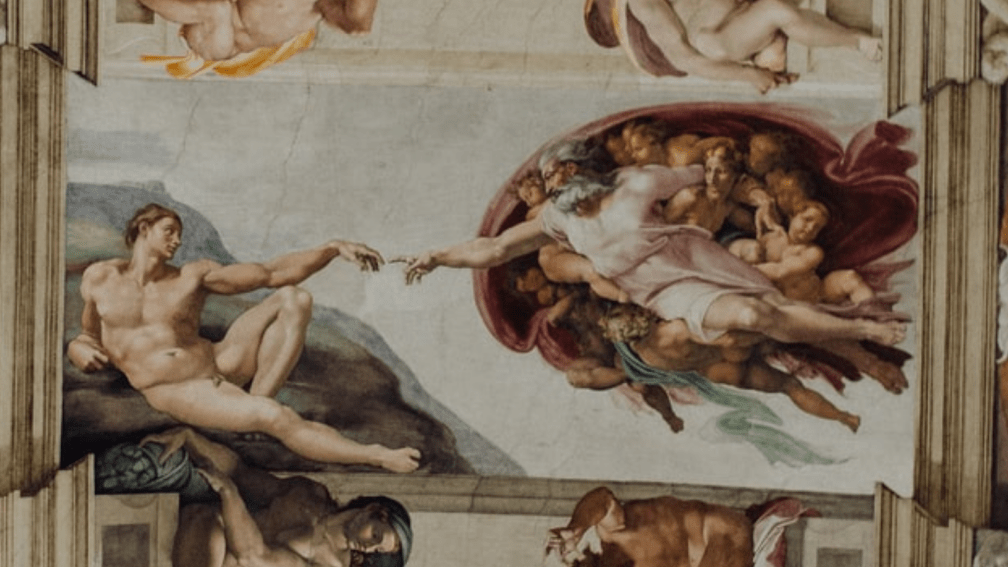
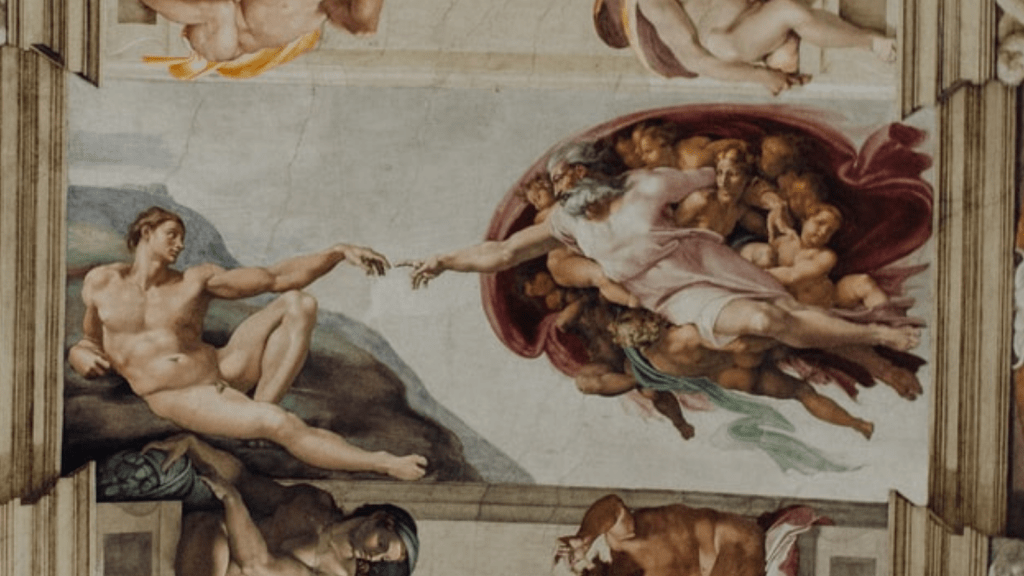
Close up of the Sistene Chapel: The Creation of Adam
Photo by Calvin Craig

Grammatical personhood has to do with levels of involvement in a linguistic expression. English and many other languages have three levels of personhood. It’s possible to have more than three levels of personhood. Blackfoot, a Native American language, has five.

At the end of the school day Zoë’s mother was waiting at the gates to walk her home. ‘Who was the first person?’ Zoë asked.

‘The first person to do what?’

‘Just, the first person. The first person there ever was.’ Her friend Holly had told her that the first person was called Adam, and he was made by God out of dust and he named all the animals. It was absurd—how could anybody know who the first person was? The thought made her head spin.

‘That sounds like a question for Uncle Joe. You can ask him when we get home.’

‘Uncle Joe’s here?’ It was always exciting to hear that Uncle Joe had stopped by, out of the blue, to stay with them for a couple of days. Uncle Joe was the best person she knew. He was big and furry, like a bear. He was also a little bit mad, but not in a scary way.

She found him sitting in the conservatory drinking a mug of milky tea. She gave him a bourbon biscuit to dunk. ‘Who was the first person, Uncle Joe?’ she asked.

When he smiled his whole beard moved, like a hedgehog waking up.

‘The first person isn’t an actual person, Zoë. It’s a concept.’

His eyes were like tiny blue eggs hidden in a nest of eyebrows.

‘It wasn’t some guy called Adam?’ She couldn’t wait to set Holly straight.

‘Well, it might’ve been called Adam. Concepts can have names. Most of them do.’

He’d left the biscuit too long in his tea. He pressed the remaining bit into his mouth. Some soggy crumbs lingered on his moustache.

‘So tell me about the first person,’ Zoë said.

‘The first person is a linguistic construct. Linguistic means language,’ he remembered to tell her. ‘In the beginning, language flowed over the earth, like the weather. It passed over everything, living and non-living, like the wind and rain, always in motion, always changing.’

Zoë had learned weather patterns in science class. They’d watched a video of clouds moving over the globe. She ate another biscuit and waited.

‘Then one day, language got stuck.’

‘It got stuck? How?’ The weather never got stuck—not in any of the videos Zoë had seen.

‘It got sucked into a human body, and the language thought that body was its own. The body and the language together began to imagine that they were a person. Me, me, me, me, they said. They thought they were the first person.’

‘Were they called Adam?’

‘Maybe,’ said Uncle Joe.

‘So who was the second person?’

‘There were lots of second persons,’ Uncle Joe said. ‘Every time the language-body saw another human body, it called that human body you. You, you, you, you. And each time that happened a little bit of language would enter into the second person, and they would believe they were the first person—me, me, me, me.

‘Wait. Were all of them called Adam?’

‘Probably not.’

‘Oh.’ Zoë wondered what it would be like to think you were the first person when you weren’t. ‘So how did language get unstuck?’ she asked.

Uncle Joe watched the swirling chunks of biscuit drowning in his mug. ‘It didn’t,’ he said. ‘Language stayed stuck.’ A heavy sorrow passed over his face, like a dark cloud, unmoving.

‘Oh,’ said Zoë. For a brief moment she knew how her uncle felt, like something exquisitely precious had been lost, like the only hope of retrieving it would be for everyone to go a little mad.

Listen to my podcast episode on this story here.

Kwinchuk

Cracking white paint
Photo by the blowup

There are two forms of the passive voice in English: the BE passive and the GET passive. With GET passives, the meaning is ‘dynamic’, which means it expresses an action rather than a state.

Tania Bettleheim can’t remember her PhD supervisor’s name. It’s awkward. She should have glanced at the plaque on the office door before she came in.

She was too excited about her discovery to think of it. She’ll have a look on the way out.

‘So Kwinchuk lacks a copular verb, that’s what you’re saying?’ asks what’s-her-name.

Tania nods enthusiastically. It had been a eureka moment to figure that out, after the painstaking weeks she’d spent acquiring enough of the language to begin to chart its grammar. No one before had studied Kwinchuk. It would have been humiliating to come back with nothing.

But she hasn’t come back with nothing. She’s come back with a linguistic discovery of monumental import. The copular verbs thing is just the beginning.

Her mentor seems unconvinced. ‘I’d have expected in such a case for the copula to be inflected on a stative adjective stem. Did you consider the possibility of an unmarked zero form?’

‘It’s not zero marked,’ Tania insisted. ‘There’s a verb in the copular slot.’

‘A verb in the copular slot is necessarily a copular verb, Ms Bettelheim.’

‘But Professor, Professor, ehm…’

Perhaps this conversation would be going better if there weren’t so many distractions. Like not knowing what to call her supervisor. And those cracks in the walls. Tania’s sure these have been expanding in the course of this meeting, thin grey lines branching through the white paint like tree diagrams, growing more complex with each passing second.

‘Copular verbs express stative meanings,’ Tania explains. ‘The verb that appears in that slot in Kwinchuk is always dynamic. The nearest equivalent in English I can find is auxiliary “get”. In Kwinchuk it is impossible to say something like “I am happy”, except to express it dynamically.’

‘I get happy?’ suggests her supervisor.

‘Exactly!’ says Tania. She can tell her enthusiasm is not shared. The cracks in the walls are still spreading. Chunks of plaster are dropping from them. Her supervisor mindlessly stirs the falling white powder into her coffee.

‘Where’s the evidence of equivalence with the English “get” auxiliary?’ she demands.

‘It’s consistent with how the Kwinchuk experience their world,’ Tania argues. ‘Nothing for them is ever at rest, nothing ever simply is. Everything’s an event. Everything’s a story. A Kwinchuk has no way of saying something like, “That’s just the way things are.” They’d have to say something like, “Things got hard.” And so all their evaluations inevitably imply another eventive possibility, such as, “Things could get better.”’

It does not look as though Professor No Name thinks things could get better. The cracks in the walls have grown to gaping holes, and the masonry is now crumbling around them. The ceiling is buckling, and if Tania doesn’t leave immediately she’ll be trapped in a pile of rubble.

If she turns back now in her flight, she’ll catch a glimpse of the plaque that has fallen from the Professor’s door. She’ll see her own name engraved upon it in gold-painted letters.

She does not look.

She gets away.