

Negative space

Greyscale photo of a couple kissing across a table. Their faces blur together. They're each holding a coffee mug.
Photo by Nathan Walker

What’s up with me and the intimacy issues? It was only my third date with Barry (coffee at the Students Union) and I’d just told him I was crazy.

We met at an interdisciplinary postgraduate conference. He said he liked my talk on negation in language.

What he actually said was, ‘I didn’t understand your paper, not one jot of it.’

His field was psychology, not linguistics, so his joke meant he’d been paying attention. I may have already been in love. 

So why the rush to tell him about the alien in my brain?

‘An alien talks to you?’ he said.

‘Yeah, he took up residence as soon as I landed on my thesis topic,’ I said. 

‘Correlation is not causality,’ Barry pointed out. 

‘He keeps asking annoying questions about my topic. He says in his language there is no negation.’

There is no negation? Isn’t that a perfect example of negation?’

‘Well, what he really said is There’s only affirmation. But we were speaking English.’

‘I don’t think you’re crazy,’ Barry said. ‘I think you have a very smart brain who’s created a sparring partner to help bring your brilliant ideas even further. Or else you really are in communication with extraterrestrial intelligence, which you should see as a great privilege.’

He had me at I don’t think you’re crazy

‘The negation is the affirmation!’ exclaimed my alien companion, with a distracting Eureka yelp.

I ignored this, leaning closer toward my human companion. ‘Can I kiss you?’ I asked.

‘I don’t see why not,’ he said, and I melted into the negative space his negative clauses revealed.


Would you like to know more about this story? I discuss it in Episode 97 of Structured Visions, ‘The intimacy of denial.’ You can also sign up to the Grammar for Dreamers newsletter to get monthly updates on the ideas that inspire my work.
Seeds of language

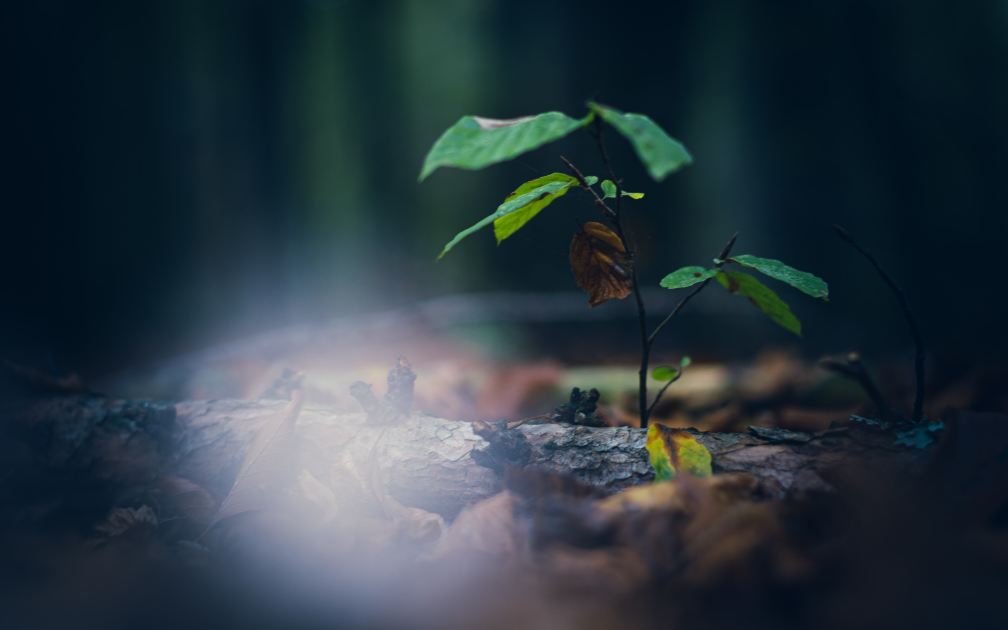
Image by Jannik Selz

I forgot Language.

Still, there it stands, against the decimated remains of a land ravaged by wildfire and warfare, on the site where we once lived as a young family, full of hope. It is all that remains alive.

I remember now.

We grew it from seeds we bought on eBay, back when eBay was still legal and the internet was open to all. ‘Seeds of language’, they were called, enticingly, but the scant product description offered no further clarification.

At the time we were teaching at the local university, before they closed down our department, then the whole university, then all the universities. 

We were both linguistics professors, so ‘Seeds of language’ intrigued us. We paid extra for expedited delivery.

‘Maybe they’ll grow into syntax trees,’ said my husband Jim, a generativist.

‘What does Noam Chomsky know about botany?’ I countered. ‘His trees grow upside down.’ I proposed instead a Saussurian species, which would wave coin-shaped signifier leaves, their signified undersides flashing suggestively in stormy breezes.

We sowed the seeds in pots in the greenhouse. We took a photo of the one that germinated and did a reverse image search to identify it.

‘Sapling,’ was all that Google could tell us. (This was when we still had Google). We named it ‘Language’ and planted it near the weeping willow behind our house. 

Soon after, we fled the country to protect our son Devon, whose gender made him an outlaw, just in time to squeeze through the nation’s tightening borders.

In the ensuing decades, I have forgotten many things. 

I am only now remembering Language.

A verdant desire sprouts from within my decomposing weariness: I want to dwell in the warm embrace of Language. I climb up to nestle in its welcoming limbs. 

Language envelops me. It roots me in its thrumming pulse. It evaporates the accumulated shame of my culture’s demise and the decimation of my own exhausted history.

‘Where have you been?’ Language wonders.

A bright new thought blossoms—that I’ve never, until now, inhabited Language—that it is only from within this sheltering space that self and culture will heal.

‘I have always been here for you,’ says Language, and tears form, flowing like sap.