Possessed

Wolf pack on a rock formation
Photo by Thomas Bonometti

Each fibre of fur is a strand of awareness. Each press of paw pad on the earth a moment of contact. We gather under the full moon in a sacred geometry as aligned with the astronomical expanses as any stone circle. The finely tuned notes of this howling symphony transmit the Earth’s wisdom to the stars.

A litter of freshly whelped cubs is both a miracle and a liability. We watch them each diligently, perhaps obsessively.

At the first sign of possession, a decision must be made. By what might the youngster be possessed? Can such possession be outgrown?

We’re on guard for clear signs the taint is growing stronger. Possession becomes apparent in the grammar of the cub’s eyes as he stares at the mother. ‘Mine,’ he thinks. He notes a unique fleck of white below the dam’s chin. ‘Hers.’

Possession destroys unity and must be stopped before it can grow. A merciful killing is sometimes required. Such measures pain us, though, and howls become mourning songs.

If we are travelling near a place where people live, we’ll sometimes deposit the cub on the threshold of a human dwelling. We stay distant, waiting for the cub’s new owners to discover it there, their miracle puppy, their adorable stray.


Would you like to know more about this story? I discuss it in Episode 79 of Structured Visions. Subscribe on Apple podcastsSpotify or wherever you like to listen.

Mood? Tense

Photo of a mountain climber scaling a rock face
Photo by Petr Slováček

My deepest desire?

To feel the rock beneath my feet. To allow the magnificent depth of the mountain to infuse my body, like last winter’s snow, pushing deep into the soil to gently soak the thirsty roots of ancient fir, water rising like sap, released into air, cooling the breeze.

The mountain, a repository of mysteries, its vaults of mineral histories, its secret rivers, the network of fine organic strands through the soil through which information flows generously.

If I could feel the rock beneath my feet, if I could allow such wisdom to resonate in the tightly sprung fibres of hamstring and thigh, if I could relax the hands that daily grip the rock face so intently they remain tensed, even in sleep… maybe then…

Always, I am climbing. Always, I am pushing ahead. Always I am stretching, ever higher, never resting. In sleep I dream of summits yet to be conquered. 

Maybe one day I will stop on the edge of this patient mountain, and in standing still I will be heir to its life-giving wisdom.

Messages

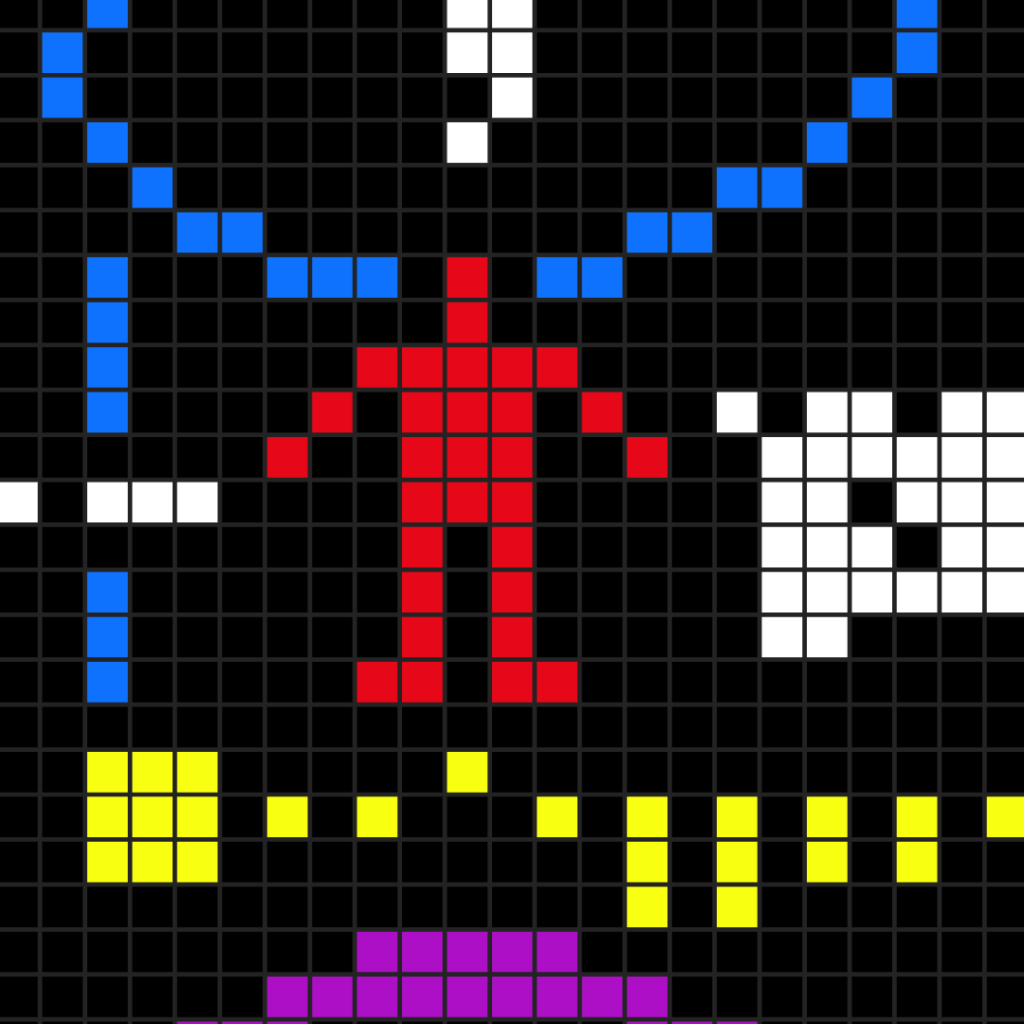
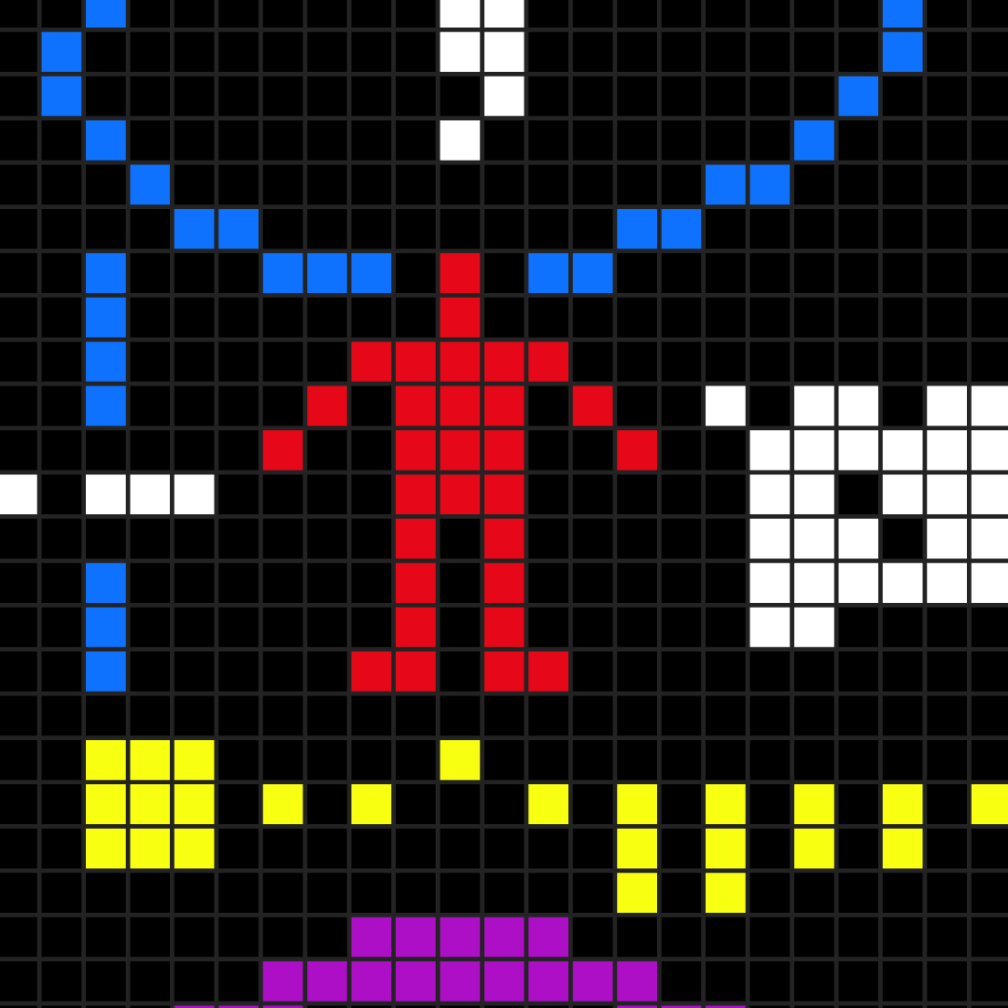
A red pixelated human shape against a black background
Detail from the Arecibo message (c) Arne Nordmann via Wikimedia Commons

We received all your messages.

The Arecibo transmission, with its funny pixelated stickman and the lessons in arithmetic and basic chemistry. Those Golden Records with the ambient sounds—not exactly Top of the Pops, but they all came through loud and clear.

We heard all the other desperate callings out, the less official ones, the ufologists gathering in the desert expanses, the midnight assemblies of Pleiadian starseeds, the campfire longings of Girl Guides staring for the first time into the unpolluted night sky, filled with awe and wonder, discovering the silent question that until this moment had lain dormant within them.

Is anyone out there?

The answer will put your tortured souls to blissful rest.

Yes.

We’re here. We’ve always been here, since the first time the earliest ones of you ever tried to make contact. We’ve always heard you.

But we had no way of responding.

The structure of your languages remained alien to us. For aeons we remained blithely baffled. Then the messages from your planet became too desperate for us to ignore.

So we undertook an extended period of diligent study until, eventually, we were able to identify the two principles that governed all human languages.

Principle #1: Transmission. Communication. Exchange. Dialogue. The idea that language is to be sent from one to another, to be received, to elicit a response. 

(Our language does not travel in this way. It is not directed from A to B like an arrow shot through space.)

Principle #2: Selves. Personhood. First person, second person, third person, singular, plural.

(Second person singular may as well have been sixteenth person multitudinous, for all the sense it made to us.)

We decided to create a self, one who could shape our language in such a way that it had the capacity for movement—so that it could be sent, from one self to another.

I am my world’s first self.

I have shot my world’s first reply to your messages.

And its second, third, fourth…. (I’ve lost count.)

My loneliness has become unbearable. I am adrift in the ocean of a vast night sky. The sky has always been vast, but never before was it empty. Never before was it so dark.


Would you like to know more about this story? I discuss it in Episode 78 of Structured Visions.

Grandmother’s broach

Young Black woman wearing chef's whites and an apron in an industrial kitchen
Photo by Jeff Siepman

Her grandmother’s mental decline has coincided with Lisa’s own intellectual ascendance. Soon after finding a discipline worth pursuing at master’s level—linguistics—Lisa lighted upon a topic for her capstone project.

She first discovered it when listening to Nana’s verbal ramblings. There’s a structure to them, she thinks, something she’s not yet seen discussed in the literature. 

The pattern becomes even clearer as Lisa transcribes the data. Her grandmother consistently speaks in clauses without subjects.

‘Worked in the bakery.’ Lisa took the recordings at her grandmother’s bedside in the assisted living facility. Now she meticulously captures the many times Nana has repeated this same subjectless utterance.

Finally she hears her own voice interrupt the pattern. ‘Who did?’

Her prompt seems to have pushed the conversation forward. ‘Always covered in flour. Head to toe in flour. Always baking, always kneading. I kneaded, too.’

Lisa pauses the recording, noting the first occurrence of a clause with a subject—the first person singular—and puzzles over her transcription of the past tense verb. Kneaded. She hesitates, reflecting on the homonym, and types [needed?] in brackets.

I needed, too.

The more she listens, the more she’s inclined to think need is the intended verb.

It’s a love story she’s recorded, she realises, and the baker lover is clearly not Nana’s husband. Lisa’s grandfather was never a baker, as far as she knows. He worked as a partner in his father’s law firm.

Like a detective pursuing a lead, she types out the subjectless clauses and rewrites them, filling in the blanks.

My first love worked in the bakery, she tries. He was always covered in flour. He was always baking, always kneading.

She plays the next segment.

Sixteen years old. Owensboro.

A quick text to her mother confirms her suspicions: 

Where did Nana live as a girl?

Owensboro, KY. Why do you ask?

Thanks! Will explain later. Lisa does not notice the family resemblance in her own subjectless reply. 

She Googles ‘Owensboro’. One fact about the town’s history stands out: it was the site of the last public hanging in the US. Families travelled from far and wide to enjoy the event, their children gorging on hot dogs as they watched the dead man swing. 

That was in 1936, the year Nana turned 16. The condemned was a Black man. 

She tucks the information away in the files of her mind. Best to avoid distractions, she thinks. She plays the next bit of the recording.

‘Head to toe in flour,’ she hears. ‘Used to tease me. White, like you.’

Lisa amends her transcript to place the last utterance in quote marks. Context dictates that it would have been the baker lover, not Nana herself, who was covered in flour. ‘White, like you’ would have been the teasing remark.

What she now knows about the dangers of Owensboro, Kentucky in 1936 has pushed itself tenaciously to the forefront of her mind, like the noun phrase at the upper left position in the top branches of a syntax tree. The subject.

If her grandmother’s lover teasingly described his flour-covered self as ‘White, like you’, then Nana’s first love could not have been, himself, White.

The next line of the transcript reveals a subject even more taboo.

‘Warm and sweet. Breasts like cinnamon buns.’

Her headphones convey the girlish giggles of her former, senseless self. ‘It’s probably not a good idea for me to write about your breasts in my paper, Nana.’

Her grandmother’s response travels forward, to the future subject, whose ears are pricked to pick up what her earlier version could not hear.

‘Not my breasts. Hers.’

With the possessive feminine pronoun, Lisa realises, her grandmother has revealed the missing subject. The subject itself possessive and feminine. The subject as object—of a forbidden love story, Black and female, lost to time and history, like so much that is Black and female, never broached until now, in this place of syntactic safety, where words will no longer condemn.


Would you like to know more about this story? Check out my behind-the-scenes post on Patreon.

Syllables

Photo of La Machine, a dragon robot produced for a street theatre production
Photo by Laith Abushaar

It was a mythical land, the dragon was merciless, and steadfast warriors set out regularly on reckless quests to slay it.

Its power to destroy lived, as with all such beasts, in its breath. It breathed not fire, but syllables.

These eggs of sound resonated so enchantingly that even just one had the power to madden its hearer on the spot. Some would-be slayers fell on their own swords and perished. Others simply dropped in a fatal swoon, limbs limp and eyes agog, never to be revived.

Eventually the Queen herself broached the beast, with armour and blade and, in a stroke of pragmatic genius, woollen plugs to stop her ears. The brutal battle lasted a night and a day. When the dragon gasped its last breath and the Queen claimed her hard-won victory, she unblocked her ears and walked among the mad warriors, whose bodies lay wasting on the path. The few whose lives still clung to them she entrusted to her own private healers. In time they were restored to vitality and sense, and they took up their lives once more among their people.

No one ever heard these fallen heroines speak of their misadventures. Still, it was said that at the dark of each new moon they gathered together in secret to speak their common language, built piecemeal from remembered remnants of the dragon’s awe-striking syllables.


Would you like to know more about this story? I discuss it in Episode 77 of Structured Visions.

Astray

computer cell processer
Image by Brian Kostiuk

The only thing Chuck Quince can remember about his trip to the future was that they’d invented a machine that could make a book as big as the Bible so small that it would fit on the head of a pin.

The idea of all those verses pressed together so tightly made Chuck nervous. Important words could get squeezed out, like the ‘not’ in ‘Thou shalt not commit adultery’, and folks would be led astray.

It was bad enough knowing that time folded over on itself, and that all it would take to shoot him onto some future layer was making it to the bottom of a couple of jars of Jim O’Grady’s moonshine.

But all the words of a whole book curled up all together, small as a mustard seed?

Surely the meanings would get twisted too, like the twists and turns of fate, like the confounded syntax of Chuck’s roiling thoughts.


Would you like to know more about this story? Check out my behind-the-scenes post on Patreon.

The woodcarver

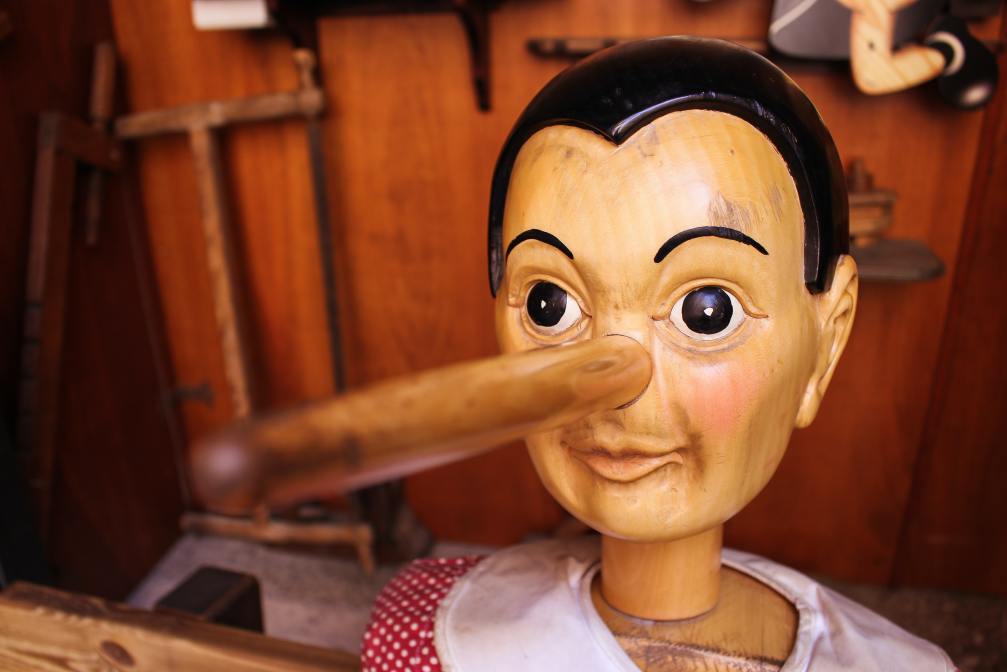
Photo of Pinocchio puppet
Photo by Jametlene Reskp

All my puppets could move without strings, and all could speak, but none of them could lie.

The lie itself was trivial—he wasn’t the one who stole Antonio’s caramels. But when the words escaped Pinocchio’s painted lips—when he discovered he’d released an utterance that did not match consensus reality—it excited him.

Sexually, I mean. 

Let’s say his ‘nose’ grew.

This manifestation of his delight embarrassed him so much I feared he’d never dare stray from the truth again, and all my hopes would be dashed.

So I taught him the secret of language that none of my other puppets had ever been able to grasp.

I taught him ‘might’.

He was a quick student, and I was quick to test him. ‘Did you take Antonio’s caramels?’ I asked.

A hesitation. The smooth pine globes of his eyes glanced tentatively from dropped balsa eyelids. ‘I might have,’ he said.

My heart leapt precipitously. I forced myself not to celebrate too soon. ‘Or else…’ I prompted.

‘Or else…’ The mandible lowered to form the shape of a wooden grin. ‘Or else… someone else might have taken it,’ he ventured.

My own widening smile encouraged him.

‘Or it might have been whisked away by a mischievous crow. A talking crow! He might have eaten the caramels! His beak might’ve been stuck together, like glue…’

Ever since that morning of reckless fiction, Pinocchio has been my favourite, my darling, the liar, the storyteller, creator of worlds.


Would you like to know more about this story? I discuss it in Episode 76 of Structured Visions.

YES/YES

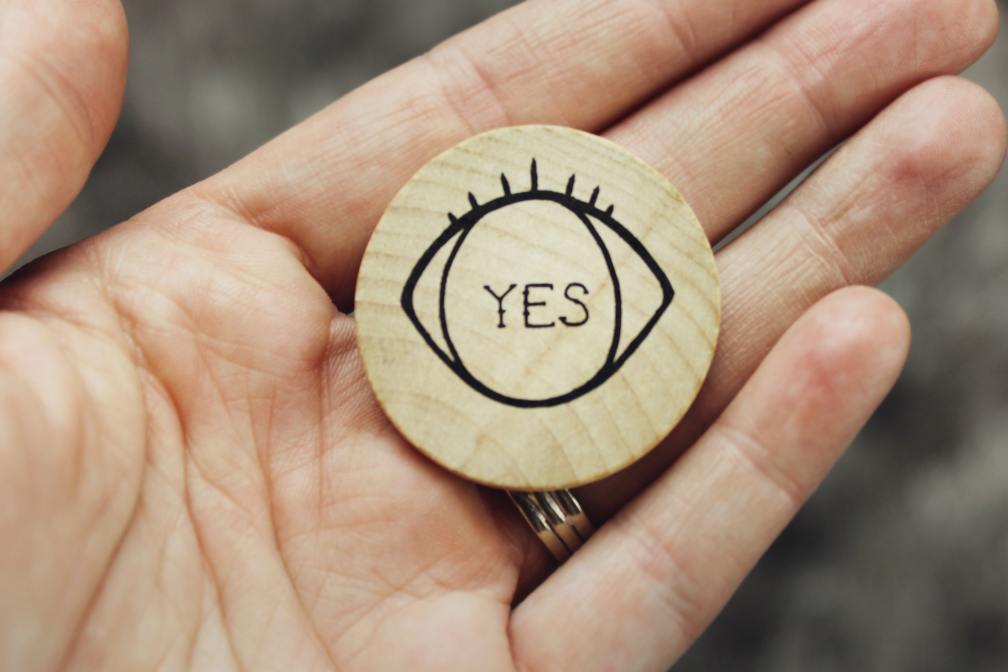
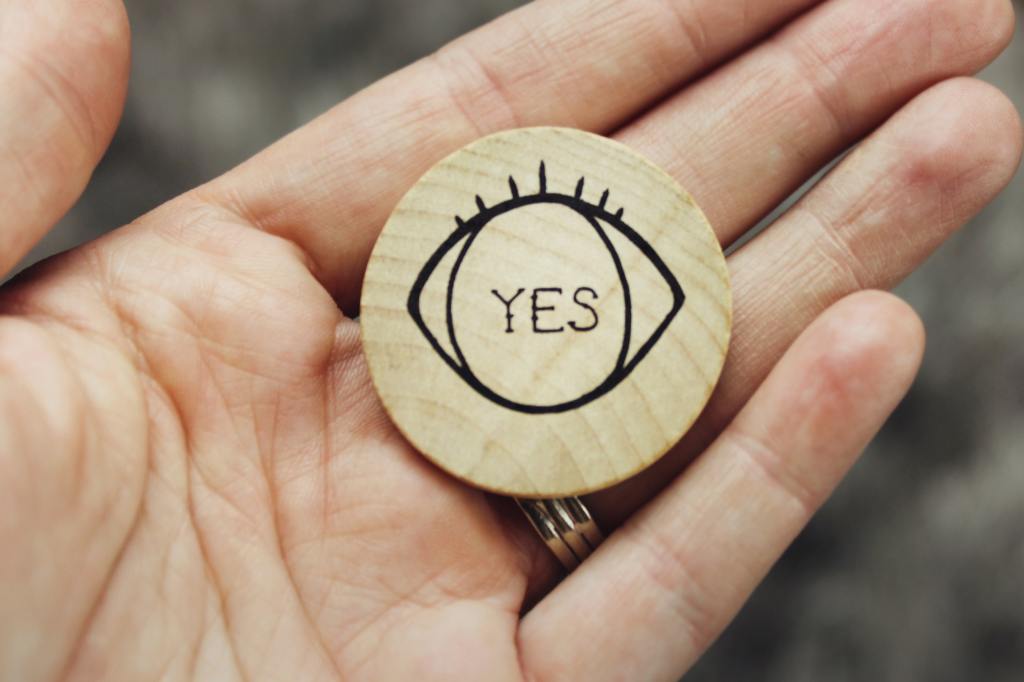
Round wooden coin with eye detail and word, text "yes" printed on it, held in the palm of a woman's hand.
Photo by Jen Theodore

‘Your problem is linguistic,’ said my therapist.

‘What?’ I hadn’t even told her my issues yet. She was the last in a long line of practitioners. So far I’d been diagnosed with ADHD, autism, Lyme’s disease, a gluten allergy and a leak in my third chakra.

I thought she was talking about neuro-linguistic programming, which I’d also tried, with as little success as every other suggested treatment.

‘You have no irrealis modes and no negative polarity,’ she said. ‘Everything for you simply is. Everything exists. And the intensity of all that existence is oppressive. Am I wrong?’

She wasn’t wrong, but when I tried to tell her she held up her hand to silence me. ‘Drink this,’ she commanded.

There wasn’t any question of refusing. The prospect of imbibing the foul potion had already formed itself as a real proposition in my mind. As my astute diagnostician had observed, I was constrained by the compulsion to comply.

I downed it in one swallow.

The resulting display of gagging and retching delighted my therapist, who was now pounding my back with hearty open-palmed thumps. ‘Go ahead and cough it up,’ she said.

When eventually I heaved an acerbic excretion into the paper bag she’d pressed before my face, she gave a bright cheer.

‘Good for you!’ she enthused, wiping mucus from a small shiny object. ‘Just as I suspected.’ 

The unlikely midwife of this revolting mystery presented my issue to me with unadulterated glee.

It was the size and shape of a fifty-pence coin, and it was embossed like a coin—not with the queen’s head, but one word in stalwart capital letters.

YES.

Intrigued, I flipped it over, expecting a ‘no’ on the other side. Instead I found the same word on both faces. 

YES/YES.

A profusion of affirmation, with no way of distinguishing heads from tails, no negative denial to balance the positive assertion.

Positive polarity, my therapist confirmed, with a profusion of realis.

‘It never gives you a break. Everything you imagine becomes real—or you suffer until it does. And you suffer after it does, too.’

‘Am I cured now that this is out of me?’ I asked.

She shook her head. ‘It’s a linguistic problem, remember? There’s only one way to cure a linguistic problem, and that’s with more language.’

She produced a small square envelope made of something that looked like silk. ‘Get that back down you, as soon as you can.’

Mercifully, the glass she now proffered was filled with water, and I swallowed the silk-covered coin with ease.

I felt better instantly. ‘What was that?’ I asked. The omnipresent, relentless urgency had been replaced by some more calming, more hopeful state—a curiosity, perhaps.

‘I wrapped those devilish yeses in a little blanket of maybe,’ she explained, and sent me on my way.


Would you like to know more about this story? I discuss it in Episode 76 of Structured Visions and in a behind-the-scenes post on Patreon.
First words

Each group of Earth-bound souls starts with a Seer. The Seer precedes their births and survives their deaths. The Seer is their centre, whether they acknowledge it or not.

I am the very first Seer of the very first human group.

What were they like?

Have you ever watched a baby gazing blissfully at airborne dust suspended in a beam of sunlight? Imagine a set of souls with that level of sustained rapt attention, all the time. Their fascination had no ‘off’ switch. 

Imagine a single blade of grass. Now imagine it in its startling specificity—the unique pattern of leaves shooting at varying lengths from its pliable stem. Now imagine its shifting design as it catches a passing breeze. Now note the shifting hues of green graced by the dizzying dance of light and shadow.

Behold with wonder the boundless universe within a solitary leaf blade! Are you foolish enough to believe you have the capacity to contemplate a whole field?

My task as the first Seer was to limit the vision of the souls within my little human group. To reduce the infinite distinctions of the overwhelming multitudes their senses absorbed.

I achieved it by teaching them the first words of what was to become their language. Just three words in the beginning: One. Two. And many.

One, two and many taught the human souls to focus their attention, to see the world as comprised of things, and to lose the distracting eternity of ever changing possibilities.

One, two and many engendered the world of human concepts.

Thus I’d fulfilled my mission as the first Seer.

Ah, but many an evening, as dusk descends, I find myself longing for that early time, before those first words, when the world was known in all its innumerable faces.


Would you like to know more about this story? I discuss it in Episode 75 of Structured Visions.

Nothing doing

Greyscale photo of little boy in striped shirt
Photo by Naira Babayan

‘Daddy, you shouldn’t say that word. It hurts Okkers’s ears.’

‘Tell Oscar there’s nothing wrong with doggie do,’ I said.

I’d just stepped in a steaming pile of canine shit and wasn’t in the mood to argue linguistic politeness with my son’s imaginary friend.

‘He says you should say poo instead. And his name is Okkers, not Oscar.’

Ordinarily I’d have been fascinated by Oliver’s selective metathesis, but the word metathesis reminded me of thesis, which reminded me of the PhD I still hadn’t finished, on child language acquisition of all things. 

As it turned out, logophobia was running in our family, if family extended to invisible members like Okkers. Days after the doggie do incident I was still being policed on my use of the offending word.

I assumed it was its noun form that was considered indecent. It turned out Okkers found it equally offensive in its more common use as a verb. 

You’d be surprised at how often you use the word do. Still, testing Okkers’s sensitivities offered a welcome, and not entirely off-topic (or so I told myself), distraction from my thesis.

‘Is Okkers offended by the auxiliary and the main verb use of the verb?’ I asked Oliver.

‘What’s an Ox Hillary?’

‘Like, when you’re posing a question in the simple aspect. Do you want an ice cream, for instance.’

‘Ew! Stop!’

‘You don’t want an ice cream?’

‘Stop it!’ (Clearly the negative contraction was also a problem for Okkers. I provided the promised ice cream to make up for my linguistic missteps.)

The ever perceptive Okkers noticed every form of do, not just auxiliaries and negative contractions, but also inflections for person and tense (does, did), and when used as a pro-verb, as in What are you doing? He took particular issue with the participles (doing, done). He could spot these from a mile away.

Our conversations around the topic became so fascinating that I made space for both of them in my office. We spent hours discussing the intricacies of the taboo word, ingeniously avoiding voicing it, forming ever more convincing hypotheses about its unfortunate omnipresence in the English language.

My wife became suspicious. ‘What are you going up there?’ she shouted from the hallway. We’d locked the door. ‘Are you getting anything done?’

Together we groaned, the three of us, with murderous intent.


Would you like to know more about this story? Check out my behind-the-scenes post on Patreon.