A hand writing the word 'ENGLISH' on a green chalkboard.

Modal auxiliaries

The life that passes before Ada Hasselback’s eyes in the moments before her death is less flash and more slow motion—at least for one scene too commonplace, she thinks, to merit such an effect. She’s standing, defeated, at the front of a classroom, looking out at a sea of bored teenage Spanish faces. From the chalked words on the dusty board behind her it is clear she’s teaching them English modals.

can
coul
d
shall
should
will
would
may
might
must

The students talk amongst themselves, oblivious to her inept attempts to interest them. At 22, with no prospects beyond this year-long post, she is already a failure. Her college boyfriend dumped her soon after she moved to Barcelona. She’ll return to Tallahassee with nothing to show for herself but the scars of self-pity.

A face through the window of the door at the back of the classroom. It brightens to recognise her. She brightens, too. It’s Adam, her fellow language assistant, from Dublin. He moves a hand to his lips, mimes going for drinks.

The film speeds up through the next few passionate weeks. She begs the divine director to linger over those blissful afternoon organisms in Adam’s mouldy studio in the Eixample—recalls how for many years after the smell of damp will stir her. But alas, what remains on the chalkboard of her dying mind are those persistent modal auxiliaries—can, could, shall, should. The vertigo of what might be, the devastation of what could have been.


Would you like to know more about modal auxiliaries, or other aspects of grammar? Check out my courses on jodieclark.com.

Grayscale photo of graffiti on a bridge.

A glimpse

Greyscale photo of graffiti under a bridge.
Photo by Toni Reed

When God visits the Earth (which isn’t that often) he tries to avoid human populations. They’re flooded with language, which he never bothered to learn.

But last Tuesday somebody spotted him under a railway bridge in Southwark, getting some homeless drunk to translate the graffiti.

The deity, having no concept of subjects and objects, struggled at first to make sense of Jimmy loves Paige. But a swig of the tramp’s Special Brew dimmed the exalted one’s consciousness just enough to see the point.

‘They see themselves as separate,’ he mused. ‘And they’re trying to come back together.’ He placed his finger on the concrete, tracing the heart-shaped line that circumscribed the message. 

‘Nope,’ said the tramp, no stranger to setting divinities straight. ‘They don’t know who they are at all. And in the other, they catch a glimpse.’

A tear slipped onto the omniscient cheek. Never before had he known not knowing, the bewildering plunge into chaos that dropped him now unswervingly into love.


Would you like to know more about this story? I discuss it in Episode 112 of Structured Visions. You can also sign up to the Grammar for Dreamers newsletter to get monthly updates on the ideas that inspire my work.

Golden grass covered in dew.

Possessive

Golden, dew covered grass
Photo by Johnny McClung

‘I’ve started talking to Proto-Indo-European.’

‘You mean you’ve started talking in…’

‘No. Talking to,’ Cassie insists. ‘I’ve personified the language. I call him Piedas.’

They meet every Friday at Lenny’s for happy hour to complain about their PhDs, how far behind they are, how mad they’re going.

‘Midas? Like the king with the golden touch?’

Cassie chews on a mojito-drenched mint leaf. She knows Beth will never understand her obsession with the noun-based languages that Proto-Indo-European generated. She never should have mentioned Piedas.

‘Like Midas, but everything he touches turns to nouns.’

It troubles Cassie that 40 percent of people, herself included, are doomed to see the world in terms of nouns. Things. Isolated, rigid, commodified. Bought, sold, stolen.

‘PIEdas. Proto. Indo. European. You’ve got to be kidding me,’ Beth says. ‘Happy hour’s almost over,’ she hints.

Cassie rises unsteadily and joins the clamouring mob at the bar. Foolishly she closes her eyes and allows the invading nouns— elbow, glass, noise, light, exhaustion, panic—to transform into verbs. Gush, swirl, flow.

She sinks, as into a river, like Midas, who dipped his tortured hands into the river Pactolus to be cleansed of his greed.

What hope is there for Piedas? Cassie wonders, moments before her head hits the sticky floor. A vision appears before her dark, unconscious eyelids.

‘Everything now you touch,’ says the river to Piedas, ‘turns to yours.’

‘Mine?’ wonders the weary king, casting his eyes over the verdant landscape that now belongs to him. Each detail now reveals itself in golden splendour—the waving limbs of his grassland, the jutting peaks of his mountains, the roiling herds of his antelope.

We can redetermine the value of the possessive, Cassie realises, as the crowd helps her to her feet.

‘You are thirsty,’ said Piedas to his wilting tulip, carrying water from his river in his palms.


Would you like to know more about this story? I discuss it in Episode 109 of Structured Visions, What makes you so special? You can also sign up to the Grammar for Dreamers newsletter to get monthly updates on the ideas that inspire my work.

Interior of a museum

The Museum of Language

Interior of a museum
Photo by Claudio Testa

When celebrated linguist Dr Sophia Lindstrom dies, her soul is brought to the Museum of Language, which displays everything she’s ever said, written or thought in her life. The exhibits are set out like concordances, each entry displayed in a different room. 

The first room showcases Give and its phrasal-verb variants. Give up, give in, give out, give over. The words have a power Sophia did not recognise when she was alive. A stream of fluid light flows from her. She is, quite literally, drained.

The Take exhibit is similarly exhausting. Take in, take over, take up, take on, take down, take after, take back. A sombre burden has been placed upon Sophia’s ethereal shoulders. A tyrant’s epaulettes.

She pulls herself from the room only to find the other exhibits have been cordoned off. The implication—that her life has been nothing more than give and take—is too distressing to contemplate.

A benevolent docent appears and leads Sophia to a quiet, spacious room, empty but for one word. Inhabit. The in sits more stably as prefix to the Latin-derived verb, Sophia observes, than as particle in the Old English equivalent, dwell in. She does not dwell on the implications—that phrasal verbs may contribute to the growing segmentalization of analytic languages. Instead she settles herself gently into the armchair that may have always been in this room and allows her newly dead self the exquisite pleasure of inhabiting the language of her life.


Would you like to know more about this story? I discuss it in Episode 103 of Structured Visions. You can also sign up to the Grammar for Dreamers newsletter to get monthly updates on the ideas that inspire my work.

Whirling dervish with abstract brightly coloured ribbons swirling around

Coming of age

Whirling dervish with abstract brightly coloured ribbons swirling around

In the old days, the more hopeful days, when we knew the power of language, the second person came first. We would wrap the child in a cocoon of benedictions, the grammatical structure unchanging: [second person subject]-[copula]-[complement]. The complement always a compliment. 

You are precious. You are our great joy. You are valuable beyond measure. You are a gift. 

The clauses would nourish and protect the child until their inner voice, the incipient I, whispered it was time to emerge. Everyone would gather to unwrap the language-formed chrysalis, each of us unwinding one thread of syntax in a complex, joyful dance. A blur of bright Maypole ribbons unravelling. The gauze of second personhood removed, the I would now spin in its own abundant freedom, a dervish whirling with unbridled possibility.

No one now remembers the coming of age ritual. The young are still wrapped in language, but the complements are insults, and no one thinks to unwind them. The cocoons harden and fester, poisoning the person trapped within, condemned to stumble through the world like a mummified zombie, never to dance.


Would you like to know more about this story? Sign up to the Grammar for Dreamers newsletter to get monthly updates on the ideas that inspire my work.

Fairest

Antique mirror resting on a bed of satin partly covered by gold tulle
Photo by Sarah Penney

Mirror, mirror on the wall…

Not this again. 

Who’s the fairest…

Let me interrupt. Fair is not a gradable adjective. Something’s either fair or not fair. It’s not a sliding scale. So you can stop with your superlative forms. 

Who’s the most beautiful…

Oh, please. Now your couplet doesn’t even scan. And saying ‘fair’ to mean ‘beautiful’ is so 16th century. 

But while we’re here, my Queen, let’s take a moment to discuss the perils of taking into mirrors. Ask Alice. Ask the fools who summoned Candyman. There’s a reason they’re called looking glasses, not talking glasses. 

When you talk to a mirror, you’re speaking to Language itself. Everything gets meta. Everything comes out backward. Out backward everything comes haha. 

Who’s the fairest…

We’re back to ‘fairest’ now? Let me make this easy for you. The girl who sells posies at the market, she’s fair. Your sister the duchess, she’s fairer than the posy seller. And you, my superlative Queen, are the fairest of these three. 

Who’s the fairest of them all? 

What is it about superlatives? It’s never enough to be better than two. When there’s three, there’s a multitude. Where there’s a multitude, there’s the one. (The best, the most, the greatest.)

Who’s the fairest…

I heard you the first time, most hapless of highnesses. How do I break it to you? There will always be someone who’s prettier than you. Go forth and destroy them with your poisoned words.


Would you like to know more about this story? I discuss it in Episode 98 of Structured Visions, ‘Linguistic singularities.’ You can also sign up to the Grammar for Dreamers newsletter to get monthly updates on the ideas that inspire my work.

Negative space

Greyscale photo of a couple kissing across a table. Their faces blur together. They're each holding a coffee mug.
Photo by Nathan Walker

What’s up with me and the intimacy issues? It was only my third date with Barry (coffee at the Students Union) and I’d just told him I was crazy.

We met at an interdisciplinary postgraduate conference. He said he liked my talk on negation in language.

What he actually said was, ‘I didn’t understand your paper, not one jot of it.’

His field was psychology, not linguistics, so his joke meant he’d been paying attention. I may have already been in love. 

So why the rush to tell him about the alien in my brain?

‘An alien talks to you?’ he said.

‘Yeah, he took up residence as soon as I landed on my thesis topic,’ I said. 

‘Correlation is not causality,’ Barry pointed out. 

‘He keeps asking annoying questions about my topic. He says in his language there is no negation.’

There is no negation? Isn’t that a perfect example of negation?’

‘Well, what he really said is There’s only affirmation. But we were speaking English.’

‘I don’t think you’re crazy,’ Barry said. ‘I think you have a very smart brain who’s created a sparring partner to help bring your brilliant ideas even further. Or else you really are in communication with extraterrestrial intelligence, which you should see as a great privilege.’

He had me at I don’t think you’re crazy

‘The negation is the affirmation!’ exclaimed my alien companion, with a distracting Eureka yelp.

I ignored this, leaning closer toward my human companion. ‘Can I kiss you?’ I asked.

‘I don’t see why not,’ he said, and I melted into the negative space his negative clauses revealed.


Would you like to know more about this story? I discuss it in Episode 97 of Structured Visions, ‘The intimacy of denial.’ You can also sign up to the Grammar for Dreamers newsletter to get monthly updates on the ideas that inspire my work.

Lessons in Latin

Page of a Latin textbook pasted into a scrapbook

If it had been any other subject I probably wouldn’t have even responded to the head teacher’s desperate predawn request. I was still reeling over Jeremy’s affair and his desire for a divorce, both of which he’d announced a mere 12 hours earlier, inciting a fraught, sleepless night. 

But my newly uncertain future made it seem unwise to turn down a job. Besides, when else was I ever going to make use of those wasted hours in Catholic school, declining nouns and conjugating verbs? I forced some drops into my puffy eyes, blinking them back like reverse tears.

‘Why is it so hard?’ the girls complained. 

‘Why is what so hard?’ I barked back. ‘Life? Love? Existential crisis? The condition of being alone?’

‘Latin, Miss,’ they clarified, meekly. Clearly I was not a supply teacher to be fucked with.

‘Latin’s not hard,’ I said dismissively. ‘You’re just not used to it. You expect it to be like an analytic language, like English, where each word stands on its own.’

Confused looks. Foolish girls! 

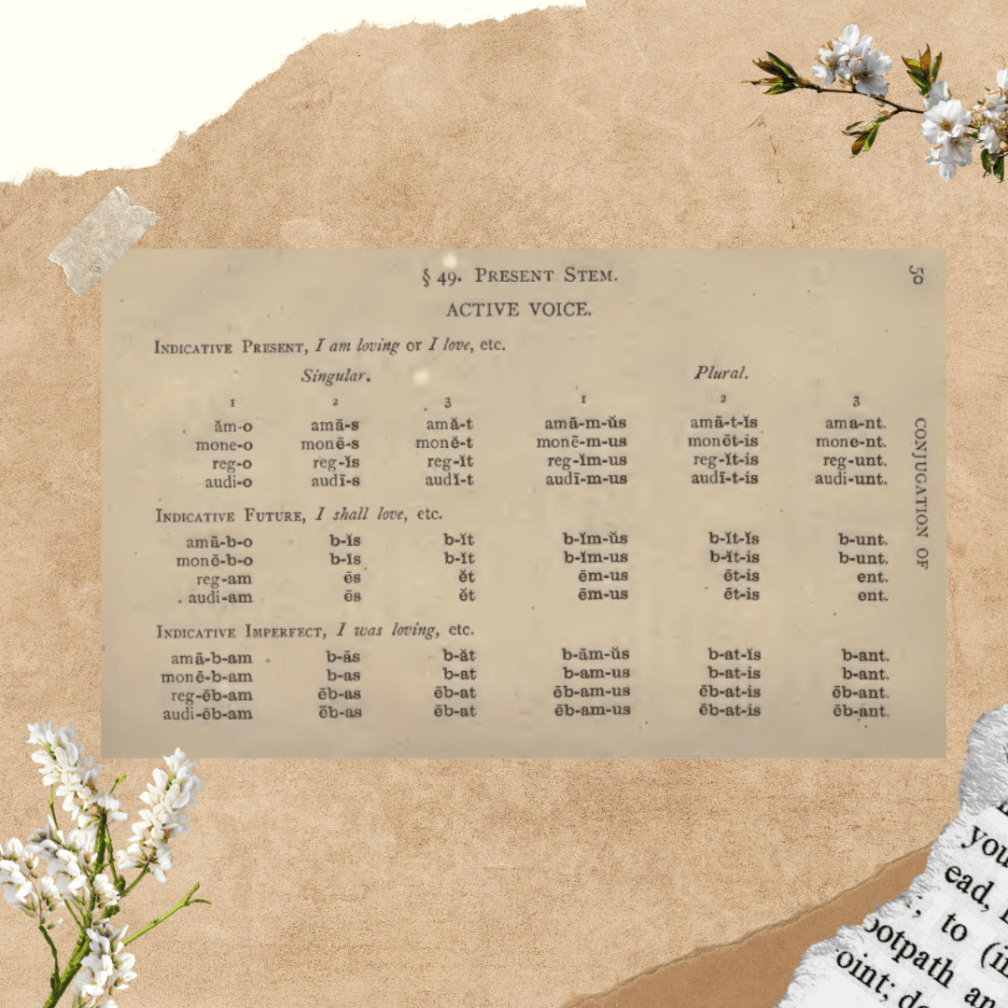
‘Latin is a synthetic language. The words are less fixed. They shift with each inflection.’ I assigned them a conjugation task (amo, amas, amat) then flipped frantically through the textbook in an anguished attempt to recall the other tenses. 

Amabam, amabamus—I was loving, we were loving. Imperfect, I mused, the truest tense for love. 

Against a chorus of whispers and scribbling pencils I performed my own faltering conjugations. I have loved. I will love again.

It’s not hard; I’m just not used to it, I thought, and set myself a task. To synthesise past and future. To reshape the grammar of my life.


Would you like to know more about this story? Sign up to the Grammar for Dreamers newsletter to get monthly updates on the ideas that inspire my work.

The brutal linearity of language

Fountain pen writing the word 'hello' on white paper
Photo by R Mo

It’s common to explore the lower realms, but no one in the team has ever, until now, been sent to a one-dimensional reality. To be trusted with such a mission is a great honour.

The training is intensive. It takes the form of repeated confrontations with the brutal linearity of language.  

Hello, my name is Jim. 

The assignment is to align the self with the excruciatingly constrictive quality of linguistic personhood. 

Hello… my… name… is…

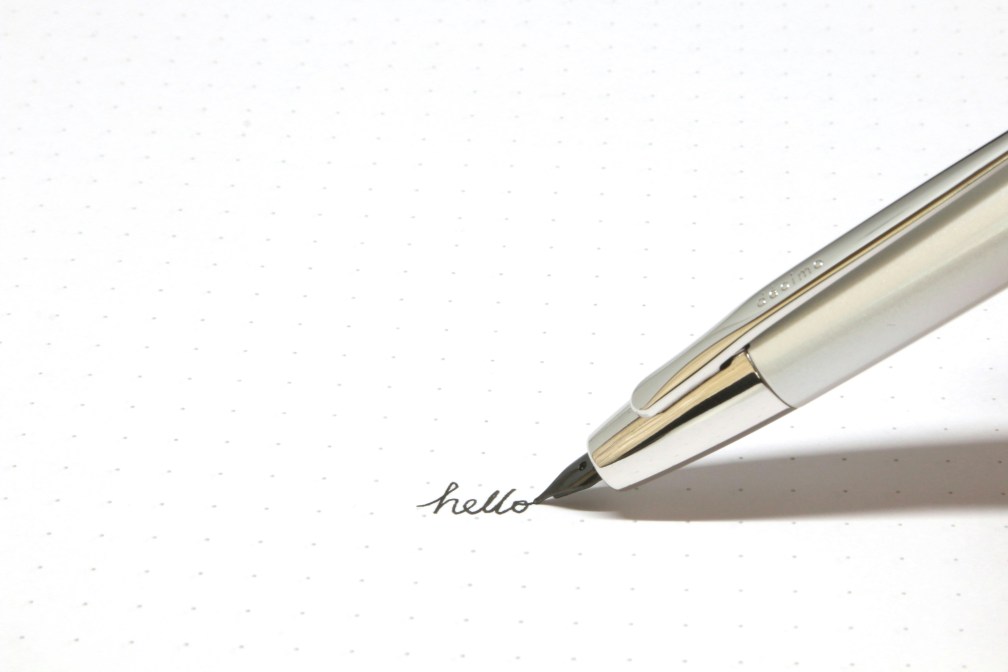
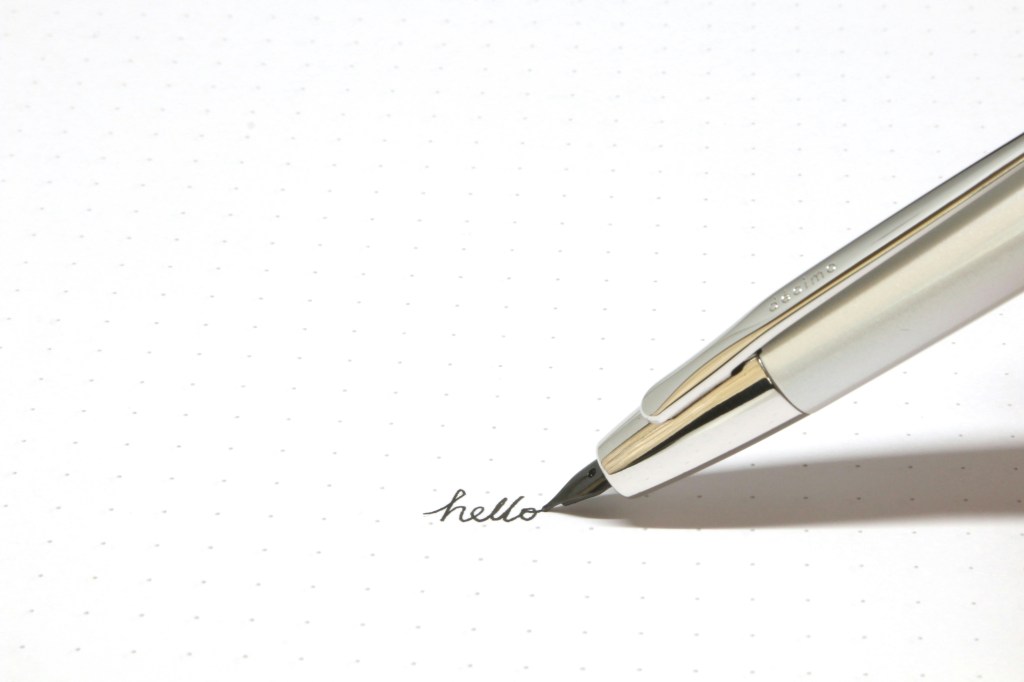
There’s guidance in the training, a meditative exercise: Imagine a fountain pen. Its reservoir is filled with the infinite ink of the uncontainable multiverse. Focus with singular attention on the nib as it traces its unidirectional line across an empty page. 

The strategy works. Soon frustration gives way to curiosity, rousing an impulse to experiment. 

Hello, my name was Jim. 

The past tense suggests a nostalgia. A longing to move backward along this narrow line, even as the syntax presses inexorably ahead.

My name is not Jim. 

Negative polarity produces erasure, annihilation. Ideas unknown in an eternally creative cosmos—the infinite ink churns and roils.

My name will never be Jim.

The line of language, freed from its singular dimension, emerges as a spiral, a fractal, a new world waiting to be found. 


Would you like to know more about this story? I discuss it in Episode 95 of Structured Visions, ‘Your name without language’. You can also sign up to the Grammar for Dreamers newsletter to get monthly updates on the ideas that inspire my work.

The lexicographer

Greyscale photo of a stack of old books and papers in a room
Photo by Felipe Furtado

The bookshelf falls with a conclusive thud. Volumes of dictionaries flap to the floor, their spines irreparably dislocated, their yellow pages exposed to greedy, scurrying mice. Billy the lexicographer realises with a tremor of despair that he is trapped. A lifetime acquiring language will end with him suffocating under the weight of words. 

He’ll spend his final moments naming things: the marble table, the antique wardrobe, the upholstered dining room chairs. Bodies of plastic baby dolls, a bag of mouldy limbs and hairless, eyeless heads. Mountains of newspaper, rodent insulation. Grandmother’s tarnished silverware. A treasure box of costume jewellery. 

An unfamiliar longing: to be free of noun phrases. To unacquire language. Billy’s gaze scurries frantically around the room, replacing objects with object pronouns. This. That. Those. Them. Him. Me. 

They. He. I. The objects become subjects. The subjects invite agreeable verbs. The verbs are finite: This too shall pass. 

I, too, shall pass, decides Billy. He raises himself up upon mouldy legs, passes a trembling hand over a hairless head and clears a path through his storeroom of hoarded language. 


Would you like to know more about this story? Sign up to the Grammar for Dreamers newsletter to get monthly updates on the ideas that inspire my work.