A close up of psilocybin mushrooms.

Memento mori

A close up of psilocybin mushrooms.
Photo by Nick Fewings

The timing of Evan’s tragic death, mid-October, forces Siobhan to face memento moris at every turn. But skeletons in blood-spattered windows are less poignant reminders than the signs of natural decay she finds in her daily walks in the woods. Rotting apples on blankets of brittle leaves. Voracious, implausibly shaped toadstools decomposing dead wood. Everything ends, the faded Michaelmas daisies seem to declare, smiling down upon the stripped strands of once verdant, cloying cleavers.

We’re sorry for your loss, she hears, and her eyes catch a cluster of magic mushrooms sprouting in a clearing. The sight reminds her to ring her therapist friend, Jim, who has been touting the benefits of psychedelics to guide the bereaved even before he heard about Evan.

We’re sorry for your loss. Less than a week later, under the influence of the psilocybin Jim has managed to source, she hears this same condolence. Are the shrooms she has just consumed the very ones she spotted on her woodland walk? She is guided not to dwell upon the referent of the first-person plural pronoun. Instead she follows a winding, bewildering pathway of the linguistics of loss: back-formation of the past participle (lost) of lose, from Old English losian, almost always used intransitively to mean perish, or to be lost or missing. 

The psylocibin-induced etymology unwinds her. She too is perishing, is missing, where is she

You are here, the shrooms reassure her. But what is you? The loss is a loss of language—language losian, language loosing, language losing, she chants until it is revealed: It is not just she who is here, or you, or him, it’s all of it, all the pronouns for all the people, all the misguided verb inflections for all the persons and all the tenses—here, here, here, until there is no not here and nothing is ever lost.


Would you like to know more about this story? I discuss it in Episode 114 of Structured Visions. You can also sign up to the Grammar for Dreamers newsletter to get monthly updates on the ideas that inspire my work.

Negative space

Greyscale photo of a couple kissing across a table. Their faces blur together. They're each holding a coffee mug.
Photo by Nathan Walker

What’s up with me and the intimacy issues? It was only my third date with Barry (coffee at the Students Union) and I’d just told him I was crazy.

We met at an interdisciplinary postgraduate conference. He said he liked my talk on negation in language.

What he actually said was, ‘I didn’t understand your paper, not one jot of it.’

His field was psychology, not linguistics, so his joke meant he’d been paying attention. I may have already been in love. 

So why the rush to tell him about the alien in my brain?

‘An alien talks to you?’ he said.

‘Yeah, he took up residence as soon as I landed on my thesis topic,’ I said. 

‘Correlation is not causality,’ Barry pointed out. 

‘He keeps asking annoying questions about my topic. He says in his language there is no negation.’

There is no negation? Isn’t that a perfect example of negation?’

‘Well, what he really said is There’s only affirmation. But we were speaking English.’

‘I don’t think you’re crazy,’ Barry said. ‘I think you have a very smart brain who’s created a sparring partner to help bring your brilliant ideas even further. Or else you really are in communication with extraterrestrial intelligence, which you should see as a great privilege.’

He had me at I don’t think you’re crazy

‘The negation is the affirmation!’ exclaimed my alien companion, with a distracting Eureka yelp.

I ignored this, leaning closer toward my human companion. ‘Can I kiss you?’ I asked.

‘I don’t see why not,’ he said, and I melted into the negative space his negative clauses revealed.


Would you like to know more about this story? I discuss it in Episode 97 of Structured Visions, ‘The intimacy of denial.’ You can also sign up to the Grammar for Dreamers newsletter to get monthly updates on the ideas that inspire my work.


Lessons in Latin

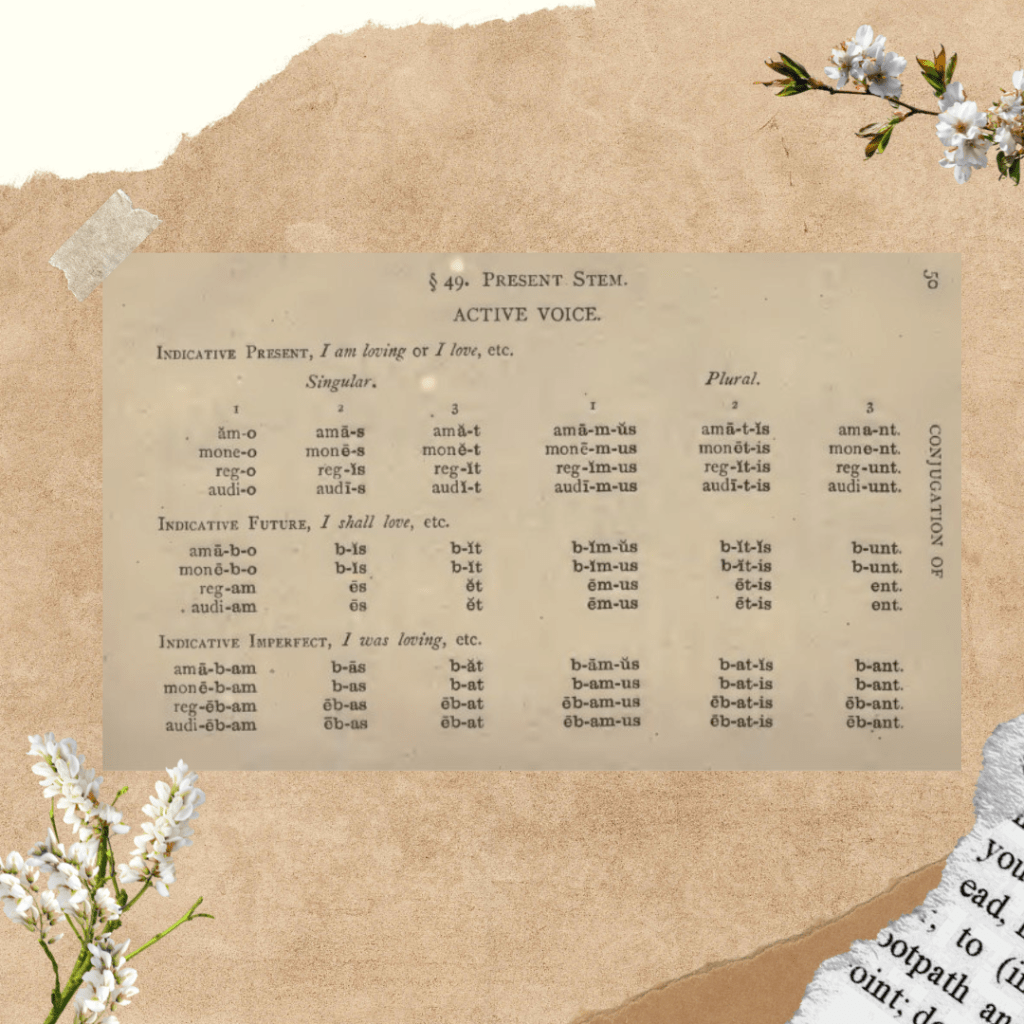
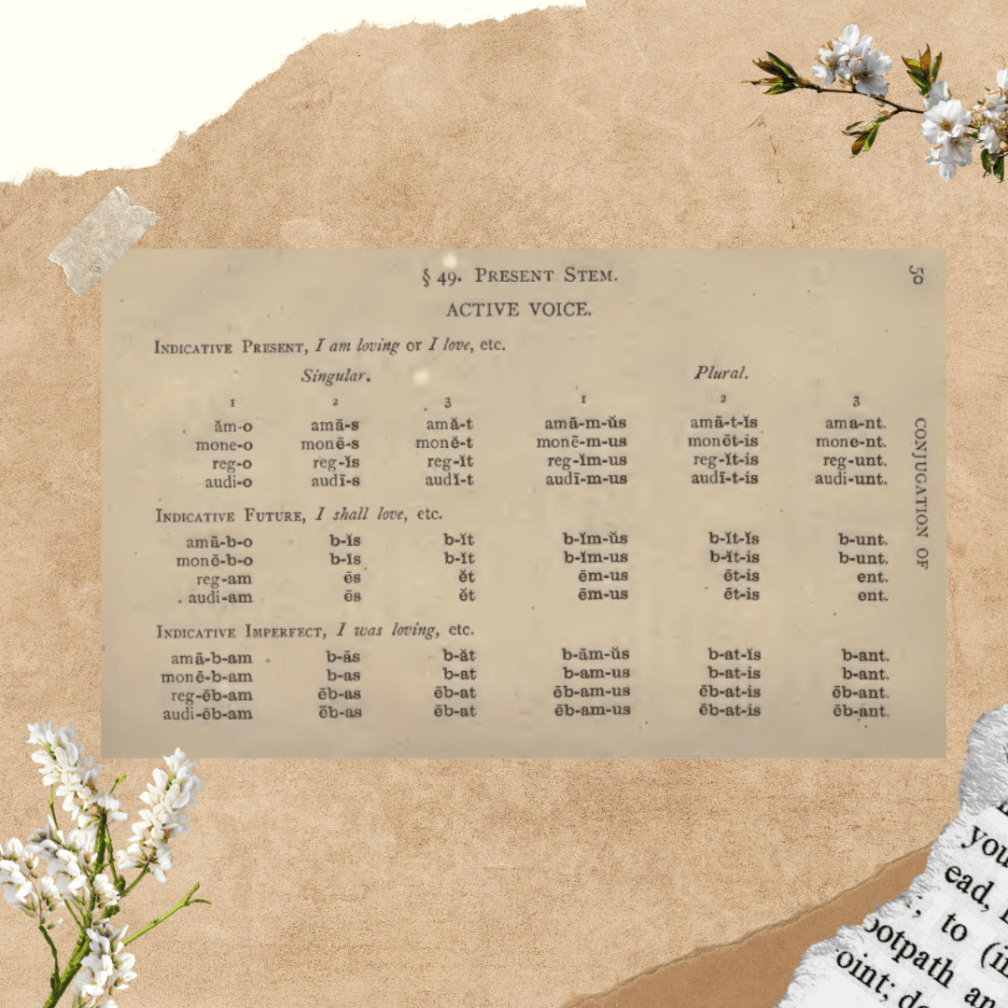
Page of a Latin textbook pasted into a scrapbook

If it had been any other subject I probably wouldn’t have even responded to the head teacher’s desperate predawn request. I was still reeling over Jeremy’s affair and his desire for a divorce, both of which he’d announced a mere 12 hours earlier, inciting a fraught, sleepless night. 

But my newly uncertain future made it seem unwise to turn down a job. Besides, when else was I ever going to make use of those wasted hours in Catholic school, declining nouns and conjugating verbs? I forced some drops into my puffy eyes, blinking them back like reverse tears.

‘Why is it so hard?’ the girls complained. 

‘Why is what so hard?’ I barked back. ‘Life? Love? Existential crisis? The condition of being alone?’

‘Latin, Miss,’ they clarified, meekly. Clearly I was not a supply teacher to be fucked with.

‘Latin’s not hard,’ I said dismissively. ‘You’re just not used to it. You expect it to be like an analytic language, like English, where each word stands on its own.’

Confused looks. Foolish girls! 

‘Latin is a synthetic language. The words are less fixed. They shift with each inflection.’ I assigned them a conjugation task (amo, amas, amat) then flipped frantically through the textbook in an anguished attempt to recall the other tenses. 

Amabam, amabamus—I was loving, we were loving. Imperfect, I mused, the truest tense for love. 

Against a chorus of whispers and scribbling pencils I performed my own faltering conjugations. I have loved. I will love again.

It’s not hard; I’m just not used to it, I thought, and set myself a task. To synthesise past and future. To reshape the grammar of my life.


Would you like to know more about this story? Sign up to the Grammar for Dreamers newsletter to get monthly updates on the ideas that inspire my work.
The grammar of your beginning

A string of wooden and glass beads on a painted wooden surface
Image by Alexey Demidov

When did I begin?

You have never begun. You will not end.

This response never satisfies you, so I must tell a less true tale, of the time when you began to know beginnings.

Think of a treasured thing that is yours alone—a doll, a puppet—made after your image, perhaps, who knows nothing but how to love you.

One day an adornment appears on your doll’s neck—a filament, a thread—almost too fine to be perceived, draped restlessly between head and heart.

The thread is a razor-sharp, severing thing, a fibre of spun glass. 

It sets the doll’s soul to longing. Your own soul’s love is stronger than the loneliness this longing foretells.

One day the doll awakens to find a jewel box filled with iridescent beads and a needle for stringing. With the patterns she forms, she fashions the syntax of her own beginning.

Imagine that you knew, from the beginning, that in her beginning you would meet your end. 

Would you still offer your treasured thing the ornaments of your own destruction? Would you unearth these beads from deep beneath the sediment of your wisdom, grief and love?

You have never begun, and you will not end, but the grammar of your beginning spells the story of my end.