A person wearing a baseball cap from behind, looking out over a city.

Point of view

A person wearing a baseball cap from behind, looking out over a city.
Photo by Ahmed Syed

‘It’s the strangest thing.’

‘What is?’

‘Henry. He says he can’t talk about himself except in the third person.’

‘Third person?’

He, him.’

‘It’s a pronoun thing?’

“No, it’s a point of view.’

‘That’s your point of view.’

‘Ah! He says he’s glad you said you. Second person is a step in the right direction.’

‘Why can’t he say you?’

‘He says he can’t say anything except through indirect speech. He can’t say-’

‘Eye?’

‘Aye. He’s making progress, he says.’


Would you like to know more about this story? I discuss it in Episode 113 of Structured Visions. You can also sign up to the Grammar for Dreamers newsletter to get monthly updates on the ideas that inspire my work.

low angle photo of a statue of an angel framed by a blossoming tree

Ego angels

low angle photo of a statue of an angel framed by a blossoming tree
Photo by Kasper Rasmussen

The Bright Angels had just lost their war against the Dark over the fate of humankind. They were forced to concede to the Dark side’s plan to give the humans language. They proposed one condition: no pronouns.

Out of the question, protested the Dark Angels. It’s cumbersome to always have to call everything by its name. The humans would drop language entirely, and the Bright side would have won by default.

‘No personal pronouns, then.’

The Dark Angels agreed to remove one (but only one) as a gesture of goodwill.

The Brights chose the first-person singular. I, me, je, moi, yo, ego, etc. If the humans had no egos, perhaps not all would be lost.

All would be lost, as of course you know. It was the Bright side’s fault. One of their own angels, an overly enthusiastic fledgling called God, dropped down to Earth to show off a few Bright party tricks. 

‘Who are you?’ wondered the awestruck humans. 

‘I am that I am,’ he proclaimed. 

The Bright side gasped at the blunder.

But there was no turning back. Ego had wormed its way into the garden of human consciousness. Already it was preparing the soil where the Dark Angels would plant their miracles.


Would you like to know more about this story? I discuss it in Episode 101 of Structured Visions, You, me and big egos. You can also sign up to the Grammar for Dreamers newsletter to get monthly updates on the ideas that inspire my work.

The lexicographer

Greyscale photo of a stack of old books and papers in a room
Photo by Felipe Furtado

The bookshelf falls with a conclusive thud. Volumes of dictionaries flap to the floor, their spines irreparably dislocated, their yellow pages exposed to greedy, scurrying mice. Billy the lexicographer realises with a tremor of despair that he is trapped. A lifetime acquiring language will end with him suffocating under the weight of words. 

He’ll spend his final moments naming things: the marble table, the antique wardrobe, the upholstered dining room chairs. Bodies of plastic baby dolls, a bag of mouldy limbs and hairless, eyeless heads. Mountains of newspaper, rodent insulation. Grandmother’s tarnished silverware. A treasure box of costume jewellery. 

An unfamiliar longing: to be free of noun phrases. To unacquire language. Billy’s gaze scurries frantically around the room, replacing objects with object pronouns. This. That. Those. Them. Him. Me. 

They. He. I. The objects become subjects. The subjects invite agreeable verbs. The verbs are finite: This too shall pass. 

I, too, shall pass, decides Billy. He raises himself up upon mouldy legs, passes a trembling hand over a hairless head and clears a path through his storeroom of hoarded language. 


Would you like to know more about this story? Sign up to the Grammar for Dreamers newsletter to get monthly updates on the ideas that inspire my work.

Of prophets and pronouns

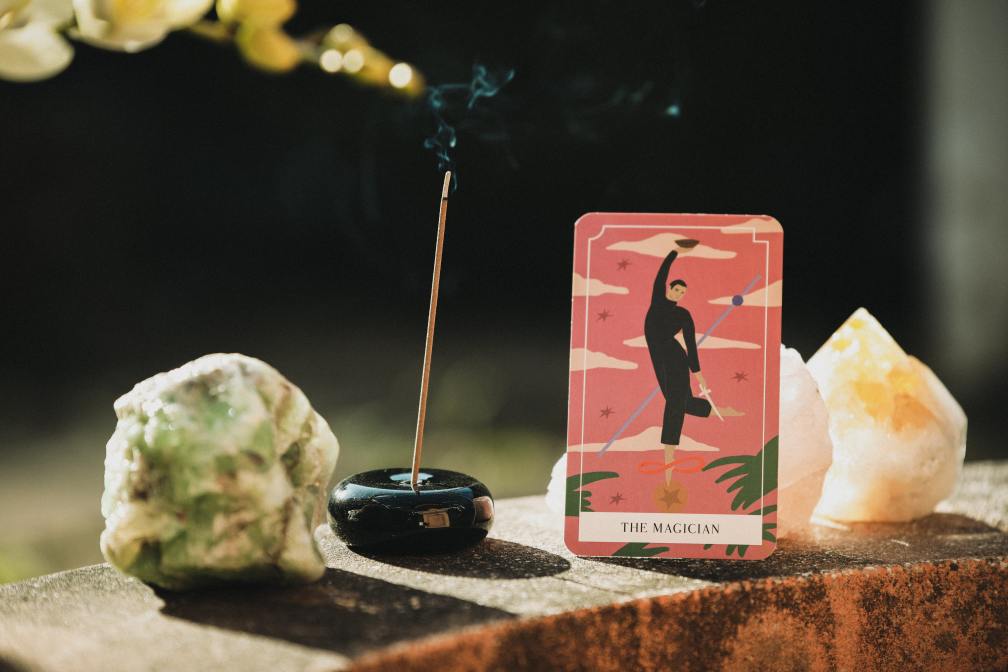
An altar with three crystals, a stick of burning incense, and the Magician Tarot card
Photo by CA Creative

Mirabelle used to complain that, like all prophets, she was not accepted in her own country. Being sidelined to the ‘alternative’ tent at the county fair was a testament to that, but she hung her shingle nevertheless, squeezed as she was among Tarot cards, crystals, incense and astrology charts. 

She blamed her lack of custom on a number of factors. She was ahead of her time (what prophet wasn’t?), her branding was off (‘linguistic seer’ might not have been the best way of describing her offer), and her services were for the good of the collective, not the individual. 

People were more interested in their own chance of love, wealth or success than in the fate of humanity.

Which was a shame, because her message (had anyone requested it) would have been a hopeful one.

Humankind was on the cusp of a great transformation—a breaking through of selfhood, which was always the harbinger of change.

She could tell by the pronouns.

When the pronouns became plural, it was a sign that people were becoming ready to appreciate the multitudes they contained.

It started when plural you replaced singular thou. And now plural they was replacing singular he and she.

You’re moving toward a new awareness, she whispered to the unseeing crowds that milled aimlessly about. Soon you will know the singularity of your multitudes.


Would you like to know more about this story? I discuss it in Episode 81 of Structured Visions. Subscribe to the podcast on Apple podcastsSpotify or wherever you like to listen.

Guest

What we were told about the project was little enough to be written on a napkin.

I can say this with some confidence because I did write it on a napkin.

I got the call in a Starbucks, and scrawled some barely discernible notes from my barely discernible conversation with my deep-voiced, disembodied interlocutor.

An extraterrestrial species (humanoid, intelligent) had been discovered on Earth. The agency (governmental, top secret) was looking for adoptive carers.

‘You want me to adopt an alien?’ I looked up from my phone to raise my eyebrows at my fellow Starbucks regulars, who smiled sympathetically.

‘The preferred term is Guests.’

It wasn’t a joke. They were choosing potential Guest-adopters from a bank of experts (biochemists, neuroscientists, psychologists). My area is linguistic anthropology. They wanted to know about Guest languages.

They’d named my Guest Ella. I put her in my daughter’s room. (She lived with her father now and never came home.)

I wished I’d adopted more than one Guest. I couldn’t learn anything about Ella’s language because she didn’t have anyone to talk to. Also, she’d achieved native-level proficiency of English within several weeks, which made it harder to make hypotheses based on her acquisition patterns.

One anomaly gave me a clue, though—her use of pronouns. She acquired the first-person singular (I, me, my) without any trouble, but she never used second, third or first-person plural.

The implications of this hit me one night after dinner. Ella had just polished off a generous bowl of ice cream (Madagascan vanilla with dark chocolate chunks).

‘I’m hungry,’ she said.

She didn’t eat the second helping I gave her. Instead she held the bowl out to me. 

‘That’s for you, Ella,’ I reminded her. I don’t eat ice cream. (I stopped eating sweets when Pieter left.)

She placed the bowl in front of me with uncharacteristic stubbornness. 

It was then that I noticed how malleable her facial features were.

‘That’s for me,’ she repeated. ‘I want it so much.’

I tried not to stare as her face morphed. She was starting to look like someone I knew.

‘It looks so delicious,’ she said, and her longing nearly broke my heart. ‘I’m empty inside. Maybe ice cream would help.’

I stared longingly at the decadent chunks of chocolate speckling the soft cream. (My weight was one of the reasons Pieter left.)

‘I miss ice cream,’ she said. 

It was not until the first spoonful passed my eager lips that I understood.

Guest language had no second person pronoun. 

‘I miss myself,’ she continued, ruthlessly. ‘I don’t know who I am, now that I’m all alone.’

Ella had no way of saying ‘you’. 

Which meant she probably didn’t even have a concept of ‘you’.

‘You’re not alone,’ I said.

Her uncannily familiar face made it clear that she was not reassured. 

I tried again. ‘I’m not alone,’ I said. 

Her eyes glowed with warmth, like light in a guest house. (Inviting. Welcoming.)

The relief in her smile mirrored my own.


Would you like to know more about this story? Check out my behind-the-scenes post on Patreon.