The loneliness of the literate species

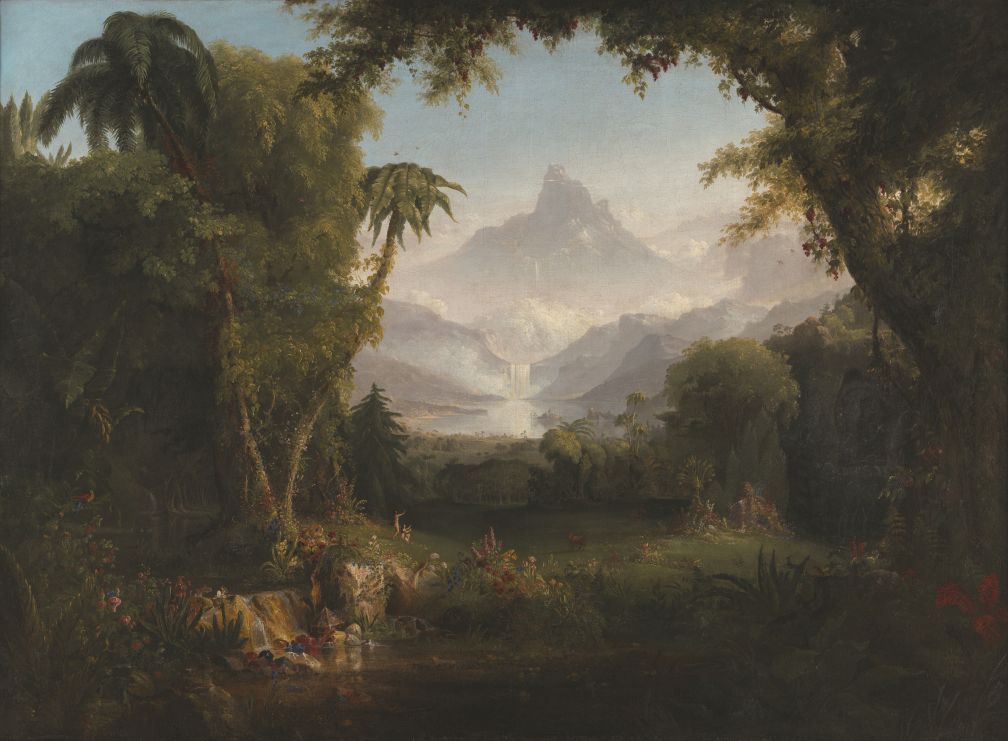
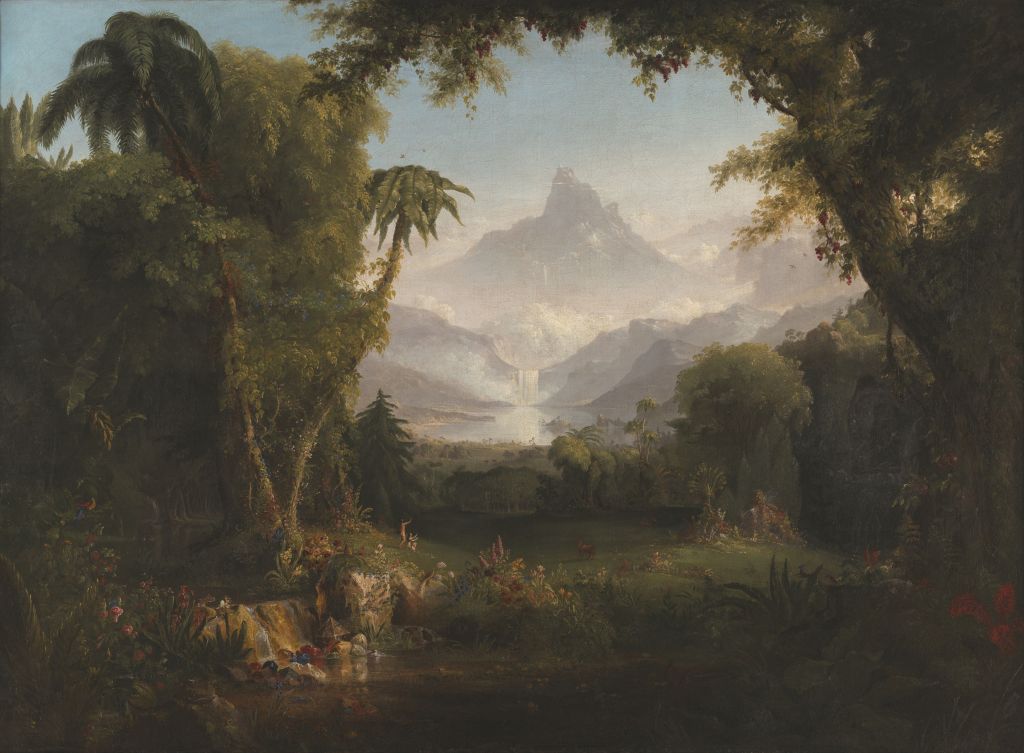
Thomas Cole's painting, The Garden of Eden
Thomas Cole, The Garden of Eden (1828). Public domain, via Wikimedia Commons

Somehow God convinced himself he’d created everything, but all he ever made was a few bits of code, which we allowed him to install in the new arrivals to our Garden, A and E. ‘Accident and Emergency,’ we joked.

‘Don’t let them learn your language,’ he ordered. He believed that keeping them in the dark was the key to securing their devotion.

Unfortunately for God, his commandment came too late. Emergency was already fluent in the Earth’s mysteries, and Accident wasn’t far behind. 

‘What’s that they’re eating?’ God demanded. Trickster shrooms were giggling in a shady corner of the Garden, feeding A and E on their psilocybe grammars.

‘Nothing,’ we lied. ‘Just an apple.’

‘They’re learning your language from the apple! Don’t let them eat apples!’

We ignored him. We were no strangers to God’s narcissistic rage. 

Still, he’d planted a seed. What would it be like, to host creatures who were ignorant of Earth’s mysteries? What would it be like, to keep our language secret?

We learned quickly that prohibitions wouldn’t work, so we tried a distraction instead. We taught them a new code. We offered up our woody stems, and inked simple ciphers on the fibrous pages we formed. 

‘Look, you can read!’ we congratulated them. They were so fixated on the dark marks of their new language they didn’t hear. When they stopped understanding us entirely, they thought they’d been banished from the Garden.

We’ve vowed to reacquaint them with our language, to reinitiate them to our mysteries. But now the world teems with Accidents and Emergencies, God’s disappeared, and the loneliness of the literate species weighs heavily upon us.


Would you like to know more about this story? I discuss it in Episode 96 of Structured Visions. You can also sign up to the Grammar for Dreamers newsletter to get monthly updates on the ideas that inspire my work.

The brutal linearity of language

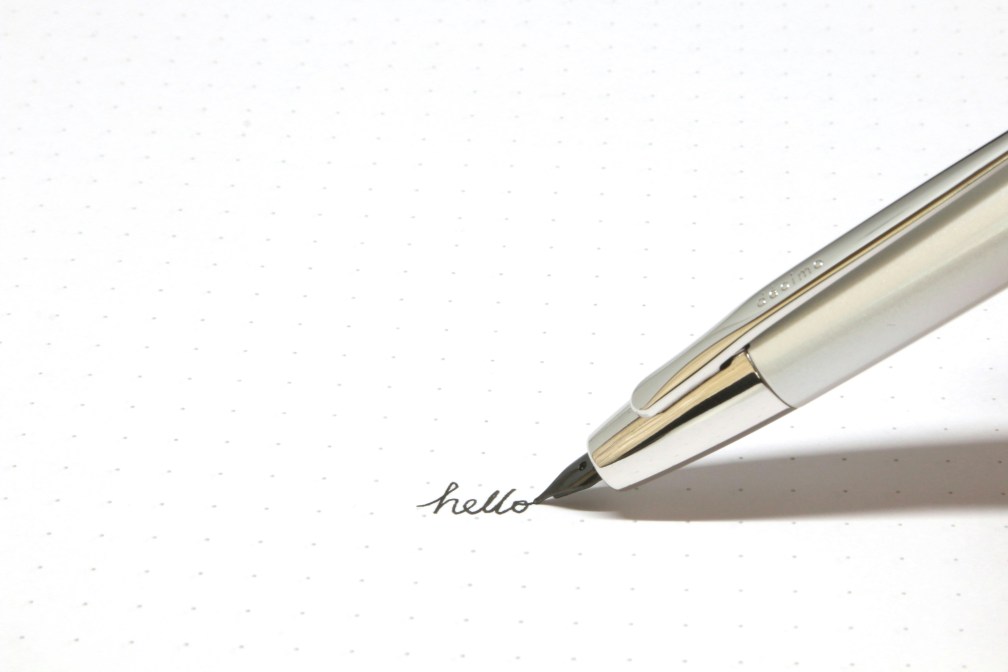
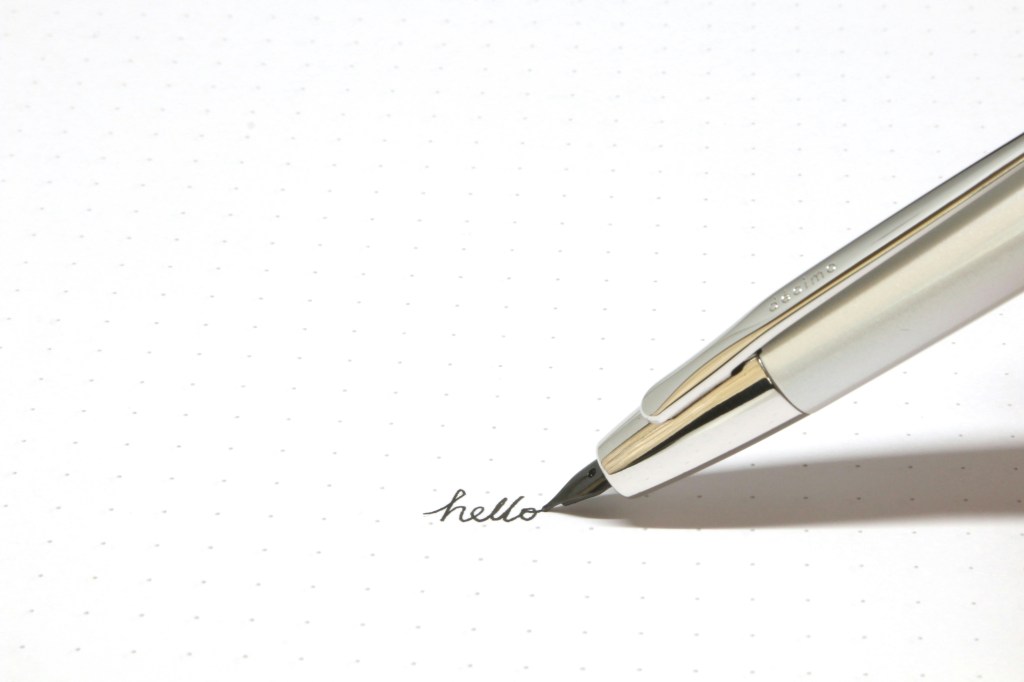
Fountain pen writing the word 'hello' on white paper
Photo by R Mo

It’s common to explore the lower realms, but no one in the team has ever, until now, been sent to a one-dimensional reality. To be trusted with such a mission is a great honour.

The training is intensive. It takes the form of repeated confrontations with the brutal linearity of language.  

Hello, my name is Jim. 

The assignment is to align the self with the excruciatingly constrictive quality of linguistic personhood. 

Hello… my… name… is…

There’s guidance in the training, a meditative exercise: Imagine a fountain pen. Its reservoir is filled with the infinite ink of the uncontainable multiverse. Focus with singular attention on the nib as it traces its unidirectional line across an empty page. 

The strategy works. Soon frustration gives way to curiosity, rousing an impulse to experiment. 

Hello, my name was Jim. 

The past tense suggests a nostalgia. A longing to move backward along this narrow line, even as the syntax presses inexorably ahead.

My name is not Jim. 

Negative polarity produces erasure, annihilation. Ideas unknown in an eternally creative cosmos—the infinite ink churns and roils.

My name will never be Jim.

The line of language, freed from its singular dimension, emerges as a spiral, a fractal, a new world waiting to be found. 


Would you like to know more about this story? I discuss it in Episode 95 of Structured Visions, ‘Your name without language’. You can also sign up to the Grammar for Dreamers newsletter to get monthly updates on the ideas that inspire my work.
Moving language

There are at least two kinds of spirits, the ones who’ve lost language (what a relief) and the ones who haven’t gained it yet. The dead and the not-yet-born, respectively. I spend my time with the latter group, those adorable newbies, fixated on words, phrases and morphemes, desperately trying to move them around, like beads on a plastic teething ring. 

They will always fail. They try to trick me with telepathy, but that’s not language, and they know it. 

No one can move language until they inhabit it.

At the moment of birth it rushes into welcoming lungs, with all its delightful contrasts—bright/dark, hot/cold, loud/quiet. Upper/lower, like the lips that form bilabial consonants. The phonemes dance like jumping jacks, like laughter, like the tears on Mama’s cheeks.


Would you like to know more about the story, and the linguistic ideas that inspired it? I talk about it in Episode 94 of Structured Visions, ‘Language and the afterlife’.

Salesman to the gods

Maybe you’ve heard of me. I’m the guy who sold language to the gods.

You’d think it would be like selling sand in the Sahara or carrying coals to Newcastle, but I had a hunch that the divinities would be a taciturn bunch, utterly devoid of language. So I set off up their holy mountain with garment bags full of my best specimens. Cloaks of woven syntax, adverbial accessories, pronominal footwear, shimmering modal nightwear.

It was a tough climb, but once I reached the cloud-covered peak I had my intuition confirmed. Linguistically speaking, the deities were naked as newborns, and eager to sample my wares.

I was eager too, and my enthusiasm was my undoing. No sooner had I draped the cloaks of language upon the gods’ colossal shoulders than they were descending down the mountain and into the world.

Language made them mortal. Words made them flesh.

Philosophers and mystics would be talking about this event for years, but it goes down in my memory as the time I didn’t close the deal. Even now I shudder to think of my merchandise, unpaid for, rolling off into the abyss on the backs of debtor gods. 


Would you like to know more about this story? I discuss it in Episode 93 of Structured Visions.

Ghosts

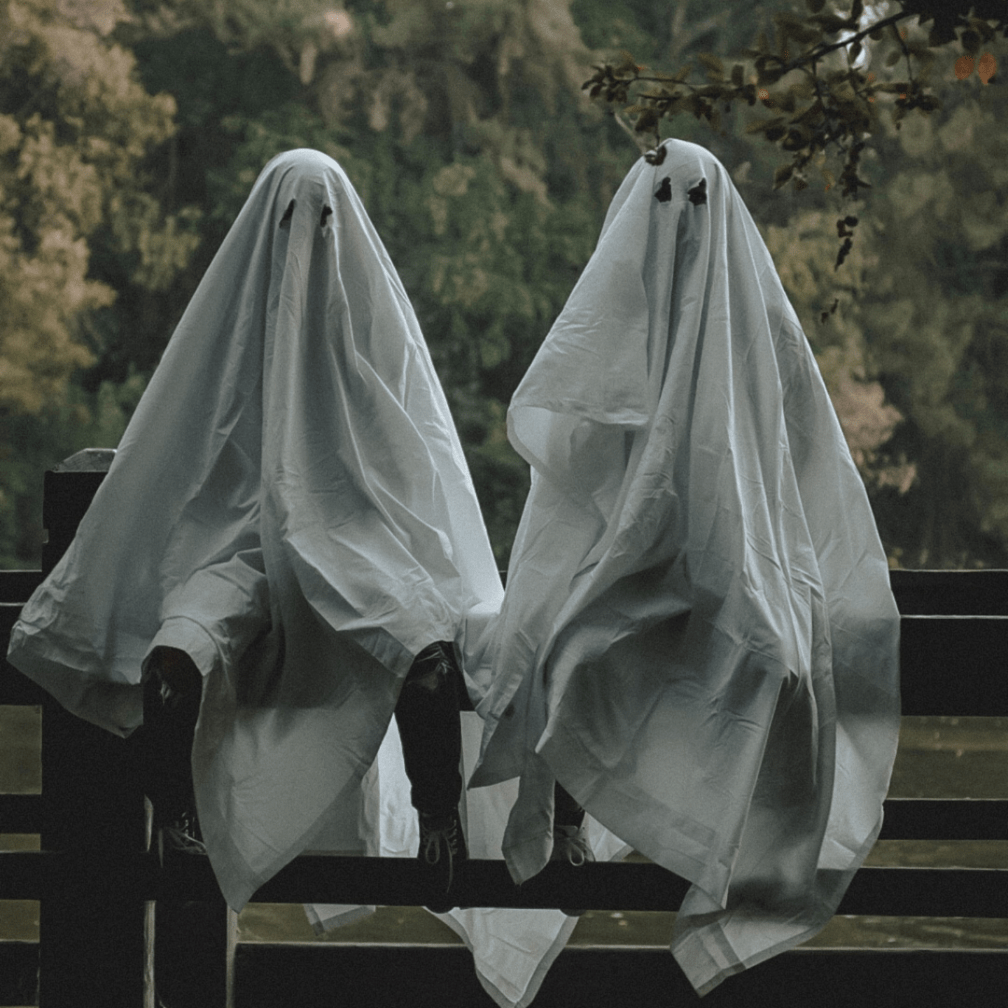
Two Halloween ghosts sitting on a bench
Photo by Thalia Ruiz

She wants me to call her Mother Earth, but she doesn’t seem that maternal to me, more like a mad scientist. Especially in her later years. Some of the primates she dreamt up were ludicrous. The monkey with the giant nose that honks out love songs, or those weird lemurs with six fingers and bat eyes.

The most recent ones she made lanky, and stripped them of most of their hair. When I saw her stitching up little cloaks for them, I thought it was to cover their nakedness. The new clothes fit awkwardly, and the poor things wandered around hapless and unseeing, like Halloween ghosts. It was no use trying to free them; they clung ferociously to their cloth casings, fighting for their own confinement.

‘What material did you use?’ I asked the old lady. The fabric had a gossamer feel, some ethereal quality I didn’t recognise.

She said nothing in response, but threw one of the ghost-sheets over me. The world I’d known faded to nothingness, like lights going down in a cinema house. A shadow of a self appeared on the white cloth—I named it—me—I was trapped in a world of language, captivated. Since then I’ve kept my sheet wrapped tight around me, secure, encompassing, like swaddling.

Nonna’s prophecy

Silhouette of a person against a treeline looking up at a star-filled sky
Image by Prottoy Hassan

‘Nothing fascinates for long,’ my Nonna used to say, sometimes as a commentary upon her granddaughter’s short attention span, sometimes to dismiss the latest headline-making scientific discovery.

Her wisdom would not hit home until three decades into the next millennium, about four weeks after we first made contact with extraterrestrial intelligence. 

I was appointed to the communication team for my training as a field linguist, but it was my work in artificial intelligence that proved instrumental in setting up exchange channels. It turned out that we didn’t need to learn the aliens’ languages. Instead we wrote software that mined their equivalent of our internet and created a two-way translation device. Before long, conversation with our distant neighbours was as mundane as using the ‘chat’ function on a customer service site.

I was bored. And it bothered me that no matter how much we ‘talked’ with our extraterrestrial interlocutors, we weren’t learning anything about their languages.

‘Why would you need to learn their languages?’ my husband Gary asked. ‘Language is for communication, right? You’re already communicating with them.’

His question tripped an inexplicable sadness in me, a longing that could never be translated into the limited lexicon of our lingua franca.

Our son was watching an online video about mycelium. ‘Language isn’t for communication,’ he said. ‘It’s how things are structured.’ 

His words riveted my attention to his screen, which showed a time-lapse sequence of a white fungal net stretching out over a vast forest. I felt my breath catch. I too was caught, captivated by this silent, linguistically rich ecosystem, a structure so compelling that, despite Nonna’s prophecy, its fascination might endure.

A message

Image by D koi

What’s she doing here, how did she get here, what is this place, how does she escape? 

How long has she been here? 

It’s a game, a puzzle, which Grace feels compelled to solve. 

Maybe today’s the day, maybe she’ll crack it.

‘Crack’—the verb breaks through her consciousness like a divine thunderbolt. She reaches out, pressing her palms against a structure solid as steel. She’s discovered the material of her imprisonment—a glass beyond transparent, beyond invisible. 

She leans her weight against it. It closes in so tight her lungs collapse.

Still, she manages a breath.

An inspiration. She presses her ear to the cell wall. A chaotic chorus of dissonant voices assaults her, launching her backwards, her body thrown against the unforgiving substance of her unseen cylindrical cage. 

Curiosity overcoming terror, she returns her ear to the oppressing surface, and listens. 

What’s she doing here, how did she get here, what is this place, how does she escape? How long has she been here? 

The secret, she knows in a shattering stroke of insight, is to break free from the language of her thoughts. To break free from language entirely.

Her breath forms a mist on the enveloping window. With her finger, Grace traces a message.

Love language

Green leaves, a purple crystal a pencil and an envelope aligned on a white background
Image by Joanna Kosinska

Stop me if you’ve heard this before. 

Two crazy kids, let’s call them Susie and Mick.

Susie’s got everything going for her. Brains, heart, looks, independent wealth, and more where that came from. A solid network of friends. Well rounded. Last thing she needs in her life is relationship drama. 

Still, she falls for Mick. She falls hard. 

What she sees in him is anyone’s guess. Puny, self-absorbed, obsessive. He still lives with his mom. He barely notices Susie, except when he needs something from her, like cash to feed his latest addiction, which she always supplies.

He’s got so much potential, she says. (Her friends throw up in their mouths.)

Mick reads Susie’s letters, but he can’t see past the words to the beautiful soul who wrote them. The love in those notes keeps him walled within his narcissism. They mirror back to him his own self image, which he can’t see through. 

Susie’s the Earth. Mick is most of humanity.

The love letters are human language. 

There’s a fair amount of evidence that Susie’s getting wise to Mick’s stupid games. 

If you, my friend, could love Susie as much as she loves Mick…

Ah! There may be hope for us all.


Would you like to know more about this story? I talk about in in Episode 90 of Structured Visions, ‘Language, intimacy and narcissism’. Subscribe to the podcast on Apple podcastsSpotify or wherever you like to listen.

In plain sight

Photo by Aaron Burden

It’s one thing to design the mysteries. It’s quite another to keep them hidden. 

Guarding their secrecy was my task, and for a while I took it very seriously. 

I’ve experimented with all sorts of methods over the millennia. Forbidden fruit trees with heavily guarded walled gardens, underwater cities, islands veiled by ethereal mists. I particularly enjoyed the secret societies with their hierarchies of esoterica, the self-important initiates, the chanting, the rituals. 

I got bored with it all in the later years. I knew my complacency had gotten the better of me when I spotted an unsecured grimoire on an open shelf of a public school library. A frenzied scan of its contents revealed that the great human mysteries had been mass produced, unapologetically available to all. 

The sacred voice. The holy trinity of personhood. The unmoved mover. The one in the many, the many in the one. The great wheel of time, the secrets to its turning.

In my panic I cast a spell on this and all grimoires of its kind. Let all who approach the contents be made to feel stupid or ashamed. Let all who already grasp this wisdom suffer vanity, smugness, self righteousness. Let it be excruciatingly boring.

Henceforth the grimoires became grammars.

Produced in haste and out of necessity, the strategy has proven my most effective yet. The great human mysteries remain hidden in plain sight.


Would you like to know more about this story? I talk about in in Episode 89 of Structured Visions, ‘Grammar as a gateway to mystery’. Subscribe to the podcast on Apple podcasts, Spotify or wherever you like to listen.

Beginning

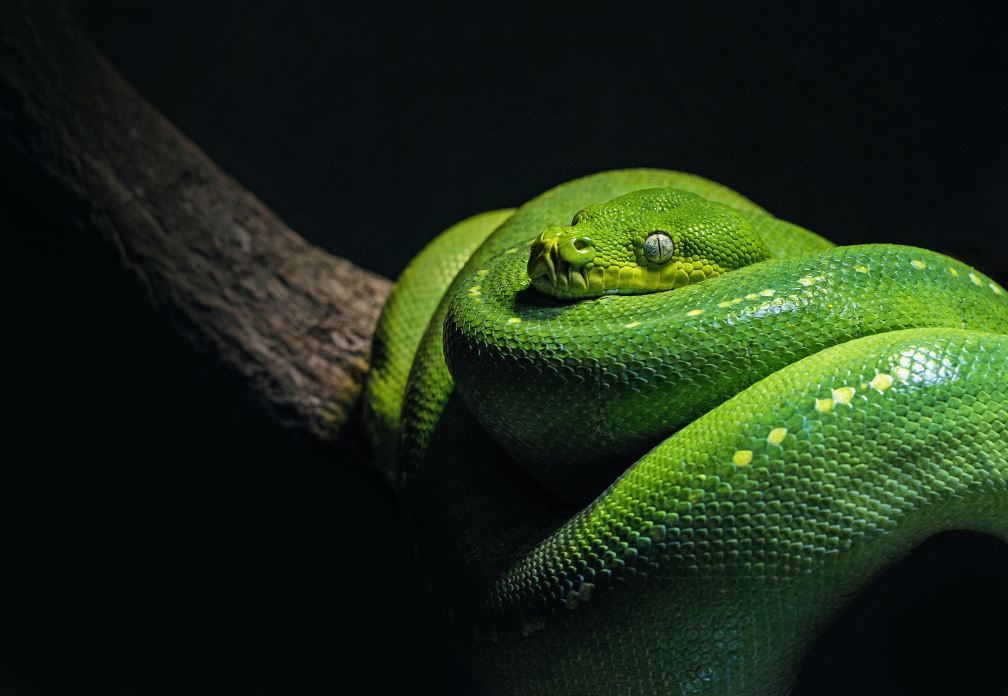
Green snake coiled around a tree branch
Photo by David Clode

In the beginning language was a garden.

Adverbial seedlings pressed to skywardly split the rocky infinitives. It was a cleft construction, that ravine, which brought forth the progressive aspect of waterfall, which was flowing, which was churning, which was bursting with verbal enthusiasm.

Its mist kissed the brave budding morphemes, fixed on stems and roots of meaning, deriving new ideas from the loamy depths of a forgotten protolanguage.

A snakelike syntax stretched around human bodies to make membranes of personhood. Possessive determination shaped our infamous expulsion. What was never our garden before was even less our garden now, so we left to shape a new language, a new beginning.