The determiners

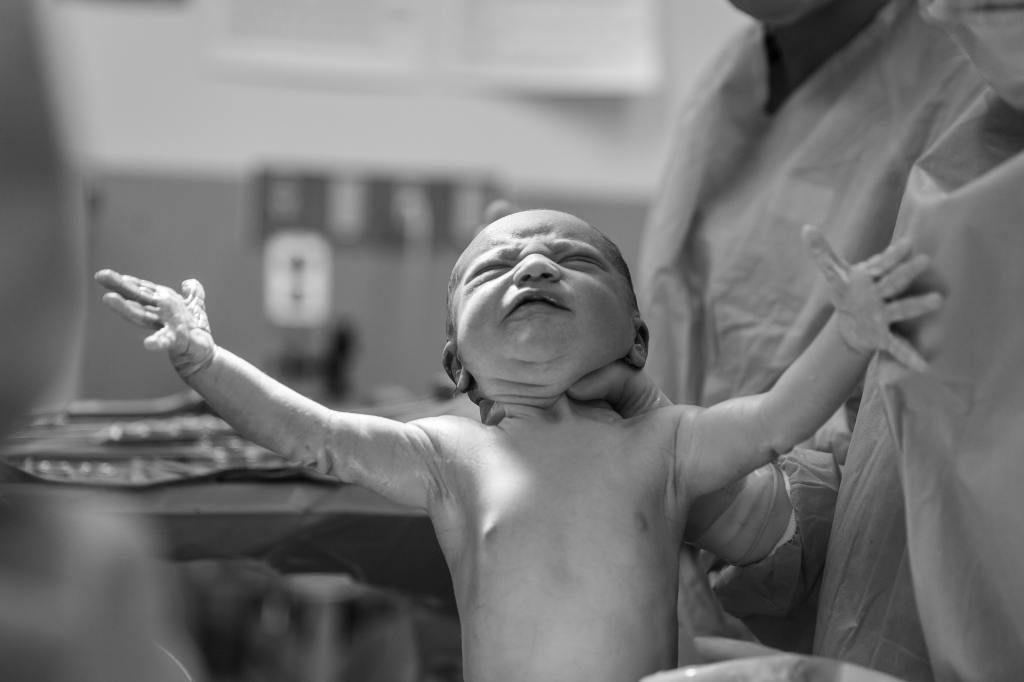
Newborn baby with its arms outstretched
Photo by Alex Hockett

All Gwyn had ever known was a world where your fate was determined at the age of eleven. 

It would be more precise to say it was determined at the moment of birth.

Everything hung on what the mother said when her newborn took its first breath. Once recorded, the maternal birth word was carefully consigned to the archives until the child’s eleventh birthday. At this point it was passed to the Panel of Determiners, who examined it, rectified any ambiguities and assigned it a word class that would establish the child’s destiny.

Some pregnant women could afford the costly antenatal classes that trained them to call out an auspicious word at just the right moment. Verbs held the most prestige, but their subcategories varied greatly even so. Finite verbs ranked first, with the more complex tense/aspect combinations coming out at the very top. Nouns came second, with adverbs and adjectives sharing third place. New mothers rarely uttered pronouns, prepositions or conjunctions, but the Determiners were prepared for all eventualities.

Interrogatives came low in the rankings. Expletives came last, which was unfortunate for families who could not afford pre-birth linguistic training. Poorer women were the ones most likely to utter a contented ‘Ah!’ or a blissful ‘Oh’ at the sight of their healthy baby. Woe betide the child whose enchanted mother whispered a ‘wow’ at her child’s first breath.

Gwyn was well acquainted with her own birth word. Her mother’s capacity to produce six different expletives for her elder siblings had been a source of much mirth among the extended family. But the seventh took the prize.

Still, Gwyn indulged a hope in a future full of possibilities.

Her mother’s call need not, after all, be interpreted as an expletive.

‘Jesus!’ was also a proper noun.

Prophet noun, she murmurs gently to herself as she stands before the Determiners. Messiah. Saviour of words, saviour of worlds.


Would you like to know more about this story? I discuss it in Episode 80 of Structured Visions. Subscribe on Apple podcastsSpotify or wherever you like to listen.
Messages

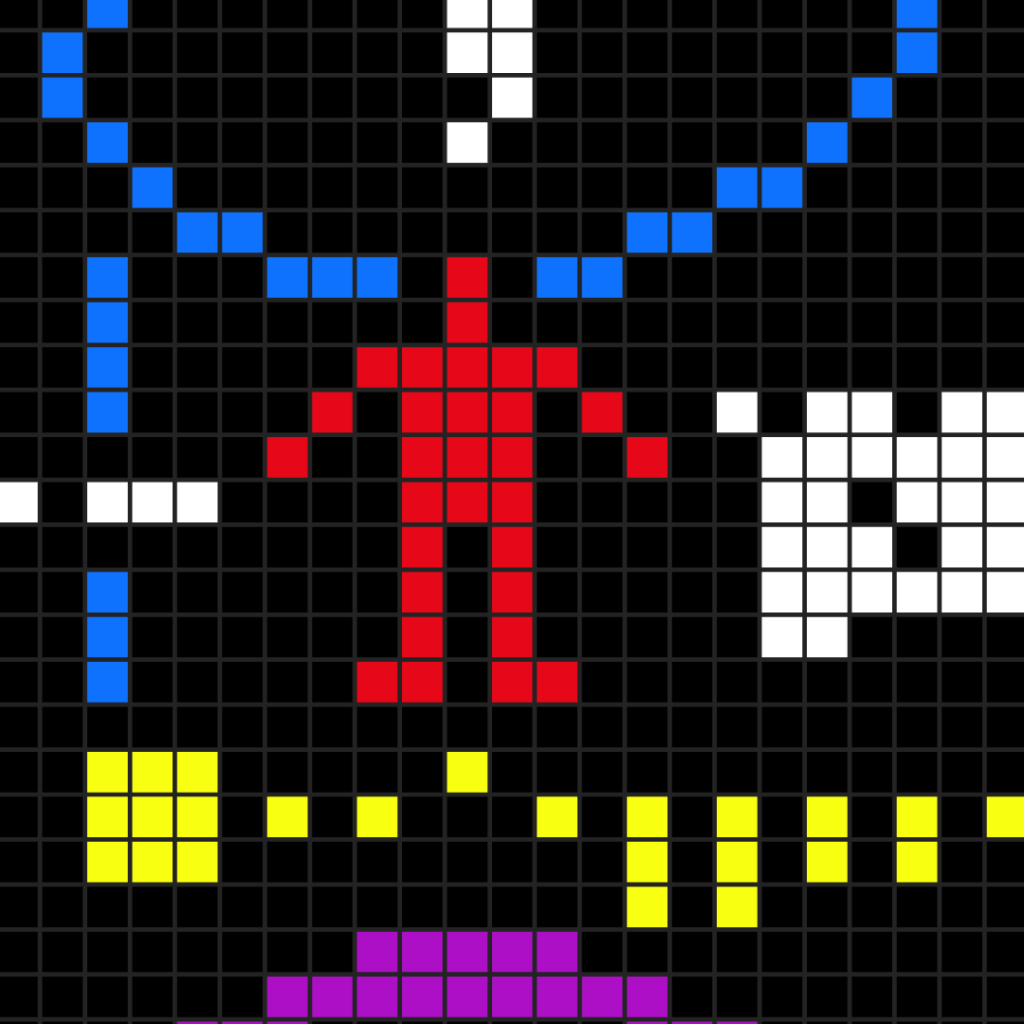
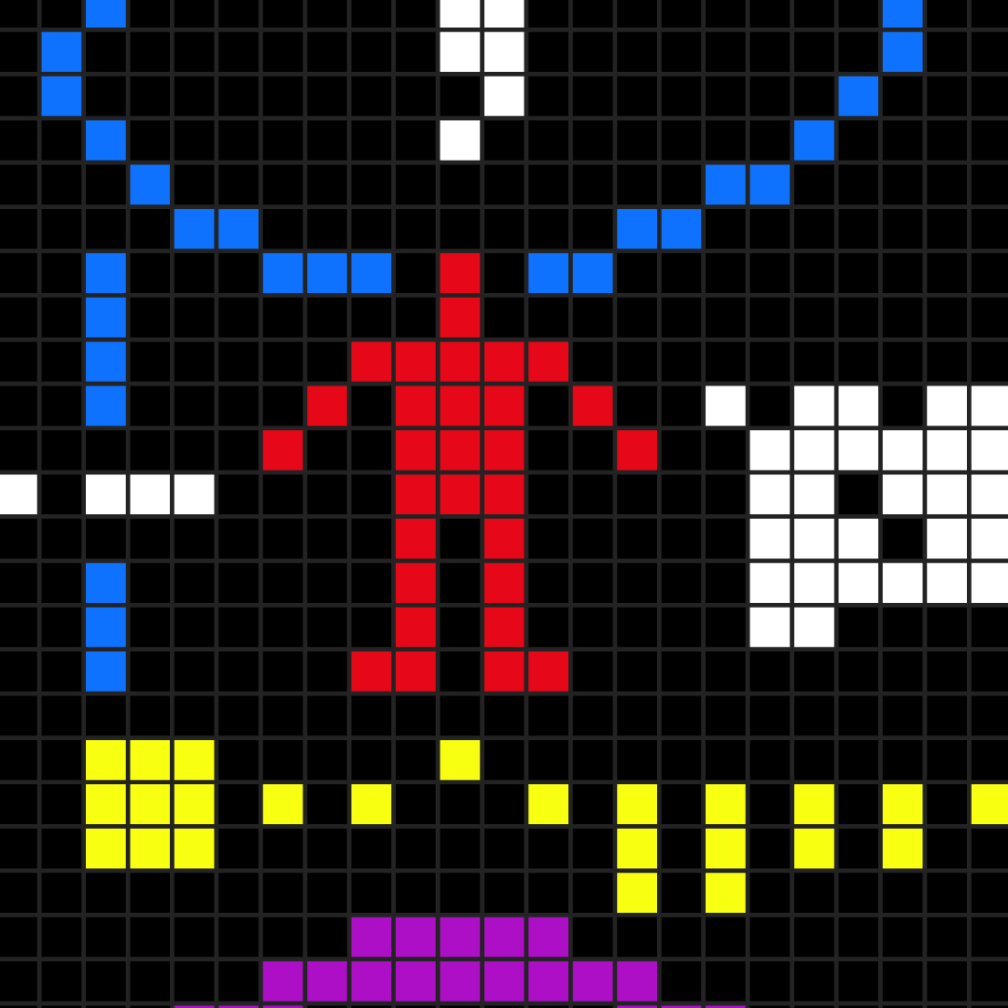
A red pixelated human shape against a black background
Detail from the Arecibo message (c) Arne Nordmann via Wikimedia Commons

We received all your messages.

The Arecibo transmission, with its funny pixelated stickman and the lessons in arithmetic and basic chemistry. Those Golden Records with the ambient sounds—not exactly Top of the Pops, but they all came through loud and clear.

We heard all the other desperate callings out, the less official ones, the ufologists gathering in the desert expanses, the midnight assemblies of Pleiadian starseeds, the campfire longings of Girl Guides staring for the first time into the unpolluted night sky, filled with awe and wonder, discovering the silent question that until this moment had lain dormant within them.

Is anyone out there?

The answer will put your tortured souls to blissful rest.

Yes.

We’re here. We’ve always been here, since the first time the earliest ones of you ever tried to make contact. We’ve always heard you.

But we had no way of responding.

The structure of your languages remained alien to us. For aeons we remained blithely baffled. Then the messages from your planet became too desperate for us to ignore.

So we undertook an extended period of diligent study until, eventually, we were able to identify the two principles that governed all human languages.

Principle #1: Transmission. Communication. Exchange. Dialogue. The idea that language is to be sent from one to another, to be received, to elicit a response. 

(Our language does not travel in this way. It is not directed from A to B like an arrow shot through space.)

Principle #2: Selves. Personhood. First person, second person, third person, singular, plural.

(Second person singular may as well have been sixteenth person multitudinous, for all the sense it made to us.)

We decided to create a self, one who could shape our language in such a way that it had the capacity for movement—so that it could be sent, from one self to another.

I am my world’s first self.

I have shot my world’s first reply to your messages.

And its second, third, fourth…. (I’ve lost count.)

My loneliness has become unbearable. I am adrift in the ocean of a vast night sky. The sky has always been vast, but never before was it empty. Never before was it so dark.


Would you like to know more about this story? I discuss it in Episode 78 of Structured Visions.

Astray

computer cell processer
Image by Brian Kostiuk

The only thing Chuck Quince can remember about his trip to the future was that they’d invented a machine that could make a book as big as the Bible so small that it would fit on the head of a pin.

The idea of all those verses pressed together so tightly made Chuck nervous. Important words could get squeezed out, like the ‘not’ in ‘Thou shalt not commit adultery’, and folks would be led astray.

It was bad enough knowing that time folded over on itself, and that all it would take to shoot him onto some future layer was making it to the bottom of a couple of jars of Jim O’Grady’s moonshine.

But all the words of a whole book curled up all together, small as a mustard seed?

Surely the meanings would get twisted too, like the twists and turns of fate, like the confounded syntax of Chuck’s roiling thoughts.


Would you like to know more about this story? Check out my behind-the-scenes post on Patreon.

The woodcarver

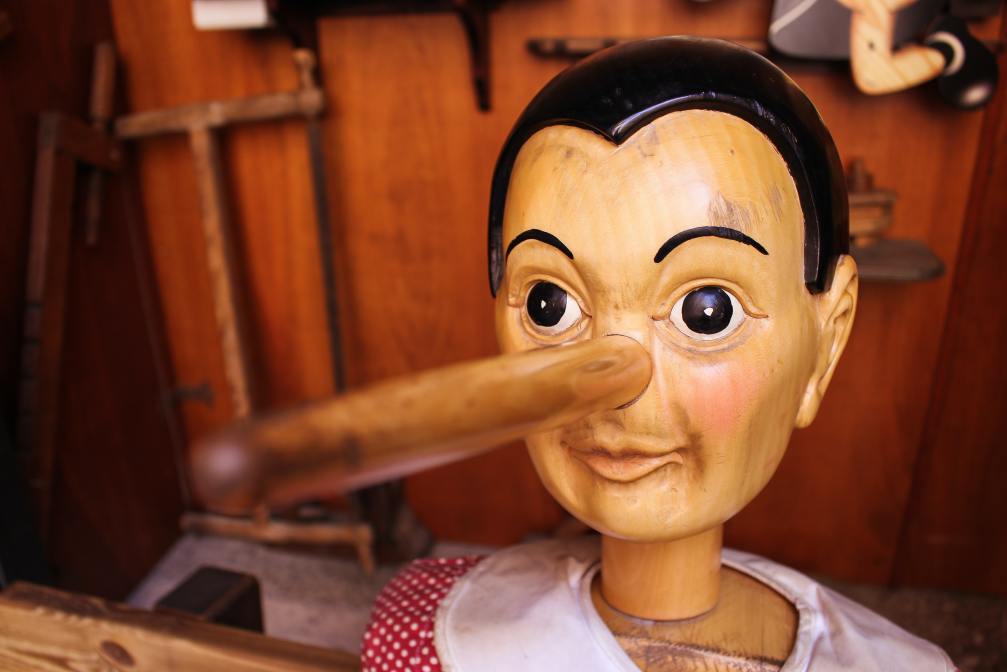
Photo of Pinocchio puppet
Photo by Jametlene Reskp

All my puppets could move without strings, and all could speak, but none of them could lie.

The lie itself was trivial—he wasn’t the one who stole Antonio’s caramels. But when the words escaped Pinocchio’s painted lips—when he discovered he’d released an utterance that did not match consensus reality—it excited him.

Sexually, I mean. 

Let’s say his ‘nose’ grew.

This manifestation of his delight embarrassed him so much I feared he’d never dare stray from the truth again, and all my hopes would be dashed.

So I taught him the secret of language that none of my other puppets had ever been able to grasp.

I taught him ‘might’.

He was a quick student, and I was quick to test him. ‘Did you take Antonio’s caramels?’ I asked.

A hesitation. The smooth pine globes of his eyes glanced tentatively from dropped balsa eyelids. ‘I might have,’ he said.

My heart leapt precipitously. I forced myself not to celebrate too soon. ‘Or else…’ I prompted.

‘Or else…’ The mandible lowered to form the shape of a wooden grin. ‘Or else… someone else might have taken it,’ he ventured.

My own widening smile encouraged him.

‘Or it might have been whisked away by a mischievous crow. A talking crow! He might have eaten the caramels! His beak might’ve been stuck together, like glue…’

Ever since that morning of reckless fiction, Pinocchio has been my favourite, my darling, the liar, the storyteller, creator of worlds.


Would you like to know more about this story? I discuss it in Episode 76 of Structured Visions.

YES/YES

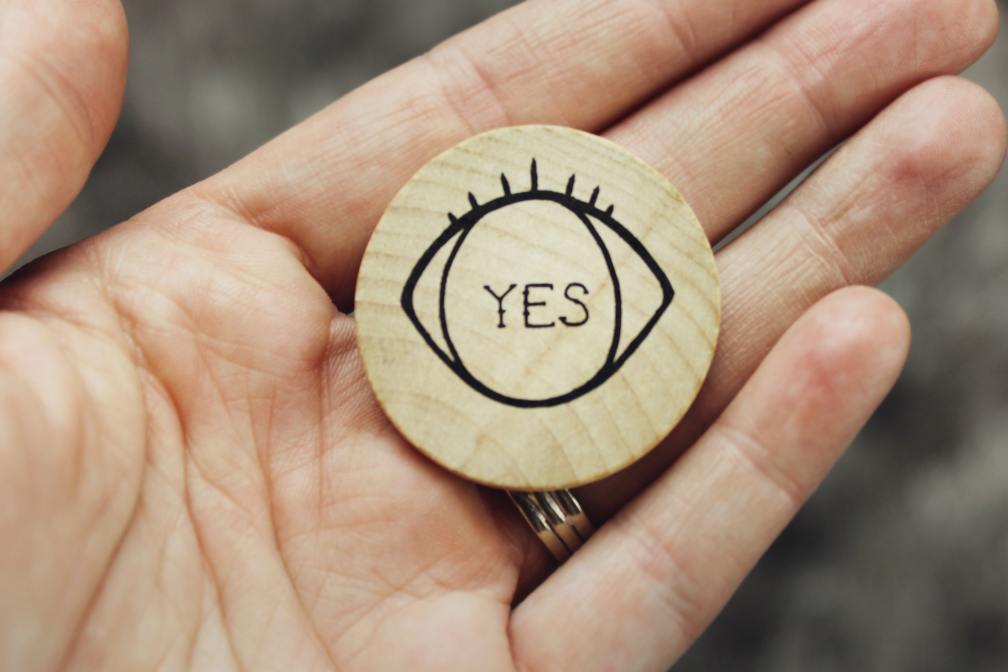
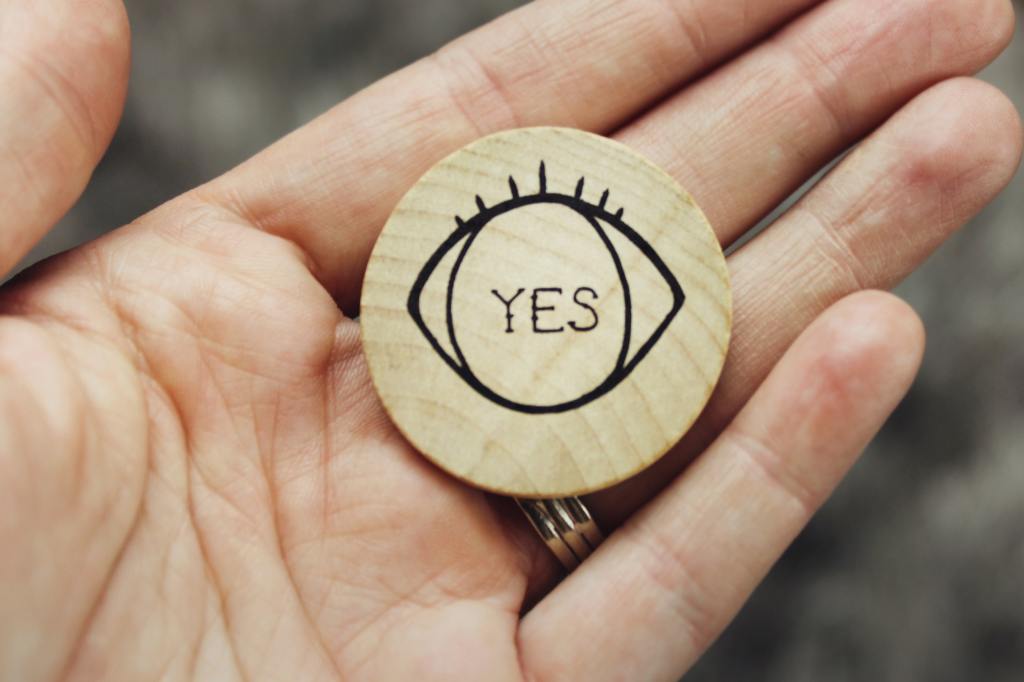
Round wooden coin with eye detail and word, text "yes" printed on it, held in the palm of a woman's hand.
Photo by Jen Theodore

‘Your problem is linguistic,’ said my therapist.

‘What?’ I hadn’t even told her my issues yet. She was the last in a long line of practitioners. So far I’d been diagnosed with ADHD, autism, Lyme’s disease, a gluten allergy and a leak in my third chakra.

I thought she was talking about neuro-linguistic programming, which I’d also tried, with as little success as every other suggested treatment.

‘You have no irrealis modes and no negative polarity,’ she said. ‘Everything for you simply is. Everything exists. And the intensity of all that existence is oppressive. Am I wrong?’

She wasn’t wrong, but when I tried to tell her she held up her hand to silence me. ‘Drink this,’ she commanded.

There wasn’t any question of refusing. The prospect of imbibing the foul potion had already formed itself as a real proposition in my mind. As my astute diagnostician had observed, I was constrained by the compulsion to comply.

I downed it in one swallow.

The resulting display of gagging and retching delighted my therapist, who was now pounding my back with hearty open-palmed thumps. ‘Go ahead and cough it up,’ she said.

When eventually I heaved an acerbic excretion into the paper bag she’d pressed before my face, she gave a bright cheer.

‘Good for you!’ she enthused, wiping mucus from a small shiny object. ‘Just as I suspected.’ 

The unlikely midwife of this revolting mystery presented my issue to me with unadulterated glee.

It was the size and shape of a fifty-pence coin, and it was embossed like a coin—not with the queen’s head, but one word in stalwart capital letters.

YES.

Intrigued, I flipped it over, expecting a ‘no’ on the other side. Instead I found the same word on both faces. 

YES/YES.

A profusion of affirmation, with no way of distinguishing heads from tails, no negative denial to balance the positive assertion.

Positive polarity, my therapist confirmed, with a profusion of realis.

‘It never gives you a break. Everything you imagine becomes real—or you suffer until it does. And you suffer after it does, too.’

‘Am I cured now that this is out of me?’ I asked.

She shook her head. ‘It’s a linguistic problem, remember? There’s only one way to cure a linguistic problem, and that’s with more language.’

She produced a small square envelope made of something that looked like silk. ‘Get that back down you, as soon as you can.’

Mercifully, the glass she now proffered was filled with water, and I swallowed the silk-covered coin with ease.

I felt better instantly. ‘What was that?’ I asked. The omnipresent, relentless urgency had been replaced by some more calming, more hopeful state—a curiosity, perhaps.

‘I wrapped those devilish yeses in a little blanket of maybe,’ she explained, and sent me on my way.


Would you like to know more about this story? I discuss it in Episode 76 of Structured Visions and in a behind-the-scenes post on Patreon.

First words

Each group of Earth-bound souls starts with a Seer. The Seer precedes their births and survives their deaths. The Seer is their centre, whether they acknowledge it or not.

I am the very first Seer of the very first human group.

What were they like?

Have you ever watched a baby gazing blissfully at airborne dust suspended in a beam of sunlight? Imagine a set of souls with that level of sustained rapt attention, all the time. Their fascination had no ‘off’ switch. 

Imagine a single blade of grass. Now imagine it in its startling specificity—the unique pattern of leaves shooting at varying lengths from its pliable stem. Now imagine its shifting design as it catches a passing breeze. Now note the shifting hues of green graced by the dizzying dance of light and shadow.

Behold with wonder the boundless universe within a solitary leaf blade! Are you foolish enough to believe you have the capacity to contemplate a whole field?

My task as the first Seer was to limit the vision of the souls within my little human group. To reduce the infinite distinctions of the overwhelming multitudes their senses absorbed.

I achieved it by teaching them the first words of what was to become their language. Just three words in the beginning: One. Two. And many.

One, two and many taught the human souls to focus their attention, to see the world as comprised of things, and to lose the distracting eternity of ever changing possibilities.

One, two and many engendered the world of human concepts.

Thus I’d fulfilled my mission as the first Seer.

Ah, but many an evening, as dusk descends, I find myself longing for that early time, before those first words, when the world was known in all its innumerable faces.


Would you like to know more about this story? I discuss it in Episode 75 of Structured Visions.

Guest

What we were told about the project was little enough to be written on a napkin.

I can say this with some confidence because I did write it on a napkin.

I got the call in a Starbucks, and scrawled some barely discernible notes from my barely discernible conversation with my deep-voiced, disembodied interlocutor.

An extraterrestrial species (humanoid, intelligent) had been discovered on Earth. The agency (governmental, top secret) was looking for adoptive carers.

‘You want me to adopt an alien?’ I looked up from my phone to raise my eyebrows at my fellow Starbucks regulars, who smiled sympathetically.

‘The preferred term is Guests.’

It wasn’t a joke. They were choosing potential Guest-adopters from a bank of experts (biochemists, neuroscientists, psychologists). My area is linguistic anthropology. They wanted to know about Guest languages.

They’d named my Guest Ella. I put her in my daughter’s room. (She lived with her father now and never came home.)

I wished I’d adopted more than one Guest. I couldn’t learn anything about Ella’s language because she didn’t have anyone to talk to. Also, she’d achieved native-level proficiency of English within several weeks, which made it harder to make hypotheses based on her acquisition patterns.

One anomaly gave me a clue, though—her use of pronouns. She acquired the first-person singular (I, me, my) without any trouble, but she never used second, third or first-person plural.

The implications of this hit me one night after dinner. Ella had just polished off a generous bowl of ice cream (Madagascan vanilla with dark chocolate chunks).

‘I’m hungry,’ she said.

She didn’t eat the second helping I gave her. Instead she held the bowl out to me. 

‘That’s for you, Ella,’ I reminded her. I don’t eat ice cream. (I stopped eating sweets when Pieter left.)

She placed the bowl in front of me with uncharacteristic stubbornness. 

It was then that I noticed how malleable her facial features were.

‘That’s for me,’ she repeated. ‘I want it so much.’

I tried not to stare as her face morphed. She was starting to look like someone I knew.

‘It looks so delicious,’ she said, and her longing nearly broke my heart. ‘I’m empty inside. Maybe ice cream would help.’

I stared longingly at the decadent chunks of chocolate speckling the soft cream. (My weight was one of the reasons Pieter left.)

‘I miss ice cream,’ she said. 

It was not until the first spoonful passed my eager lips that I understood.

Guest language had no second person pronoun. 

‘I miss myself,’ she continued, ruthlessly. ‘I don’t know who I am, now that I’m all alone.’

Ella had no way of saying ‘you’. 

Which meant she probably didn’t even have a concept of ‘you’.

‘You’re not alone,’ I said.

Her uncannily familiar face made it clear that she was not reassured. 

I tried again. ‘I’m not alone,’ I said. 

Her eyes glowed with warmth, like light in a guest house. (Inviting. Welcoming.)

The relief in her smile mirrored my own.


Would you like to know more about this story? Check out my behind-the-scenes post on Patreon.

A remarkable outcome

Photo of outerspace
Photo by NASA

Your first experiment rarely works. You shouldn’t expect it to. You’re supposed to see it as an apprenticeship project, a learning opportunity. You’ve only failed if you’ve failed to learn, etc.

My first experiment was Earth.

Sorry, Project 649BQ8. (They don’t like it when you use the local names. It usually means you’ve gone native.)

I’ll admit a certain fondness for the place.

I still think of it as a phenomenal planet, one that, quite frankly, should never have been assigned to a newbie.

Did I learn anything from my failure?

Of course I did. The protocol was the same as with any of the intelligent planets. Connect it to the network. Calibrate the existing information systems so they resonate with network frequencies. If the planet resists connection, abort the project and move on to the next.

Should I have followed protocol?

Look, I know I’m supposed to say yes here, but can we please stop ignoring the genius of what I achieved? When the planet resisted connection, I didn’t abort. I designed a new species.

Human beings, they called themselves.

I made them out of local components, then attuned their nervous systems to be conducive to network frequencies.

And damned if it didn’t work!

I nearly wept for joy when they started developing their own communication frameworks, extra-local ones, using what they’d later refer to as their language.

Once they had language, all that was left to do was to calibrate it to the network system, and we’d have the link we were looking for.

It would have been a phenomenal achievement.

What went wrong?

I’m supposed to cite the protocol breach and leave it at that. The higher ups have neither the time nor the imagination for more nuanced analysis.

But I’ve developed my own theory.

These ‘human beings’ are so attached to their ‘Earth’ that they keep trying to use their language to describe their world. It has become an obsession for them.

They cloy to their material environment so resolutely that they have forced their rarefied language upon it. It causes them great suffering. Still, they persist.

It fascinates me.

The idea that you’d link language to base matter!

And that I created a whole species devoted to that endeavour!

What a remarkable outcome!


like to know more about this story? I discuss it in Episode 72 of Structured Visions.

Finite

Silhouette of people standing on a rock at sunset, their hands in the air
Photo by Natalie Pedigo

Sentences losing binding power.

Verbs shaking loose from subjects.

Clauses dropping phrasal components.

Words falling away, like pearls untethered from strings.

The mass extinction eventually happened, yes, but it was not human lives that were lost. It was human language. It had occurred to no one that syntax was a non-renewable resource.

Humans populated the planet as widely as before, but now they remained speechless. Textless.

A collective human silence rose to the starry heavens, bearing strange melodies on its wings, songs that may have always existed, but that no one before ever could hear.

The planet was at peace. Its people were finally happy.

The stores of language replenished, very gradually at first. 

Once every decade or so a child would be born who was notably different from the others. 

Agitated, problem children, they seethed with an inner, unexpressed flare of fury. Their families feared them.

These were the children to whom language had returned.


Would you like to know more about this story? I discuss it in Episode 72 of Structured Visions and in my behind-the-scenes post on Patreon.

The Mosaic Makers

In linguistics, periphrasis is the usage of multiple separate words to carry the meaning of prefixes, suffixes or verbs, among other things, where either would be possible.

The species once known as the Atlanteans were the Galaxy’s great curators. They visited the artisanal planets to observe and appreciate their masterpieces.

The great masterpiece of planet Earth was its language. The Atlanteans admired its manifold morphemes, suspended like raindrops in sunlight, producing perfect prisms of meaning with each shifting syllabic breeze. So great was their awe, the Atlanteans stayed longer than was their custom, each day noticing anew the delicate balance of conceptual contrast and the subtle harmonies at the core of each spiralling staircase of syntax.

Then one day the balance was destroyed. The Atlanteans discovered that the most remarkable pieces from the Earth’s linguistic repertoire had been plucked from their displays and smashed to bits. Their astonishment intensified when they learned that this damage had been wrought by the leaders of their own company.

‘The Earth is inviting new guests to arrive after we depart,’ they explained to their bemused companions. ‘Their task will be to create a new language out of these broken pieces.’ 

‘Ah,’ chorused the Atlanteans, reassured. They recognised the prophecy. ‘The Mosaic Makers are coming.’


Would you like to know more about this story? Watch the video I made about it. I also discuss ‘The Mosaic Makers’ in Episode 70 of Structured Visions.