Grayscale photo of graffiti on a bridge.

A glimpse

Greyscale photo of graffiti under a bridge.
Photo by Toni Reed

When God visits the Earth (which isn’t that often) he tries to avoid human populations. They’re flooded with language, which he never bothered to learn.

But last Tuesday somebody spotted him under a railway bridge in Southwark, getting some homeless drunk to translate the graffiti.

The deity, having no concept of subjects and objects, struggled at first to make sense of Jimmy loves Paige. But a swig of the tramp’s Special Brew dimmed the exalted one’s consciousness just enough to see the point.

‘They see themselves as separate,’ he mused. ‘And they’re trying to come back together.’ He placed his finger on the concrete, tracing the heart-shaped line that circumscribed the message. 

‘Nope,’ said the tramp, no stranger to setting divinities straight. ‘They don’t know who they are at all. And in the other, they catch a glimpse.’

A tear slipped onto the omniscient cheek. Never before had he known not knowing, the bewildering plunge into chaos that dropped him now unswervingly into love.


Would you like to know more about this story? I discuss it in Episode 112 of Structured Visions. You can also sign up to the Grammar for Dreamers newsletter to get monthly updates on the ideas that inspire my work.

Person standing on a precipice.

The precipice

Person standing on top of a precipice.
Photo by EJ Strat

The gorge plunges beneath Susanna’s feet, her shoes displacing loose red rocks that tumble to the unseeable depths. At the precipice of this dizzying landscape all she can think about is the parenthetical you. The subject of imperatives. As she’s always taught her students, the shortest sentences are one-word commands, like Stop! The subject (you) is understood.

The parentheses around her own (you) hold her back like cords. Stay safe. Come back. Don’t jump.

Syntax, she tells her students, is like the pattern of beads on a string.

It would be easy, she thinks, to cut that string.

It is easy. She breathes one word, an onomatopoeic expletive. Snip! It will feel like flying, she thinks. The imperatives release their hold. 

To her surprise, she does not jump.

Disentangled from the strands of syntax, her body now pulses with the deeper language that thrums from the ancient red rock and expansive blue heights. She feels its embrace, a rising warmth, rooting her in a panoramic welcome, opening her heart to the magnitudes.


Would you like to know more about this story? Sign up to the Grammar for Dreamers newsletter to get monthly updates on the ideas that inspire my work.

Interior of a museum

The Museum of Language

Interior of a museum
Photo by Claudio Testa

When celebrated linguist Dr Sophia Lindstrom dies, her soul is brought to the Museum of Language, which displays everything she’s ever said, written or thought in her life. The exhibits are set out like concordances, each entry displayed in a different room. 

The first room showcases Give and its phrasal-verb variants. Give up, give in, give out, give over. The words have a power Sophia did not recognise when she was alive. A stream of fluid light flows from her. She is, quite literally, drained.

The Take exhibit is similarly exhausting. Take in, take over, take up, take on, take down, take after, take back. A sombre burden has been placed upon Sophia’s ethereal shoulders. A tyrant’s epaulettes.

She pulls herself from the room only to find the other exhibits have been cordoned off. The implication—that her life has been nothing more than give and take—is too distressing to contemplate.

A benevolent docent appears and leads Sophia to a quiet, spacious room, empty but for one word. Inhabit. The in sits more stably as prefix to the Latin-derived verb, Sophia observes, than as particle in the Old English equivalent, dwell in. She does not dwell on the implications—that phrasal verbs may contribute to the growing segmentalization of analytic languages. Instead she settles herself gently into the armchair that may have always been in this room and allows her newly dead self the exquisite pleasure of inhabiting the language of her life.


Would you like to know more about this story? I discuss it in Episode 103 of Structured Visions. You can also sign up to the Grammar for Dreamers newsletter to get monthly updates on the ideas that inspire my work.

Whirling dervish with abstract brightly coloured ribbons swirling around

Coming of age

Whirling dervish with abstract brightly coloured ribbons swirling around

In the old days, the more hopeful days, when we knew the power of language, the second person came first. We would wrap the child in a cocoon of benedictions, the grammatical structure unchanging: [second person subject]-[copula]-[complement]. The complement always a compliment. 

You are precious. You are our great joy. You are valuable beyond measure. You are a gift. 

The clauses would nourish and protect the child until their inner voice, the incipient I, whispered it was time to emerge. Everyone would gather to unwrap the language-formed chrysalis, each of us unwinding one thread of syntax in a complex, joyful dance. A blur of bright Maypole ribbons unravelling. The gauze of second personhood removed, the I would now spin in its own abundant freedom, a dervish whirling with unbridled possibility.

No one now remembers the coming of age ritual. The young are still wrapped in language, but the complements are insults, and no one thinks to unwind them. The cocoons harden and fester, poisoning the person trapped within, condemned to stumble through the world like a mummified zombie, never to dance.


Would you like to know more about this story? Sign up to the Grammar for Dreamers newsletter to get monthly updates on the ideas that inspire my work.

Negative space

Greyscale photo of a couple kissing across a table. Their faces blur together. They're each holding a coffee mug.
Photo by Nathan Walker

What’s up with me and the intimacy issues? It was only my third date with Barry (coffee at the Students Union) and I’d just told him I was crazy.

We met at an interdisciplinary postgraduate conference. He said he liked my talk on negation in language.

What he actually said was, ‘I didn’t understand your paper, not one jot of it.’

His field was psychology, not linguistics, so his joke meant he’d been paying attention. I may have already been in love. 

So why the rush to tell him about the alien in my brain?

‘An alien talks to you?’ he said.

‘Yeah, he took up residence as soon as I landed on my thesis topic,’ I said. 

‘Correlation is not causality,’ Barry pointed out. 

‘He keeps asking annoying questions about my topic. He says in his language there is no negation.’

There is no negation? Isn’t that a perfect example of negation?’

‘Well, what he really said is There’s only affirmation. But we were speaking English.’

‘I don’t think you’re crazy,’ Barry said. ‘I think you have a very smart brain who’s created a sparring partner to help bring your brilliant ideas even further. Or else you really are in communication with extraterrestrial intelligence, which you should see as a great privilege.’

He had me at I don’t think you’re crazy

‘The negation is the affirmation!’ exclaimed my alien companion, with a distracting Eureka yelp.

I ignored this, leaning closer toward my human companion. ‘Can I kiss you?’ I asked.

‘I don’t see why not,’ he said, and I melted into the negative space his negative clauses revealed.


Would you like to know more about this story? I discuss it in Episode 97 of Structured Visions, ‘The intimacy of denial.’ You can also sign up to the Grammar for Dreamers newsletter to get monthly updates on the ideas that inspire my work.


The brutal linearity of language

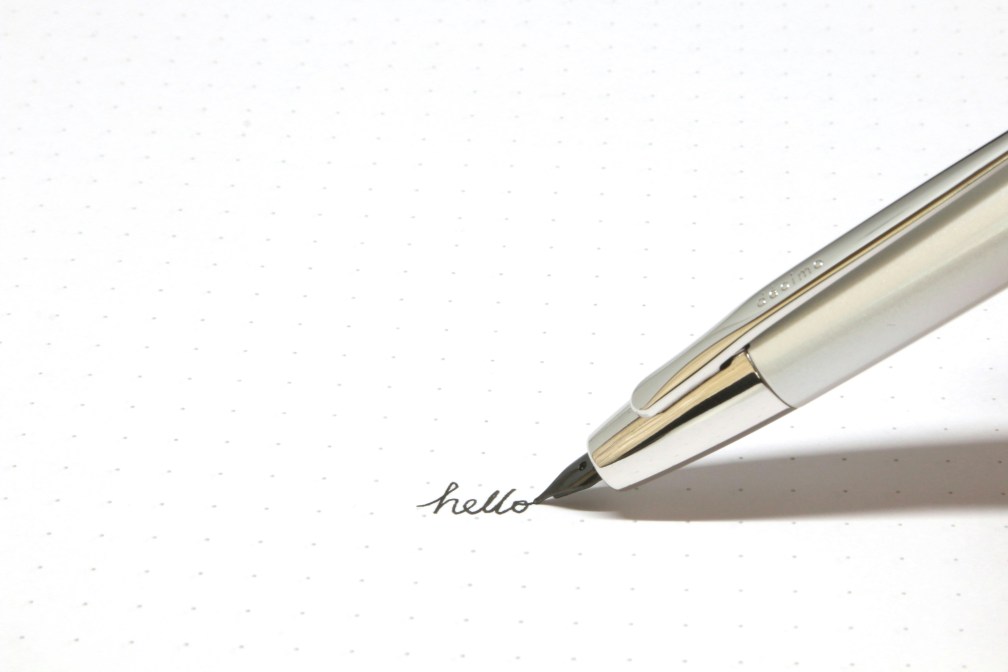
Fountain pen writing the word 'hello' on white paper
Photo by R Mo

It’s common to explore the lower realms, but no one in the team has ever, until now, been sent to a one-dimensional reality. To be trusted with such a mission is a great honour.

The training is intensive. It takes the form of repeated confrontations with the brutal linearity of language.  

Hello, my name is Jim. 

The assignment is to align the self with the excruciatingly constrictive quality of linguistic personhood. 

Hello… my… name… is…

There’s guidance in the training, a meditative exercise: Imagine a fountain pen. Its reservoir is filled with the infinite ink of the uncontainable multiverse. Focus with singular attention on the nib as it traces its unidirectional line across an empty page. 

The strategy works. Soon frustration gives way to curiosity, rousing an impulse to experiment. 

Hello, my name was Jim. 

The past tense suggests a nostalgia. A longing to move backward along this narrow line, even as the syntax presses inexorably ahead.

My name is not Jim. 

Negative polarity produces erasure, annihilation. Ideas unknown in an eternally creative cosmos—the infinite ink churns and roils.

My name will never be Jim.

The line of language, freed from its singular dimension, emerges as a spiral, a fractal, a new world waiting to be found. 


Would you like to know more about this story? I discuss it in Episode 95 of Structured Visions, ‘Your name without language’. You can also sign up to the Grammar for Dreamers newsletter to get monthly updates on the ideas that inspire my work.

The lexicographer

Greyscale photo of a stack of old books and papers in a room
Photo by Felipe Furtado

The bookshelf falls with a conclusive thud. Volumes of dictionaries flap to the floor, their spines irreparably dislocated, their yellow pages exposed to greedy, scurrying mice. Billy the lexicographer realises with a tremor of despair that he is trapped. A lifetime acquiring language will end with him suffocating under the weight of words. 

He’ll spend his final moments naming things: the marble table, the antique wardrobe, the upholstered dining room chairs. Bodies of plastic baby dolls, a bag of mouldy limbs and hairless, eyeless heads. Mountains of newspaper, rodent insulation. Grandmother’s tarnished silverware. A treasure box of costume jewellery. 

An unfamiliar longing: to be free of noun phrases. To unacquire language. Billy’s gaze scurries frantically around the room, replacing objects with object pronouns. This. That. Those. Them. Him. Me. 

They. He. I. The objects become subjects. The subjects invite agreeable verbs. The verbs are finite: This too shall pass. 

I, too, shall pass, decides Billy. He raises himself up upon mouldy legs, passes a trembling hand over a hairless head and clears a path through his storeroom of hoarded language. 


Would you like to know more about this story? Sign up to the Grammar for Dreamers newsletter to get monthly updates on the ideas that inspire my work.

Death of a grammarian

Close up photo of maple leaf in autumn with shallow depth of field
Image by Matt

As my language deteriorates, a steadier syntax is revealed. A tree dropping leaves of wisdom in my life’s autumn.

The verbs that remain are release, surrender, let go. The first person–that once grasping branch–now sets its objects free. They spiral skyward, earthward, held safe within some other grammar, invisible as air.


Would you like to know more about this story? I discuss it in Episode 92 of Structured Visions.

The deal

Bronze statue of Hans Christian Andersen's The Little Mermaid.
Photo by K. Mitch Hodge

The deal was this: that I’d lose my mermaid’s voice, and gain human language. Determiner, adjective, noun, auxiliary, lexical verb. The welcoming buoyancy of the sea’s pulsing grandeur reduced to a linear gravity. Each phrase chained to another in a relentless syntax, like knives piercing the sole of each fresh footstep.

An airy wasteland, this world, where meaning is lost in the wind, and everyone shouts to be heard. Whatever yearning once delivered me to this shore has long since receded with the tide.

Seeds of language

Image by Jannik Selz

I forgot Language.

Still, there it stands, against the decimated remains of a land ravaged by wildfire and warfare, on the site where we once lived as a young family, full of hope. It is all that remains alive.

I remember now.

We grew it from seeds we bought on eBay, back when eBay was still legal and the internet was open to all. ‘Seeds of language’, they were called, enticingly, but the scant product description offered no further clarification.

At the time we were teaching at the local university, before they closed down our department, then the whole university, then all the universities. 

We were both linguistics professors, so ‘Seeds of language’ intrigued us. We paid extra for expedited delivery.

‘Maybe they’ll grow into syntax trees,’ said my husband Jim, a generativist.

‘What does Noam Chomsky know about botany?’ I countered. ‘His trees grow upside down.’ I proposed instead a Saussurian species, which would wave coin-shaped signifier leaves, their signified undersides flashing suggestively in stormy breezes.

We sowed the seeds in pots in the greenhouse. We took a photo of the one that germinated and did a reverse image search to identify it.

‘Sapling,’ was all that Google could tell us. (This was when we still had Google). We named it ‘Language’ and planted it near the weeping willow behind our house. 

Soon after, we fled the country to protect our son Devon, whose gender made him an outlaw, just in time to squeeze through the nation’s tightening borders.

In the ensuing decades, I have forgotten many things. 

I am only now remembering Language.

A verdant desire sprouts from within my decomposing weariness: I want to dwell in the warm embrace of Language. I climb up to nestle in its welcoming limbs. 

Language envelops me. It roots me in its thrumming pulse. It evaporates the accumulated shame of my culture’s demise and the decimation of my own exhausted history.

‘Where have you been?’ Language wonders.

A bright new thought blossoms—that I’ve never, until now, inhabited Language—that it is only from within this sheltering space that self and culture will heal.

‘I have always been here for you,’ says Language, and tears form, flowing like sap.